Haplogroup I1a1b1a1b3a

– 5 min read


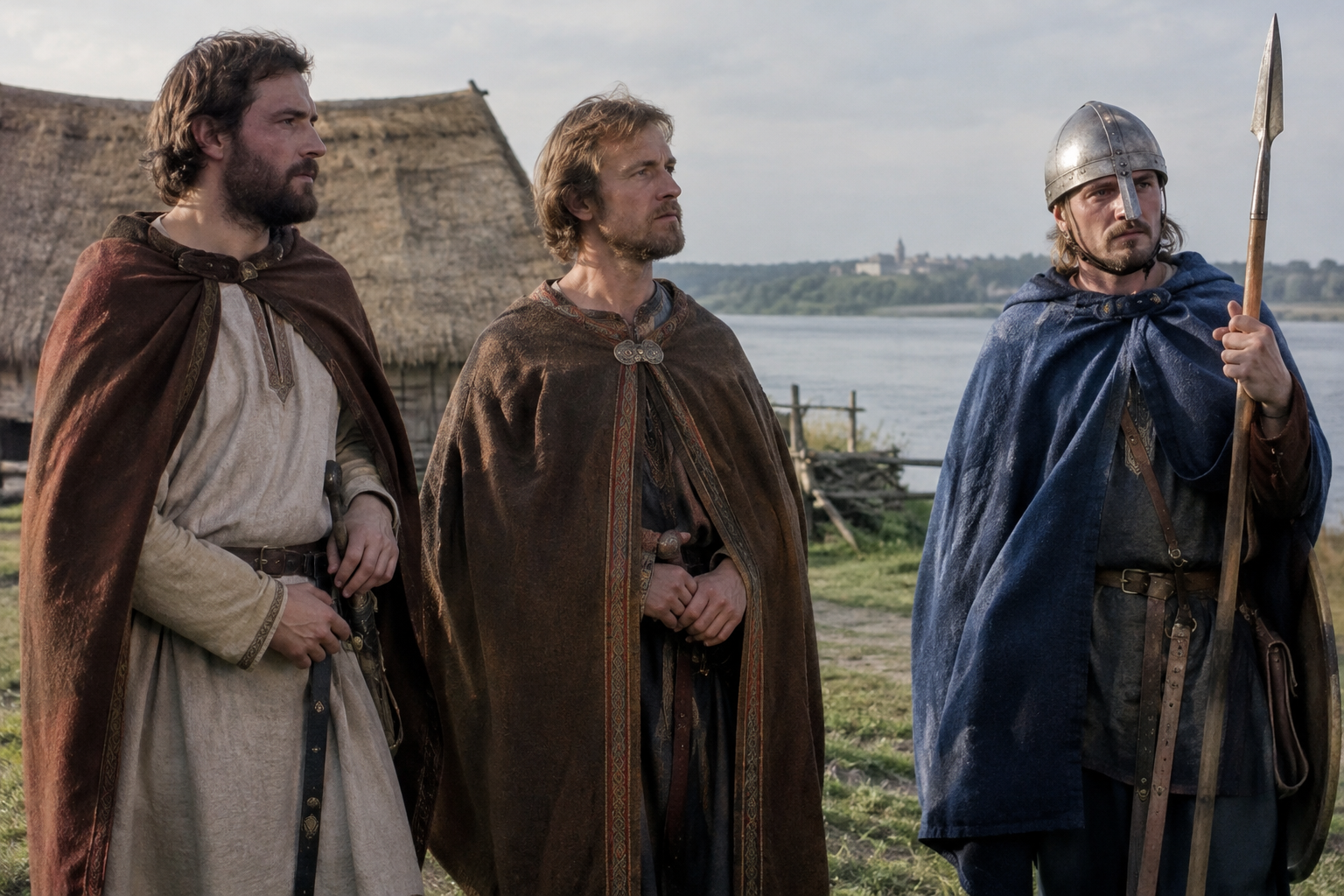
At Velim-Velistak on the Dalmatian coast of Croatia, two men buried around AD 775 appear in the record under the IDs VEM056 and VEM058. On paper that may look spare, almost frustratingly so: a site name, a date, two identifiers. Yet even this modest cluster is revealing, because both are associated here with the Y-DNA haplogroup I1a1b1a1b3a, placing this paternal line in an early medieval Adriatic community at precisely the time when the post-Roman Balkans were being reshaped by new political and cultural realities.
That matters because Y-DNA follows one direct paternal line only - father to son to grandson - and so it does not describe a whole person's ancestry. But when the same branch turns up in more than one early medieval burial, and then again farther north in the medieval Low Countries, it begins to sketch something historically interesting: not a single "people," still less a dynasty, but a northern European paternal lineage present in very different communities along the North Sea and Adriatic worlds.
The wider haplogroup I1 is best known as a northern European Y-chromosome branch with deep roots in Scandinavia and strong later visibility around the Baltic and North Sea. The narrower label in this article, I1a1b1a1b3a, is much more specific. That precision is useful, but it also demands caution: we should not simply transfer everything known about broad I1 history onto this exact subclade unless the evidence supports it.
What the ancient samples do show is that a paternal line nested within that wider I1 world appears in early medieval Croatia and in a later medieval individual from Groningen in the Netherlands. In other words, this is not just a story about "Scandinavian" ancestry in the abstract. It is a story about how a particular paternal branch can surface in regions linked by trade, migration, military service, marriage, and the slow knitting together of medieval Europe.
The two Croatian individuals, VEM056 and VEM058, come from Velim-Velistak, a site in the Dalmatian hinterland. Around AD 775 this was a frontier-like world in the broadest historical sense: the Roman imperial order had long since fractured, Byzantine influence still mattered along the coast, and Slavic-speaking populations had become part of the region's social landscape. Any burial ground from this period has to be read against that mixed and changing background.
What makes these two men notable is not that they let us pin a tribe-name neatly onto a chromosome. They do not. What they do suggest is that an I1-derived paternal line was part of the male population in early medieval Croatia. That fits a growing picture from archaeogenetics in which paternal lineages in the Balkans could shift considerably over time even where other parts of ancestry showed longer local continuity.
A research project connected with these Croatian materials is hosted at https://www.ebi.ac.uk/ena/browser/view/PRJEB81250, and the larger point is an important one: early medieval Croatia was not genetically sealed off. It sat within a zone of movement linking the Balkans to central Europe and, through maritime routes, to the wider Adriatic and beyond.
The repetition of the same reported branch at one site also deserves notice. Two men associated with I1a1b1a1b3a at Velim-Velistak may indicate a local paternal continuity, a small kin cluster, or simply the presence of a lineage that was not rare in that community. Without explicit kinship analysis, one should not leap to family trees. But nor should one dismiss the pattern. In an early medieval cemetery, recurrence itself is evidence.
To find a branch within wider I1 in Dalmatia is historically intriguing because the eastern Adriatic was a meeting ground rather than a margin. Roman towns, inland settlements, Christian institutions, and mobile warrior elites all left their mark here. The centuries after Rome did not produce a blank slate; they produced new combinations of older local ancestry and incoming paternal lines.
That is why the Velim-Velistak evidence is more than a footnote. It shows that by the later 8th century, a lineage today usually discussed in connection with northern Europe had become part of a lived population in Croatia. That presence could reflect movement over generations through central Europe, contacts mediated by the Carolingian sphere, or the broader demographic churn of the Migration Period and its aftermath. What it does not allow us to say is that these men were "Vikings" or members of any single named ethnic group.
The third sample linked here, GRO021, comes from Groningen in the Netherlands and is dated to about AD 1090, in the Carolingian-era-to-medieval North Sea world that followed the great transformations of the early Middle Ages. Groningen was not some remote backwater. It belonged to a region shaped by coastal exchange, Frisian and Saxon histories, ecclesiastical networks, and growing urban life.
Seen beside the Croatian samples, GRO021 gives the haplogroup a different setting altogether. Here the same reported branch appears in a region much closer to the wider historical heartland of I1. That does not mean Groningen was the "origin" of I1a1b1a1b3a, but it does remind us that by the 11th century this paternal line belonged within the population fabric of the North Sea zone as well.
There is a useful broader comparison here with early medieval population studies from northwestern Europe, including work on mobility and ancestry formation in England such as https://www.researchgate.net/publication/363736520_The_Anglo-Saxon_migration_and_the_formation_of_the_early_English_gene_pool. That research is not evidence about GRO021 specifically, but it helps frame the historical world to which Groningen belonged: one in which North Sea populations were connected by substantial movement of people as well as goods and ideas.
If we place Velim-Velistak and Groningen side by side, the temptation is to draw a bold arrow across the map and announce a migration route. Real history is usually less tidy than that. Medieval lineages spread through repeated small-scale processes: one family moving, one soldier settling, one marriage linking regions, one community absorbing newcomers over centuries.
That slower, messier picture is often closer to what ancient DNA actually supports. The presence of I1a1b1a1b3a in Croatia around AD 775 and in Groningen around AD 1090 suggests a branch circulating across parts of medieval Europe that were increasingly interconnected, even if they looked very different politically and linguistically. The line did not belong to one civilisation alone. It could sit in a Dalmatian burial ground and also in a North Sea settlement world.
Archaeology has been pushing in this direction for some time. Early medieval cemeteries are no longer read as simple ethnic labels in the ground. They are local communities shaped by long memories, new allegiances, regional customs, and human mobility. A Y-chromosome branch like this one becomes most interesting when treated in exactly that way: as evidence of paternal continuity and movement, not as a shortcut to identity.
For someone researching I1a1b1a1b3a today, the most distinctive point is that this branch is already visible in the early medieval Adriatic and again in the medieval North Sea region. That is a valuable combination. It places your direct paternal line, or a closely related one, in the sort of historical Europe built not by a single dramatic invasion but by generations of movement between regions, especially those tied into northern and central European networks.
The ancient evidence here is still modest, and that is worth respecting. But modest evidence can still be good evidence. In this case, it suggests a paternal lineage at home in the complicated human geography of medieval Europe - present in Croatia's changing post-Roman world and also in the coastal societies of the Netherlands, where northern lineages remained part of everyday population history.

Comments