Haplogroup E1b1b1b1b
– 5 min read


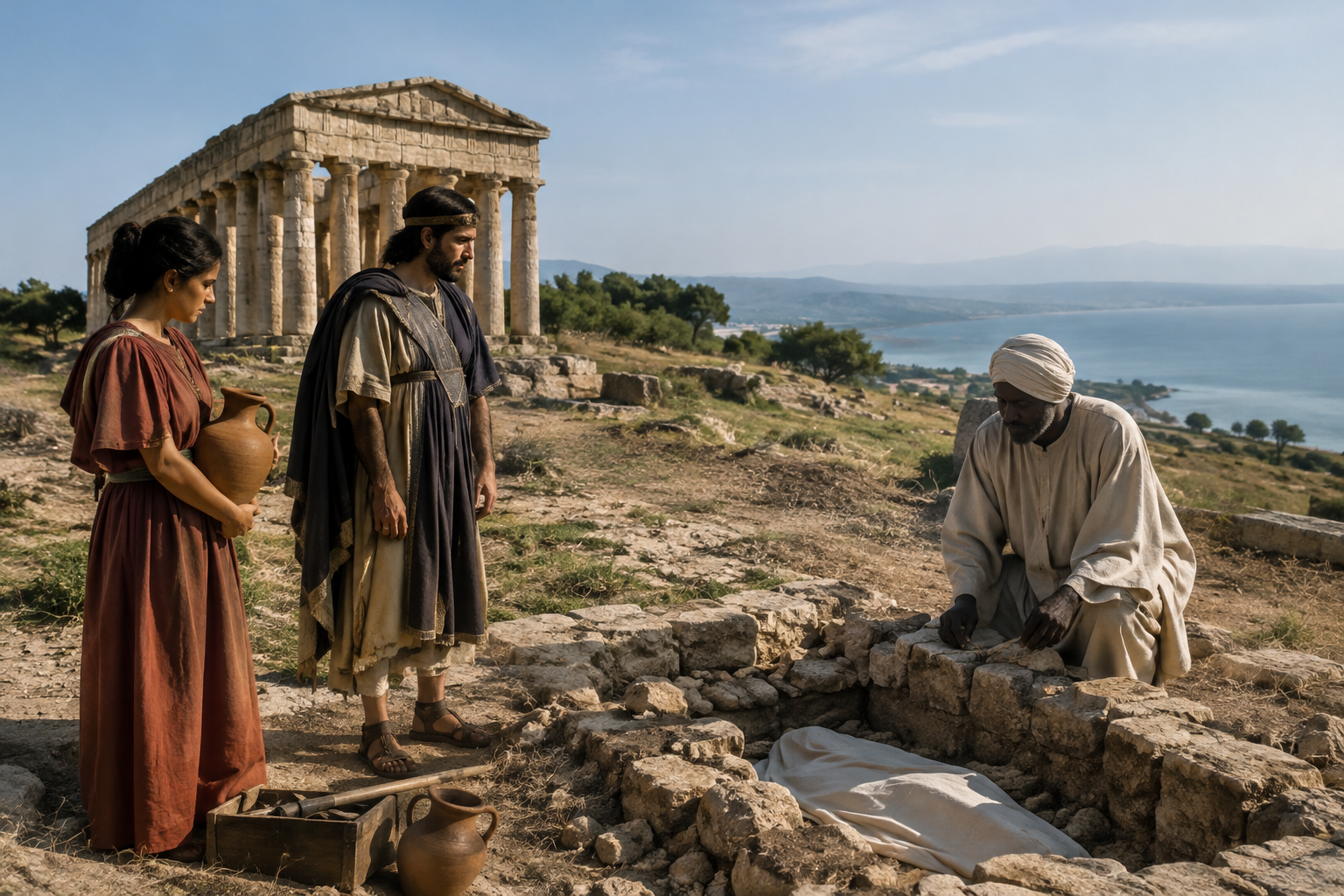
At Segesta in medieval Sicily, one excavated burial stands out not because it belonged to a king or a conqueror, but because it captures the island's human complexity in unusually direct form. The individual labelled SGBN2, dated to about AD 1200 and identified as an African Muslim grave, carries the Y-DNA haplogroup E1b1b1b1b in a setting where politics, religion, trade, and migration were all crossing at once.
That is a good place to begin, because Sicily has a habit of turning neat historical categories into untidy human realities. Y-DNA tracks one direct paternal line rather than a person's whole ancestry, but even that single line can be revealing. In the case of E1b1b1b1b, the evidence here points not to one isolated origin story, but to a Mediterranean history in which North Africa, the central Mediterranean, and Sicily were repeatedly connected across many centuries.
By the time SGBN2 was buried, Sicily had already lived several political lives. Byzantine rule had given way to Muslim polities; Norman rulers then took the island, but did not erase its population overnight. Arabic, Greek, Latin, Christian, Muslim, and Jewish communities all formed part of the island's medieval landscape, and the genetics of burials increasingly show that this was not just a literary commonplace but a demographic reality.
SGBN2 matters because the label "African Muslim grave" places the individual within that multi-faith and multi-origin world with unusual clarity. A paternal lineage assigned to E1b1b1b1b in this context fits a wider historical picture in which men from North Africa, or descended from North African paternal lines, were present in Sicily well into the high Middle Ages. That need not mean a recent arrival in every case. It could reflect movement across one or several generations, in a region where the sea connected communities more often than it separated them.
A recent study of medieval Sicilian populations has helped sharpen this picture of diversity, showing how burial communities on the island preserved evidence of multiple ancestral backgrounds rather than a single homogeneous medieval population. For readers following that broader setting, MyTrueAncestry has also explored Medieval Sicily's Multi-Faith Genetic History.
The strongest point is not that one grave can explain Sicily, because it cannot. It is that SGBN2 gives E1b1b1b1b a securely medieval Sicilian appearance in a burial explicitly tied to an African Muslim context. That makes the haplogroup part of a documented social world, not merely an abstract line on a phylogenetic tree.
The second sample pushes the story much further back. I21971, from Marsala in Sicily and dated to about 550 BC, belongs to the Phoenician era in western Sicily. Here the historical frame is very different from that of Segesta in AD 1200, yet the broad Mediterranean setting is strikingly familiar: western Sicily as a zone of maritime contact, colonial settlement, exchange, and mixed populations.
Marsala, ancient Lilybaeum, stood within the Punic world of the central Mediterranean. In that world, Carthaginian and Phoenician-linked communities were connected not only to North Africa and the Levant but also to Iberia, Sardinia, and Sicily. A paternal lineage reported here in association with E1b1b1b1b is therefore historically suggestive, because it places this branch in a Sicilian setting already shaped by transmarine networks centuries before Rome dominated the island.
What makes I21971 especially interesting is not that it proves a single unbroken family line between Phoenician Sicily and medieval Muslim Sicily. It does not. What it does show is that a paternal branch linked to E1b1b1b1b appears in Sicily in two very different eras: once in the Phoenician-Punic orbit of the first millennium BC, and again in a medieval burial context tied to African Muslim identity. That repetition makes Sicily itself the story.
Research on the ancient Italian islands has increasingly emphasized just how variable and connected these island populations were. For the wider background, see a major ancient DNA study of the Italian islands, which places Sicilian populations within larger Mediterranean patterns rather than treating them as isolated communities.
The label E1b1b1b1b sits within the broader Y-DNA macro-lineage E1b1b1, a major paternal cluster with a long and complicated history across Africa, the Mediterranean, and parts of western Eurasia. But one has to be careful here. The broad branch has a huge geographic spread, and its many daughter lines do not all share the same historical path in any simple way.
So the responsible question is not "where did all of E1b1b1 come from?" but "what does this narrower branch look like in the contexts we can actually document?" In the evidence here, E1b1b1b1b appears in Sicily at two moments when the island was deeply embedded in southern Mediterranean networks: first in a Phoenician-era western Sicilian context, then in a medieval African Muslim burial. That does not define the whole branch, but it does make Sicily a meaningful place to study it.
For anyone researching this haplogroup today, that is important. A present-day E1b1b1b1b result does not automatically identify someone as Phoenician, Punic, Arab, Berber, Sicilian, or anything else so tidy. What it may indicate instead is that one paternal line was part of the long history of movement linking North Africa and the central Mediterranean.
Historians often write of Sicily as though successive peoples arrived in layers: Phoenicians, Greeks, Romans, Byzantines, Arabs, Normans. Useful as that can be, ancient DNA keeps reminding us that real populations do not stack so neatly. They overlap, intermarry, persist, and sometimes reappear in unexpected places and periods.
That is precisely why the pairing of I21971 and SGBN2 is so valuable. One comes from western Sicily in the Phoenician era, the other from medieval Segesta in a Muslim burial context. The shared haplogroup association does not collapse eight or nine centuries of history into one story, but it does reveal continuity of connectivity. Sicily repeatedly drew in men whose paternal lines linked the island to the southern Mediterranean.
This is also why medieval Sicilian evidence deserves to be read alongside evidence from Iberia and other former Islamic Mediterranean zones. Comparable questions about African and North African ancestry in medieval contexts are turning up across the western Mediterranean. Readers interested in those broader comparisons may want to look at Genetic and Disease Diversity in Medieval Islamic Ibiza Burials and Shifting Sands: Population Dynamics during the Muslim-Christian Transition in 11th-13th Century Algarve.
There is also a specifically Sicilian angle here. The Punic west of the island and the medieval Islamic island are often studied separately, as though one belongs to classical antiquity and the other to medieval studies, full stop. Yet a haplogroup like E1b1b1b1b can cut across those disciplinary boxes and force the more interesting question: how often did Sicily function as a shared human corridor across very long stretches of time?
On their own, each sample is intriguing. I21971 places the branch in Phoenician-era western Sicily. SGBN2 places it in a medieval African Muslim burial at Segesta. Together, they give E1b1b1b1b a distinctly central Mediterranean profile grounded in excavated individuals rather than modern distribution maps alone.
A study examining medieval Sicilian burials has added to this broader picture of diversity and mobility on the island; the relevant research can be found here. Used carefully, evidence like this helps shift discussion away from crude labels and toward something more historical: actual people in actual places, living within connected Mediterranean worlds.
For E1b1b1b1b, the most distinctive lesson is not a single homeland claim but a pattern of presence in Sicily at moments when the island was tied closely to North Africa and wider seaborne exchange. If this is your paternal haplogroup, these ancient matches suggest that your direct male line may belong to that long history of Mediterranean contact, where identities changed, states rose and fell, but movement across the sea remained a constant.
Comments