Haplogroup R1a2a
– 5 min read


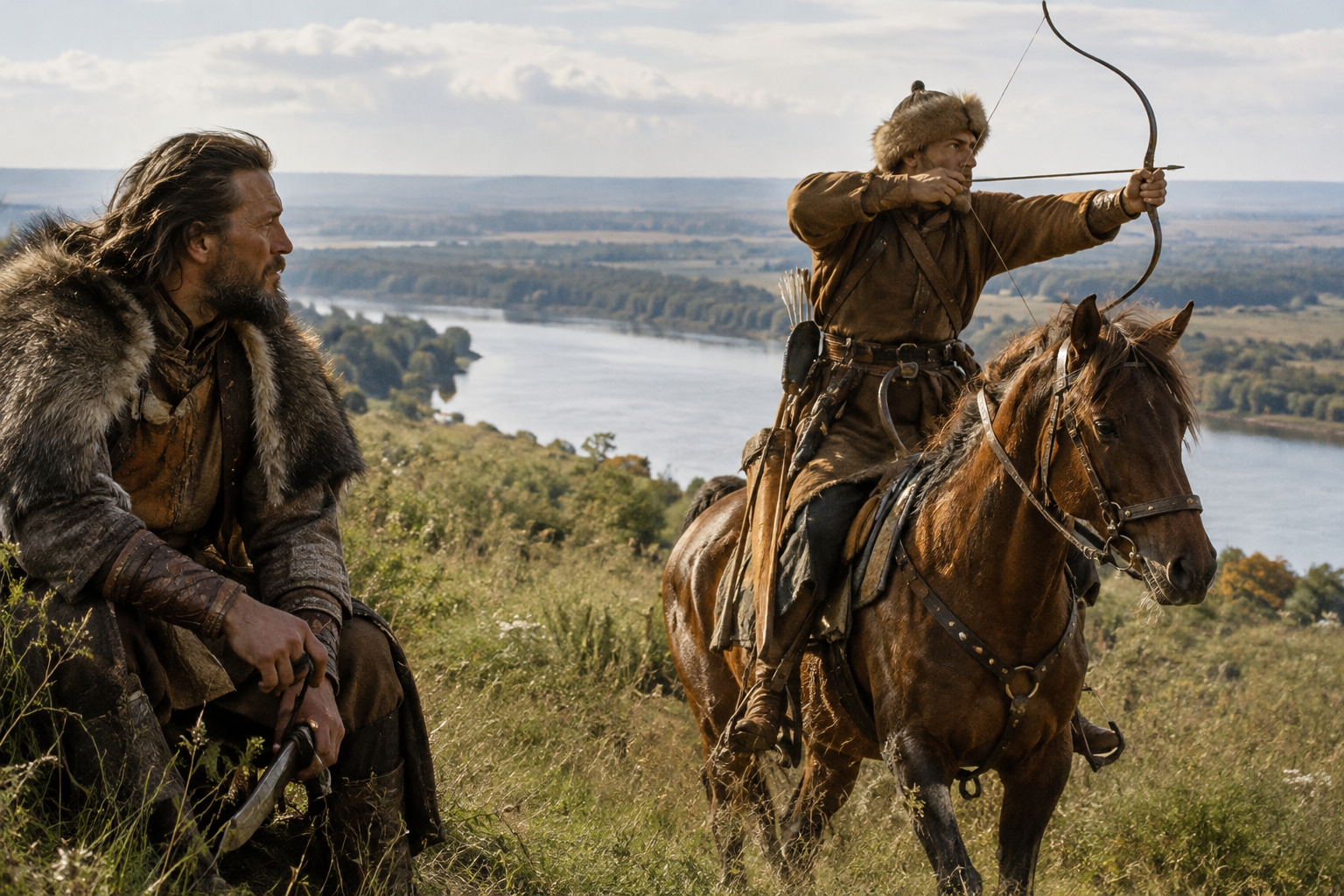
Around 675 BC, somewhere in the forest-steppe zone by the Dnipro River, a man now labeled UKR105 was buried in a landscape that sat between worlds. This was the northern Black Sea frontier: not quite the open steppe of mounted pastoral empires, not quite the settled farming belt to the west, but a contact zone where mobility, exchange, and conflict all left their mark. In that setting, the Y-DNA haplogroup R1a2a appears not as an abstract code but as the paternal line of a real Iron Age individual.
A second sample, UKR111, dated to around 660 BC and described as a Scythian Iron Age horse archer from Cheremushna in the Kharkiv region of Ukraine, sharpens the picture. Two men, close in time, both linked to the Scythian horizon, both carrying the same reported paternal branch: that is enough to make R1a2a historically interesting here. Y-DNA traces one direct male line only, not a person's whole ancestry, but in the Scythian world that single line can still tell us something important about who was present in the north Pontic zone during the early Iron Age.
The most revealing thing about UKR105 is his setting. The forest-steppe along the Dnipro was one of the great borderlands of Eurasian history, a region where farming communities, mobile herders, and emerging Iron Age powers repeatedly met. To place a man with reported R1a2a here in the 7th century BC is to place that paternal lineage inside a frontier society rather than at some neat point of origin.
That matters because Scythian archaeology has long shown that the north Pontic region was never simple. "Scythian" in historical writing can sound like a single people moving as one block across the grasslands. In practice, the archaeological record shows varied local communities, different burial traditions, and a spectrum of lifeways from more mobile to more settled. A genetic study of this broader Ukrainian corridor, examining mobility in Ukraine from the Bronze Age to the early modern period, fits that larger historical picture: the region is best understood as a crossroads.
If UKR105 gives us the frontier, UKR111 gives us the classic Scythian image: the mounted warrior. The description attached to UKR111 identifies him as a Scythian Iron Age horse archer from Cheremushna, in the Kharkiv area, around 660 BC. That does not mean every detail of his life can be reconstructed from the label alone, but it does place R1a2a squarely within the military and mobile sphere for which Scythian societies are famous.
This is where caution and interest go together. We should not pretend that one horse archer speaks for all Scythians, nor that one Y-chromosome branch defines an entire confederation. But when a paternal lineage shows up in a specifically Scythian martial context, it tells us that R1a2a was part of the male-line landscape of the early Iron Age steppe frontier, not merely a background lineage lingering somewhere beyond the action.
The Kharkiv region also matters geographically. It lies east of the Dnipro heartland and helps show that this was not a one-site curiosity. Even with only two ancient individuals in hand, the distribution suggests a branch present across more than one part of Scythian Ukraine.
It is worth being precise about the genetics. This article concerns R1a2a, a named paternal branch, not the whole of R1a and not every later lineage descended from broader R1a ancestors. The temptation with well-known steppe-associated haplogroups is always to tell an immense story too quickly. But a narrower branch should not be made to carry claims that belong only to a larger parent lineage unless the evidence specifically supports that move.
So what can responsibly be said? In these two early Iron Age Ukrainian samples, R1a2a appears in a Scythian context on the north Pontic frontier. That supports the idea that this paternal line was among the many male lines participating in the social world of the 7th century BC steppe and forest-steppe. It does not by itself prove an original homeland for the branch, a single tribal identity, or an unbroken line from one famous historical people to any modern surname group.
Even so, the combination is historically suggestive. The Scythian horizon drew on populations with deep roots in the wider Eurasian steppe zone, and paternal lineages linked to that world often appear in contexts shaped by mobility, mounted warfare, and regional mixture. R1a2a, in these cases, sits inside that pattern.
One of the most useful lessons from ancient DNA is that cultural labels and genetic profiles do not line up neatly. To the Greeks, "Scythian" could serve as a broad term for formidable northern riders. To archaeology, Scythian-era burials reveal local variation. To genetics, populations associated with Scythian and related steppe cultures often show a mixture of ancestries and multiple paternal lines.
That is exactly why UKR105 and UKR111 are so valuable. They do not flatten the Scythian world into a stereotype. Instead, they give us two fixed points: two men, in two Ukrainian settings, at roughly the same historical moment, both associated with Scythian life and both reported under R1a2a. Their importance lies in the concreteness of that evidence.
The wider historical setting makes these finds more than a footnote in haplogroup history. The northern Black Sea and Ukrainian forest-steppe were repeatedly reshaped by movement: Bronze Age expansions, Iron Age nomadic formations, Classical contacts, later Sarmatian and Gothic horizons, and much else besides. A lineage found here may reflect continuity, migration, local adoption into a new political order, or several of those processes at once.
That is why the regional frame matters as much as the individual graves. A branch like R1a2a becomes interesting not because it can be attached to a mythic founding people, but because it can be observed inside an actual historical corridor where communities were continually being remade. The Dnipro and Kharkiv samples show that this paternal line belonged to that remaking at an early Scythian date.
For readers interested in how later steppe and frontier populations continued to complicate simple ethnic labels, the story does not stop with the Scythians. The north Pontic and adjacent regions remained genetically and culturally mixed for centuries afterward.
The distinctive value of R1a2a in this article is not sheer antiquity or prestige, but context. Here it is tied to early Iron Age Scythian Ukraine through two concrete individuals: UKR105 from the Dnipro forest-steppe and UKR111 from Cheremushna in the Kharkiv region. That places the lineage within one of Eurasia's great contact zones, where mounted power, local adaptation, and cross-regional exchange all mattered.
For someone researching this paternal branch today, that does not offer a simple ethnic badge. What it does offer is a historically grounded glimpse of one setting in which R1a2a was present: the Scythian north Pontic world of the 7th century BC, a frontier society built not on purity or isolation, but on movement.
Comments