Haplogroup G2a2b2a1a1c2

– 5 min read


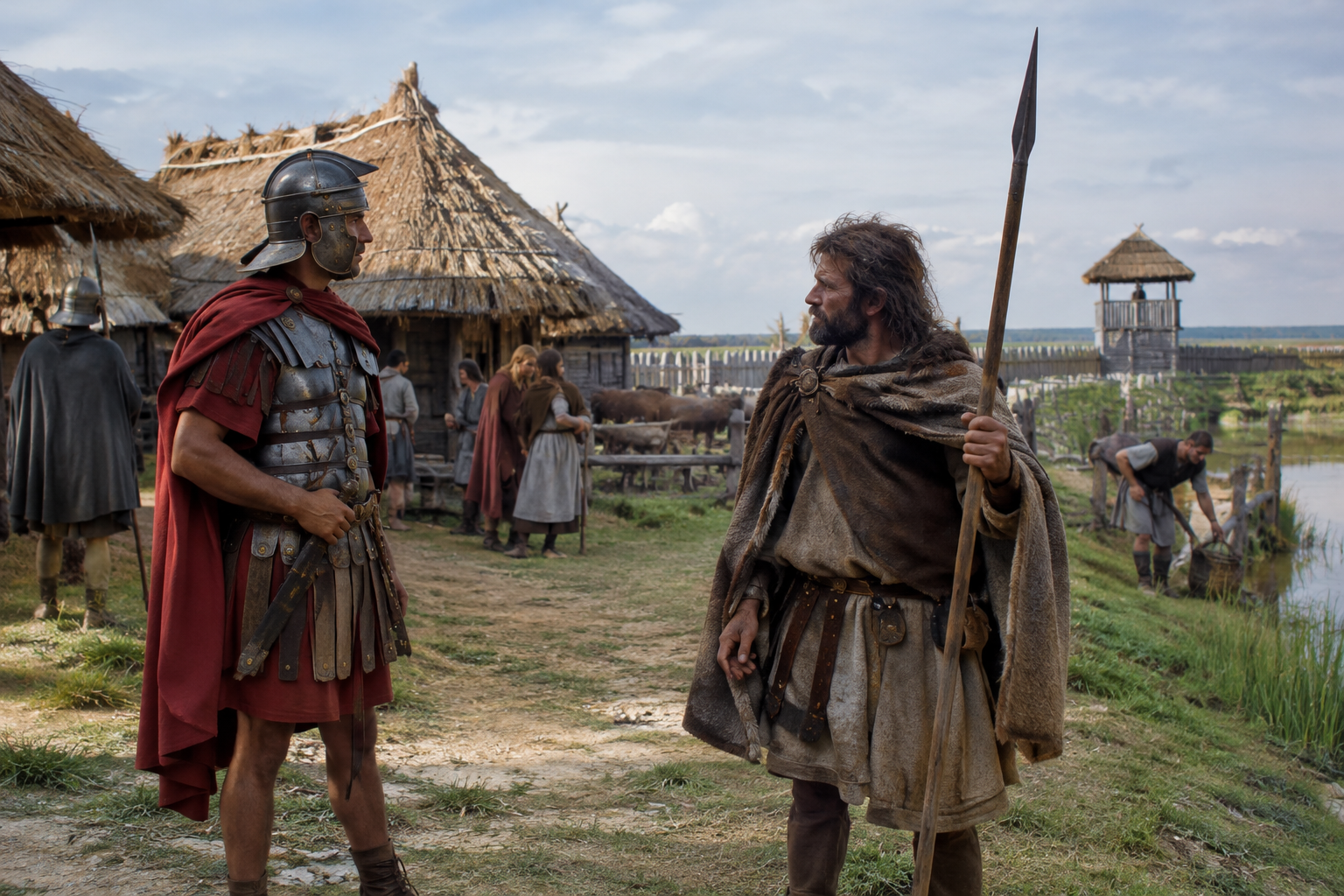
At Timacum Kuline in the village of Ravna in eastern Serbia, one man buried around AD 410 has become an unexpectedly useful witness to the end of Roman power in the Balkans. He is known in the genetic record as I15555, a Late Imperial Roman-era individual from a frontier zone that had seen soldiers, officials, traders, and local communities mixing for centuries. He has been associated with the Y-DNA haplogroup G2a2b2a1a1c2, a very specific paternal branch that turns up here not in some grand imperial capital, but in a provincial landscape where Rome was already fraying at the edges.
A second appearance comes a little later and a little farther north: HMU054, from post-Roman Pannonia at Scarbantia-Hegykő in Barbaricum, Hungary, dated around AD 525. Put the two together and the interest sharpens. This is not a story about a single "ethnic people" marching neatly across a map. It is a story about a paternal line appearing in the unsettled world between the late Roman Balkans and the post-Roman Carpathian Basin, where political labels changed faster than families did.
Y-DNA traces one direct paternal line: father to son to son across generations. That makes haplogroup G2a2b2a1a1c2 useful for following one narrow thread through history, but not for defining an entire person's ancestry, language, or identity. A man with this lineage in a Roman cemetery was not "made Roman" by his Y chromosome, nor does the lineage itself tell us whether he spoke Latin, Greek, a local Balkan language, or something else entirely.
What it does offer is a clue about continuity and movement. The broader haplogroup G is well known in ancient Eurasian history, especially in early farming populations, but that larger background must not be lazily collapsed into this exact subclade. For this article, the secure point is narrower: this reported branch appears in two individuals from the late 4th to 6th century world of the middle Danube and Balkans, both from regions where imperial institutions, frontier society, and post-Roman mobility were tightly entangled.
Timacum Minus, the Roman settlement near modern Ravna, sat in a strategically important corridor in what is now Serbia. By the early 5th century, this was a tense landscape. Roman administration still existed, but pressure from raids, military reorganization, and shifting regional power was transforming the old provincial order. In that setting, the individual I15555 matters because he anchors the haplogroup in a real late imperial context rather than in retrospective legend.
We should be careful here. The sample tells us that a man associated with G2a2b2a1a1c2 was present in this frontier zone around AD 410; it does not by itself reveal whether his paternal ancestors had been local for centuries or had arrived more recently through army service, migration, or marriage networks. But eastern Serbia was precisely the kind of place where those possibilities overlapped. Frontier communities were rarely simple. They drew in local Balkan people, recruits from other provinces, and families living in the long shadow of the army.
An ancient DNA study of populations from the wider Roman world and its aftermath has helped sharpen this picture by showing how varied communities could be even within shared imperial settings. Rather than imagining one uniform "Roman" biological type, the evidence points repeatedly to mixture, mobility, and local complexity, especially in border regions such as the Balkans and Danubian frontier.
The second sample, HMU054, comes from Scarbantia-Hegykő in Hungary, dated to about AD 525 and described as post-Roman Pannonia in Barbaricum. That phrase alone tells you a great deal. We are now in a world after the formal collapse of western Roman rule, yet still living amid Roman infrastructure, Roman memories, and populations shaped by centuries of contact with the empire.
Scarbantia, near modern Sopron, had been a Roman town, but by the 6th century the surrounding political geography had changed dramatically. "Barbaricum" was a Roman label for lands beyond direct imperial control, not a precise ethnic diagnosis. A man carrying this paternal line in that context might have belonged to a community with ties reaching into former Roman provinces, neighboring groups in the Carpathian Basin, or mixed populations that no ancient writer could have described neatly.
This is one reason the pair of samples is so suggestive. The lineage is present on both sides of the imperial threshold: once in a late Roman Serbian context, and again in a post-Roman Hungarian one. That does not prove a direct family connection between I15555 and HMU054, of course, but it does show that the branch had a place in the human landscape of this transitional zone across more than a century of upheaval.
Research on post-Roman communities in the Carpathian Basin has increasingly emphasized exactly this point: the 5th and 6th centuries were not simply a sequence of replacement populations. They involved recombination, local persistence, and new social formations built from people of varied backgrounds. A major study on this period is available here: https://www.science.org/doi/10.1126/science.aec2634.
There is a temptation, when faced with a rare-looking terminal branch, to search immediately for a single homeland and a single migration route. The archaeology of these two samples pushes against that habit. The Balkans and Pannonia were not passive corridors through which peoples simply passed. They were places where lineages could persist, mix, and be absorbed into new political worlds without leaving tidy textual labels behind.
That is especially true in the centuries around AD 400 to 550. Roman forts and towns still structured settlement. Old provincial populations remained in place in some districts. Military federates, mobile groups from neighboring regions, and communities operating partly inside and partly outside imperial systems all left their mark. In such a setting, a paternal lineage turning up in Serbia and then Hungary is less a tale of one dramatic migration than evidence of a social world knitted together by repeated movement and contact.
For readers interested in how deep Balkan population history complicates later political labels, there is a useful wider context in this related piece:
One of the most interesting things about G2a2b2a1a1c2 in this evidence is that it appears precisely when old categories were becoming unreliable. "Roman", "provincial", "barbarian", "local", and "migrant" were all real historical terms, but on the ground they often overlapped. A burial in late imperial Serbia and another in post-Roman Hungary remind us that people did not sort themselves according to the clean boxes later historians sometimes prefer.
The best way to read this haplogroup, then, is not as a badge of one people, but as a marker of paternal continuity within changing societies. The men carrying it lived in regions where frontiers shifted, administrations weakened, and new powers emerged. Yet the male line itself persisted through those disruptions, turning up in archaeological contexts on both sides of a major historical divide.
A broader ancient DNA study exploring transformation across Europe and western Eurasia in later periods has also helped normalize this picture of complexity rather than replacement: https://www.sciencedirect.com/science/article/pii/S0092867423011352. That matters here because these two samples fit a now-familiar pattern in archaeology: when texts describe rupture, graves often reveal continuity mixed with change.
So what does haplogroup G2a2b2a1a1c2 currently suggest? Not a royal pedigree, not a single tribe, and not an all-purpose origin story. What it does suggest, from the evidence at hand, is a paternal line present in the late Roman Balkans and still visible in the post-Roman world of Pannonia, embedded in the complicated human traffic of frontier Europe. For someone researching this lineage today, that is the valuable clue: your direct paternal branch belongs to the sort of history that flourished not in neat ethnic blocks, but in contact zones where empires waned and communities remade themselves.






Comments