Haplogroup R1b1a1b1a1a1c2b2a1b1

– 5 min read


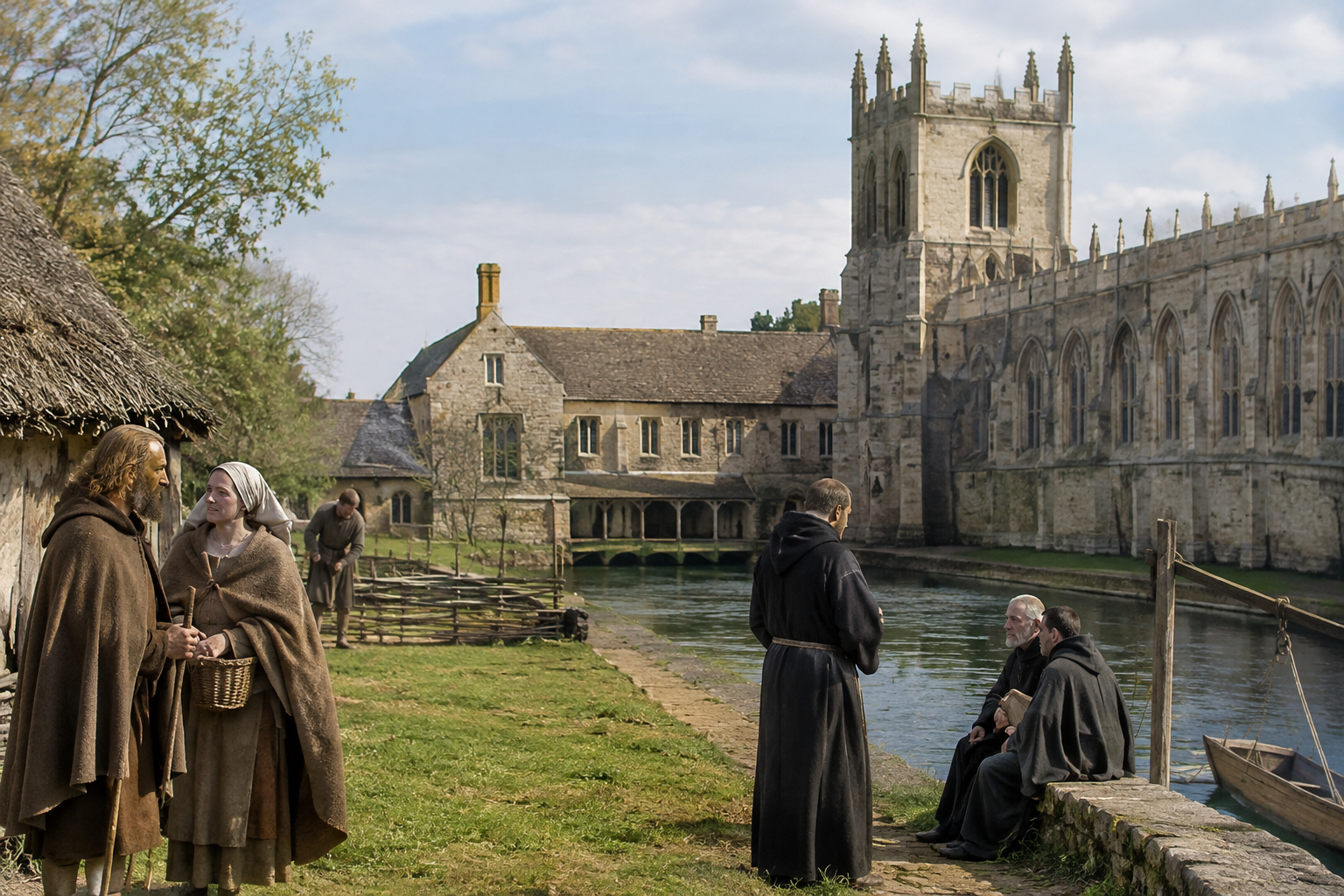
One of the clearest clues for the paternal line tagged here as R1b1a1b1a1a1c2b2a1b1 comes from medieval Cambridge: an individual from St John's Hospital, dated to around AD 1250 and identified as ATP_PSN_78. It is an evocative setting not because we can spin romance out of it, but because hospitals in medieval towns sat at the crossroads of ordinary life, illness, charity, movement, and death. A Y-chromosome lineage found in that context is not the badge of a single tribe or class. It is a trace of one paternal line moving through a living English town.
The same branch is also associated here with an earlier man from Hatherdene Close, Cambridgeshire, sample HAD011, dated to around AD 500 in the early Anglo-Saxon period. That pairing makes this lineage especially interesting. Instead of appearing once in isolation, it turns up in two Cambridgeshire contexts separated by roughly seven and a half centuries: one in the centuries after Roman rule, the other in a mature medieval urban institution.
Y-DNA follows a direct paternal line: father to son to son across generations. That makes it powerful for tracing one narrow ancestral thread, but only one. A man carrying R1b1a1b1a1a1c2b2a1b1 in medieval England was not "nothing but" that haplogroup, and neither is a present-day tester. Still, when the same branch appears in archaeological burials from a region with good historical context, it can help us see continuity, replacement, or mixture in sharper focus.
This particular label is a very fine-grained subclade within the much broader R1b family, one of the major Y-chromosome groupings in western Europe. That broader fact matters, but it should not be exaggerated. The evidence here supports discussion of a specific paternal branch in early medieval and medieval eastern England, not a sweeping claim about all R1b men or the entire peopling of Britain.
A useful background for that bigger picture comes from research on early English population formation, including a study linked to the Hatherdene Close context at https://www.researchgate.net/publication/363736520_The_Anglo-Saxon_migration_and_the_formation_of_the_early_English_gene_pool. The broad lesson from such work is that early medieval England was shaped by mixture, migration, and regional variation rather than a simple one-time replacement.
HAD011, from Hatherdene Close in Cambridgeshire and dated to around AD 500, belongs to a moment when eastern England was changing fast. This was the era after the end of Roman administration, when burial customs, settlement patterns, and material culture in parts of lowland Britain were being transformed. To find this paternal branch in that setting places it in the social world usually described as early Anglo-Saxon England.
That phrase, though familiar, needs handling with care. "Anglo-Saxon" is an archaeological and historical label for a period and cultural milieu; it is not the same thing as a single genetic type. A Y-line such as R1b1a1b1a1a1c2b2a1b1 could have been carried by a man whose wider ancestry was mixed in ways invisible from the Y chromosome alone. Even so, the appearance of this branch in an early Anglo-Saxon burial ground in Cambridgeshire suggests that this paternal line was already embedded in the communities forming early English society in the east.
Cambridgeshire is exactly the kind of place where this matters. It lay within a zone deeply affected by North Sea contacts, migration, and local survival from late Roman Britain into the early medieval centuries. One ancient individual cannot stand for the whole region, but HAD011 gives us a fixed point: this paternal branch was present there near the beginning of the documented Anglo-Saxon period.
If HAD011 shows us the branch near the start of early medieval England, ATP_PSN_78 shows it in a very different society. By around AD 1250, Cambridge was not a frontier landscape of post-Roman reorganization. It was an established medieval town with religious institutions, trade, scholars, and systems of care for the poor and sick. St John's Hospital belonged to that world.
The significance of ATP_PSN_78 lies partly in its ordinariness. Ancient DNA often tempts us toward elites and spectacular graves, but hospitals capture a broader social history. A paternal line found there had made its way through many generations of marriages, inheritances, local movements, and perhaps immigration into town life. In other words, this branch was not just present in conquest-era or migration-era eastern England; it was still part of the male population of Cambridge centuries later.
Research on medieval Cambridgeshire populations, including work connected to https://www.biorxiv.org/content/10.1101/2023.03.03.531048v1, has helped place burials like these into a wider framework of continuity and change across the medieval period. The important point is not that every paternal line stayed fixed, but that medieval towns preserve evidence for how earlier regional lineages continued within changing institutions and communities.
Cambridgeshire before and after plague
By themselves, neither HAD011 nor ATP_PSN_78 can found a dynasty, map a migration route, or identify a surname. Together, though, they are historically suggestive. They place the same fine-scale paternal branch in the same English county in two very different periods: one close to the emergence of early Anglo-Saxon England, the other in the dense institutional landscape of the 13th century.
That pattern raises a sensible possibility of regional persistence. Not unbroken proof of one family, of course, but evidence that this branch was not a fleeting arrival represented by a single isolated burial. In a county like Cambridgeshire, where settlement continuity coexisted with substantial migration and social change, that is precisely the sort of modest but valuable conclusion ancient DNA can support.
It also reminds us that eastern England's history is not well described by simple ethnic labels. The same landscape that once formed part of Roman Britain later became central to Anglo-Saxon kingdoms and then to medieval English urban life. A paternal line surviving across those phases does not erase change; it shows how change and continuity can exist together.
Roman and early medieval Britain
Because this haplogroup sits within the wider R1b family, many readers will wonder whether it should be called "Celtic," "Germanic," "British," or something else. The honest answer is that the narrow branch in this article cannot be reduced to any one of those labels on the evidence here. Broad R1b lineages were already widespread in western Europe long before the early Middle Ages, and later historical identities were layered onto that deeper background.
What the Cambridgeshire evidence does support is more local and more interesting. This was a paternal branch present in eastern England during the early Anglo-Saxon period and still present in medieval Cambridge. That makes it part of the long male-line population history of England, not as a mythic founding marker, but as one thread among many in a region shaped by Roman legacies, North Sea migrations, and medieval urban growth.
For someone who carries R1b1a1b1a1a1c2b2a1b1 today, the strongest insight from these ancient finds is not a claim to one famous ancestor, but a grounded historical setting. This paternal line is associated here with real men from Cambridgeshire: one living in the early Anglo-Saxon centuries, another in medieval Cambridge around AD 1250. That is a good example of how Y-DNA can anchor family research in documented human landscapes, showing a branch not in legend but in the burials of early and medieval England.






Comments