Haplogroup G2a2b2b1a1b
– 4 min read


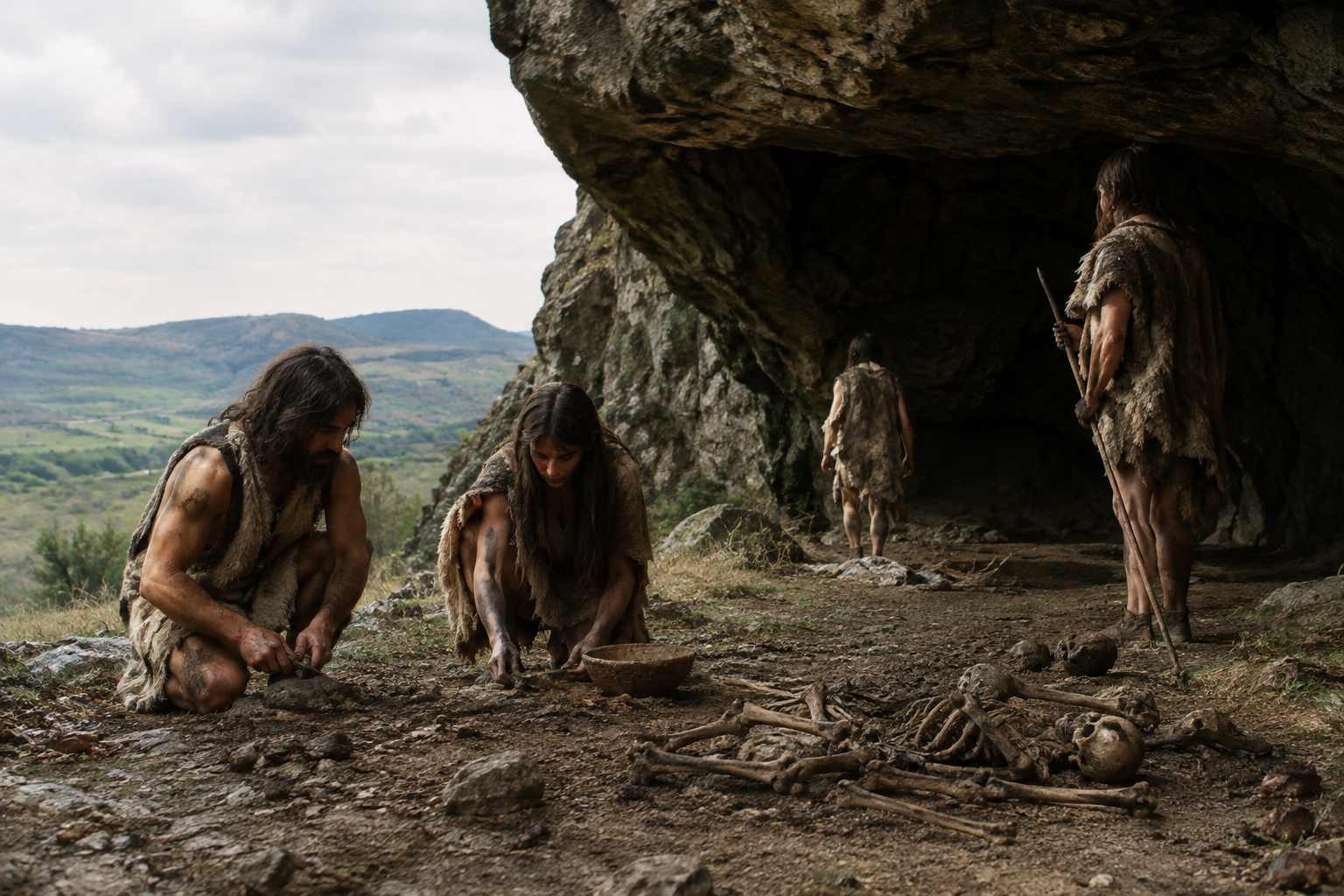
At Asparn-Schletz in Lower Austria, the archaeology is grimly memorable. This early Neolithic enclosure has become famous for evidence of large-scale violence around 5000 BC, and among the men caught up in that world was sample I24886, associated here with Y-DNA haplogroup G2a2b2b1a1b. That matters because this is not a lineage turning up in some vague prehistoric haze: it appears in communities living through the tense, unstable centuries when farming had already transformed central Europe, but security clearly had not followed.
The second anchor point is far to the south, at Tren Cave in Albania, where sample I13840, dated to about 4150 BC, connects the same paternal branch to a very different setting in the later Neolithic Balkans. Two finds are not a continent-wide census, of course. But together they place this branch of G2a in the old heartlands of European farming, from the middle Danube zone to the western Balkans.
G2a2b2b1a1b is a very specific branch within the wider Y-DNA haplogroup G2a, a lineage strongly associated in ancient DNA studies with many of Europe's early farming populations. Y-DNA follows one narrow line of descent, from father to son, so it does not describe a person's whole ancestry, appearance, language, or identity. Still, paternal branches can be historically revealing when they recur in well-dated archaeological contexts.
In this case, the important point is not to load too much onto the final letters and numbers. The broader pattern is secure enough to be interesting: this haplogroup sits in a family of lineages that appears repeatedly among early and middle Neolithic men in southeastern and central Europe. What these two samples suggest is that the branch represented by G2a2b2b1a1b belonged to that agricultural world, and did so across a substantial geographical arc.
A wider ancient DNA study of Neolithic Europe, published in Science, helped clarify just how important such farmer-associated lineages were in the spread and reshaping of European populations after the adoption of agriculture. That larger context is essential here, because these two men were not isolated curiosities. They belonged to societies already linked by farming, settlement, exchange, and movement.
Asparn-Schletz has a peculiar place in European prehistory because it forces us to drop any sentimental picture of the Neolithic as simply a calm age of first farmers. The site is associated with one of the best-known massacre contexts of early farming Europe. Human remains there point to a community overwhelmed by violence, and the setting has become central to discussions of conflict among early agricultural groups in the Linear Pottery world and its aftermath.
Sample I24886, dated here to about 5000 BC, places G2a2b2b1a1b in exactly that troubled environment. What makes this so striking is not merely the haplogroup itself, but the social scene around it: enclosed settlements, cultivated land, livestock, territorial pressure, and the very real possibility of organized attack. In other words, this paternal lineage was present not at the margins of Neolithic Europe but in one of its most discussed human dramas.
That should make us careful as well as excited. A man carrying this branch at Asparn-Schletz was not a symbol of an entire people, nor proof that one haplogroup "caused" anything. But he does show that G2a2b2b1a1b belonged to the biological and historical fabric of early farming communities in the Danube basin.
If Asparn-Schletz gives us a violent settlement context in central Europe, Tren Cave offers something different: a later Neolithic setting in Albania, dated here to about 4150 BC. Sample I13840 links G2a2b2b1a1b to the western Balkans, a region crucial to the story of how farming populations developed after their first arrival in Europe.
Caves in Balkan archaeology are often awkwardly revealing places. They can preserve traces of habitation, ritual use, burial activity, or repeated occupation across long spans of time. Without inventing details not provided for this individual, we can still say why the location matters: Albania sits in one of the great contact zones between the Aegean, the Adriatic, and the inland Balkans. A paternal branch turning up there in the fifth millennium BC fits a landscape of movement and local continuity rather than a single simple migration event.
This is especially interesting because the Balkans are not merely a stepping stone in prehistory. They were one of the major theatres in which Europe's first farmers mixed, spread, and diversified. G2a lineages are often part of that story, and I13840 suggests that this particular downstream branch was present within those later Neolithic populations as well.
Two samples do not map a perfect route, but they do sketch a credible zone. One appearance lies in Lower Austria around 5000 BC; the other in Albania around 4150 BC. That is enough to place G2a2b2b1a1b within the wider Neolithic belt that stretched from southeastern Europe into the Danubian interior.
What is most plausible, then, is not some dramatic late migration of this exact subclade, but its participation in the long demographic history of Europe's farming populations. The parent haplogroup G2a is well known in early agricultural contexts, and these two instances fit that bigger picture neatly. They suggest a paternal line embedded in communities that farmed, settled, expanded, and sometimes fought across the Neolithic Balkans and central Europe.
Research on ancient genomes from southeastern Europe and neighboring regions has repeatedly shown that these societies were not static. They mixed with local hunter-gatherer groups to varying degrees, and they changed over time. A more recent regional study available at bioRxiv reflects that continuing effort to refine the genomic history of Balkan populations and their deep roots.
For someone exploring haplogroup G2a2b2b1a1b today, the strongest supported insight is quite specific: this branch is already visible in Neolithic Europe, and not in just one corner. It appears in an early farming community in Austria marked by conflict, and in a later Neolithic context in Albania, within the wider Balkan sphere that helped shape the continent's first agricultural populations.
That does not turn a modern carrier into the descendant of any one excavated man. It does, however, place your paternal line in an old and historically important layer of European ancestry: the world of early and middle Neolithic farmers, where settlement, movement, and social stress were already reshaping the map of Europe. In that sense, G2a2b2b1a1b is not simply ancient. It belongs to one of the foundational human stories of the continent.
Comments