Haplogroup G2a2b2a1a1b1a1a2a1a1b2a

– 5 min read


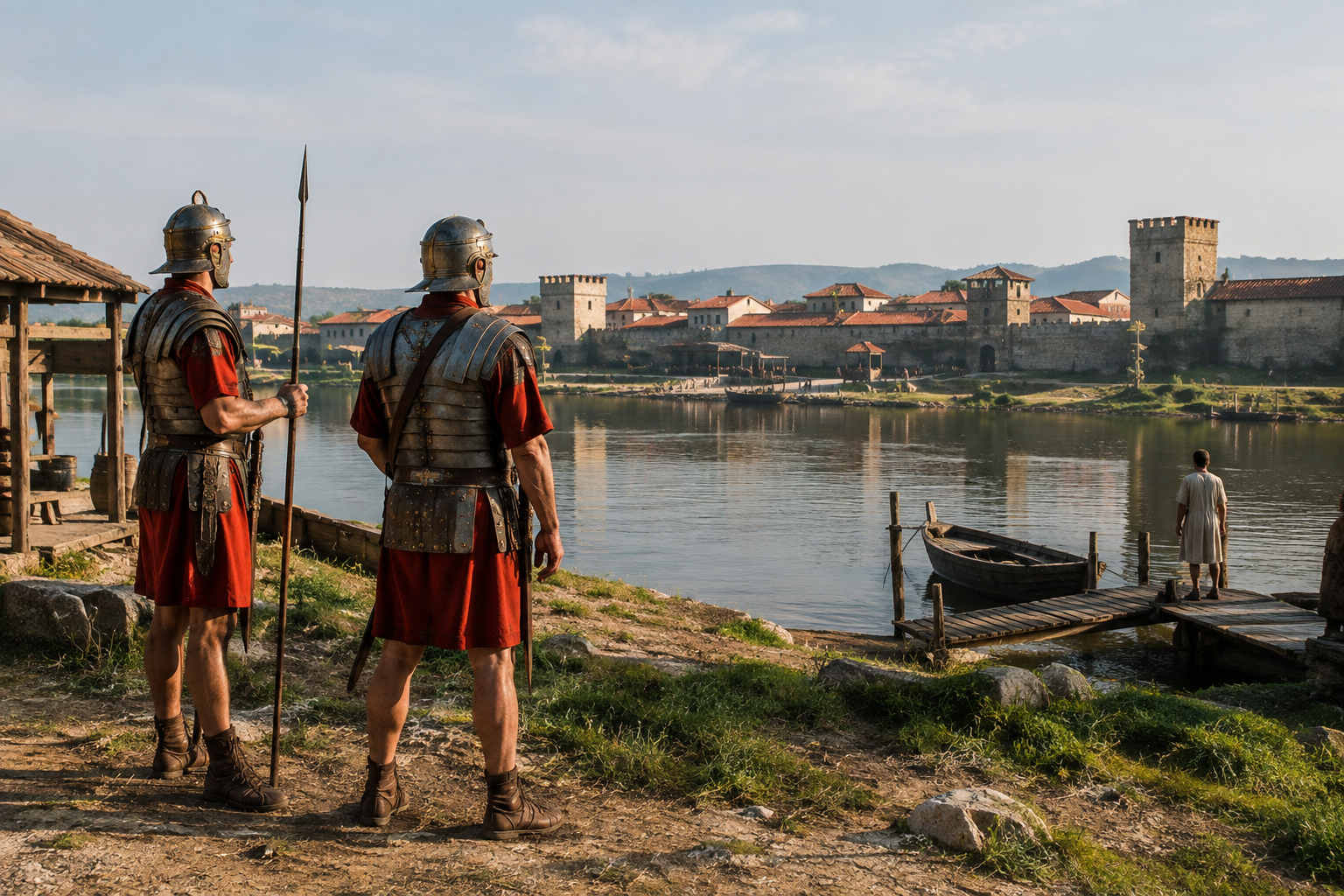
At Osijek in eastern Croatia, the Roman town of Mursa has been yielding a complicated picture of imperial life on the Danube frontier. Among the ancient men dated to around AD 170 from this setting are two individuals, R3655 and R3655a, both reported in connection with the very specific Y-DNA branch G2a2b2a1a1b1a1a2a1a1b2a. That is a mouthful, certainly, but the historical interest lies in something simpler: a paternal line more often associated with much deeper layers of European prehistory turning up in an Imperial Roman context.
This does not mean that one Roman-period grave can tell us the whole history of a lineage. Y-DNA follows only a direct father-to-son line, not a person's entire ancestry. But when a rare or tightly defined branch appears in a documented archaeological setting, it gives us a fixed point in time. In this case, that point sits in Roman Croatia, in a frontier world of soldiers, traders, settlers, and families living under imperial rule.
Osijek stands near the site of ancient Mursa, one of the important Roman centres in Pannonia. By the second century AD, this was not some distant outpost at the edge of the map, but part of a heavily connected military and civilian zone stretching along the Danube. Roads, river traffic, army logistics, and urban life all pulled people into the region.
The two Osijek individuals matter precisely because they are so close in place and date. R3655 and R3655a, both assigned to Imperial Roman Croatia around AD 170, suggest that this paternal branch was not a one-off stray signal in the region. Even without over-claiming kinship between them, the repetition is meaningful. It places this lineage within a real Roman-period community in northeastern Croatia.
An ancient DNA study of Croatia and its long-term population history has helped frame such finds by showing both continuity and change in the region across time. The broader pattern is not one of a population being simply replaced from one century to the next, but of older local ancestry interacting with new arrivals and shifting social worlds. That makes a lineage like G2a2b2a1a1b1a1a2a1a1b2a especially interesting here: it may represent one thread in that longer regional continuity, preserved into the Roman imperial era.
Croatia's shifting paternal lines
At a broad level, haplogroup G is famous in European archaeogenetics because it appears so often among early farming populations, especially those connected with the Neolithic spread into Europe. That does not allow us to claim that this exact Roman-era branch had the same path, or that every later G lineage is a straightforward survival of the first farmers. Branches split, spread, disappear, and reappear in different places over thousands of years.
Still, the wider background matters. When a downstream branch of G turns up in a Roman burial from Croatia, it raises a sensible historical question: are we seeing a paternal line with deep roots in southeastern or central Europe that persisted through many cultural changes, or a lineage carried into Mursa through the mobility of the empire? On present evidence, both remain possible. The Roman frontier was full of movement, but the Balkans were also full of older local populations whose descendants lived on under Roman administration.
That tension between continuity and mobility is exactly what makes frontier archaeology so compelling. Rome did not land on an empty landscape. It occupied, taxed, recruited, settled, and reshaped regions already dense with their own histories.
We should be careful not to turn sample labels into mini biographies. For R3655 and R3655a, the secure facts here are their identifiers, their Imperial Roman context, their location at Osijek, and their approximate date around AD 170. But even those bare details are enough to place them in a vivid historical moment.
The later second century was a turbulent time on the Danubian frontier. Armies moved, border pressures intensified, and provincial towns had to function amid imperial demands. Men buried in and around Mursa might have been drawn from local families, military circles, nearby rural communities, or wider provincial networks. The point is not to choose one dramatic identity without evidence. The point is that Roman provincial society was mixed, layered, and local at the same time.
A wider genetic investigation of ancient Croatian material, available as research on population history in Croatia, is relevant here because it encourages exactly that sort of caution. Roman-period individuals in the region do not collapse into one neat ethnic box. They sit instead within a changing landscape of ancestry, kinship, and historical contact.
If this haplogroup appears in Roman Osijek, the broader regional history helps explain why that matters. The Balkans were one of the great hinge-zones of Eurasian history: a place where prehistoric farming spread, where Bronze and Iron Age societies developed in dense interaction, and where Greek, Illyrian, Thracian, Celtic, Roman, Gothic, Avar, and Slavic worlds later overlapped in different combinations.
That does not mean one Y-line can be assigned to any of those labels. It does mean that southeastern Europe is exactly the sort of region where an ancient paternal lineage could survive through repeated political and cultural change. Roman rule often intensified connectivity rather than erasing local descent lines altogether. A man with a deeply rooted Balkan paternal ancestry could live in a Roman town, speak Latin or Greek or a local language, serve in the army, marry into another provincial family, and be buried in an unmistakably imperial setting.
This is one reason Roman-era genetics has been so productive. It keeps exposing how misleading the old oppositions can be: local versus foreign, Roman versus native, centre versus frontier. The evidence from ancient DNA repeatedly shows that provincial life was usually more entangled than those tidy categories allow.
The exact branch name here, G2a2b2a1a1b1a1a2a1a1b2a, is far narrower than the parent haplogroup G. That distinction is important. The famous prehistoric story of broad G lineages is useful background, but it is not a substitute for direct evidence about this particular terminal branch. With the material at hand, the safest statement is that this branch is attested in two Imperial Roman males from Osijek around AD 170.
That alone is valuable. For someone researching this paternal line today, the most defensible historical insight is not a claim of royal descent or a single grand migration route. It is a more grounded and, in some ways, more interesting point: this lineage was present in a real Roman-era community on the middle Danube, in a region where local depth and imperial mobility met face to face.
That makes the branch historically legible. Not fully explained, certainly. But legible enough to place one paternal line within the lived world of Roman Croatia, where old ancestries and imperial structures coexisted in the same graves.
Some haplogroups are represented by grand clusters spread across many centuries. Others emerge from just a few ancient individuals, sharply dated and firmly placed. This branch belongs, for now, to the second category. R3655 and R3655a do not give us a complete dynasty or a long parade of named ancestors, but they do something just as important: they anchor G2a2b2a1a1b1a1a2a1a1b2a in the Roman Balkans with unusual clarity.
For modern descendants, that is a solid historical foothold. It points toward a paternal story connected not just with abstract prehistory, but with the crowded, mobile, stubbornly local world of Mursa under the Roman Empire.






Comments