Haplogroup I

– 6 min read


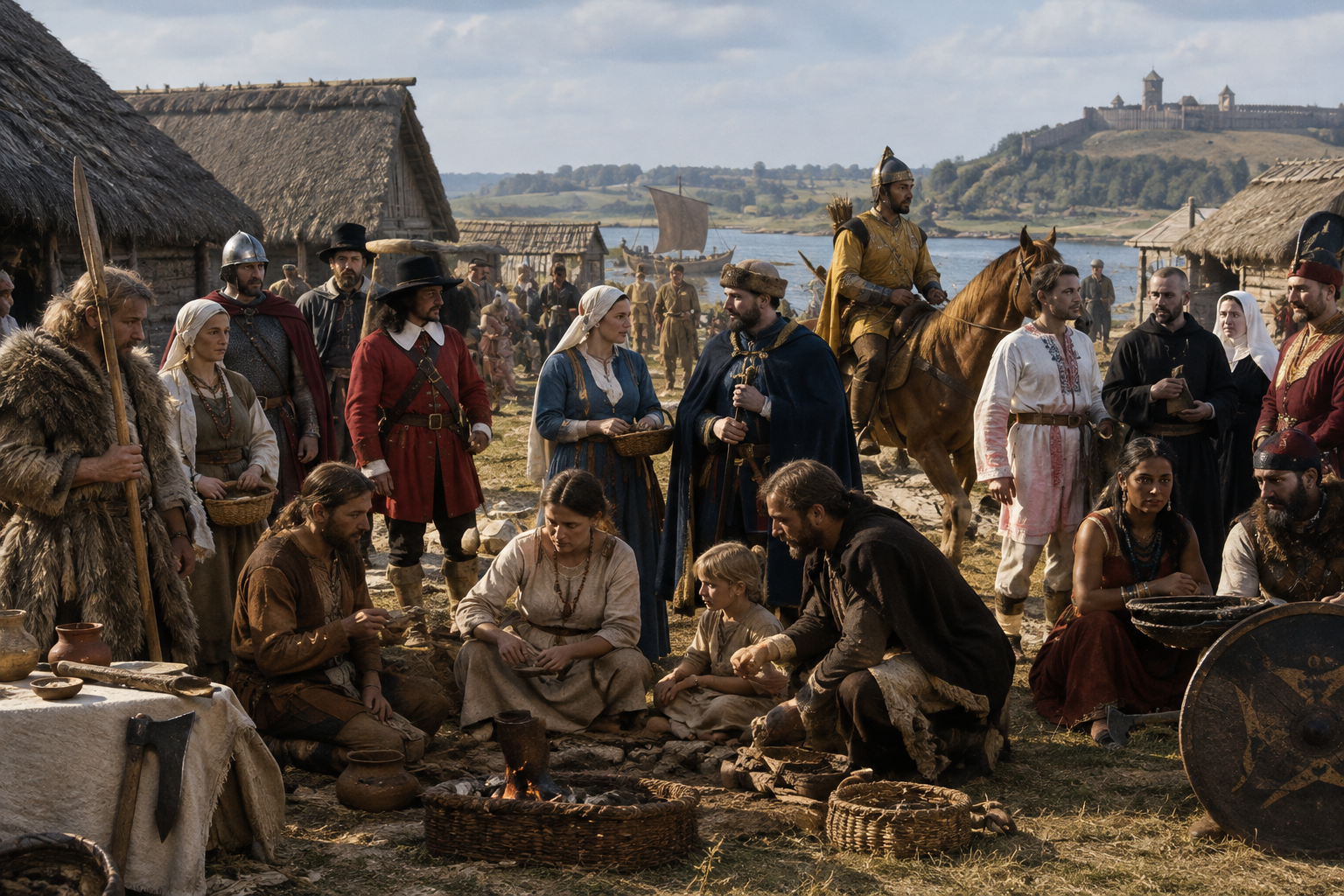
Haplogroup I is one of the most intriguing paternal lineages in Europe because it feels, in a sense, stubbornly local. While many Y-chromosome branches are tied to large later expansions, Haplogroup I is often discussed as one of the old European paternal lines that was already present in the continent long before the medieval kingdoms, castles, and surnames that dominate written history. That alone makes it historically irresistible: here is a lineage that turns up not only in medieval graves, but also in some of the deep archaeological layers of prehistoric Europe.
As always, a caution is needed at the start. A Y-DNA haplogroup traces only one narrow line of ancestry: the direct paternal line from father to father to father. It does not describe a person's full ancestry, culture, language, or identity. Nor does sharing a broad haplogroup with an ancient burial or a noble house prove direct descent. But as a tool for following long-term paternal continuity and change, Haplogroup I is extraordinarily useful, especially now that ancient DNA has given us real men from real graves instead of guesswork alone.
Within the Y-chromosome tree, Haplogroup I sits inside the larger IJ branch and is widely associated with ancient European paternal ancestry. In broad terms, it is often linked with lineages that survived in Europe through deep prehistory and then persisted, in different branches, through the Mesolithic, Neolithic, Bronze Age, and medieval periods. That does not mean every branch of I has the same story. Some subclades became more common in Scandinavia, others in the Balkans or central Europe, and others appear in later historical settings shaped by migration, marriage, conquest, and local survival.
The supplied ancient samples make that long chronology unusually vivid. At Vasilevka in ancient Ukraine, two individuals dated to 8879 BC, NEO545 and NEO549, show how early this paternal background appears in Europe's archaeological record. These are not knights, chiefs, or dynasts in any written sense. They belong to a world before metal, before farming in much of Europe, before any castle had been imagined. Yet they remind us that some paternal lines later found in medieval Europe were already part of the human landscape in the post-Ice Age world.
By the Mesolithic and Neolithic, Haplogroup I is still visible across northern and eastern Europe. NEO13 from Hedegaard Bislev in Denmark, dated to 7561 BC, is especially striking, as is NEO3 from Vaengese II, East Jutland, dated to 4142 BC. These Danish finds help show that paternal branches of I were present across the north during the long transition from foraging to farming. They do not tell a simple story of one people replacing another. Rather, they suggest that local male lines could persist through major cultural shifts.
The Neolithic evidence broadens the map considerably. NEO149 from Gorzsa Cukormajor in ancient Hungary, dated to 5028 BC, places Haplogroup I in the Carpathian Basin. Kretuonas5 from Neolithic Lithuania, dated to 4400 BC, shows it in the eastern Baltic zone. I18067 from Pommeroeul in Neolithic Belgium, dated to 2916 BC, brings it into the Low Countries. Meanwhile, NEO41 and NEO43 from Saksild Rude in East Jutland, dated to 3581 BC and 3442 BC, and NEO702 from Jorlundegard in Sjaelland, dated to 3321 BC, underline that Denmark remained one of its important prehistoric settings.
That distribution matters because it warns against lazy historical labels. Haplogroup I cannot be neatly boxed as "Celtic," "Germanic," "Slavic," or any other later identity. Those categories belong to much later cultural and linguistic worlds. The prehistoric record instead shows a paternal lineage moving through many societies and many ways of life.
By the Bronze Age, the picture becomes even more interesting. Samples such as I12828 from Smeeni in Romania, dated to 2050 BC, Bul8 from Beli Breyag in Bulgaria, dated to 2500 BC, and I2440 from Dzhulyunitsa in Bulgaria, dated to 3000 BC, show Haplogroup I in southeastern Europe. R11668 from Beniamin in Bronze Age Armenia, dated to 1125 BC, and I13166 from Velika Gruda in Montenegro, dated to 1225 BC, hint at how branches of this broad lineage could appear well beyond the northern European zone with which it is often casually associated.
In Scandinavia, the later prehistoric record continues with Rise179 from Battle Axe Abekas in Sweden, dated to 1890 BC, followed by Rise175 from Bronze Age Abekas, dated to 1270 BC, and Rise210 from Angamollan, dated to 1360 BC. Here the story is not one of disappearance, but of adaptation. Cultural horizons changed; paternal lines continued.
Once we reach the first millennium AD, Haplogroup I is no longer merely prehistoric. It appears in historical settings that can be linked to named polities and better-understood societies. MGS004b from an Avar Period grave at Moedling-An der Goldenen Stiege in the Vienna Basin, dated to 650 AD, places it in a frontier world shaped by steppe powers, post-Roman restructuring, and local central European populations. G23 from Lauchheim Mittelhofen in Merovingian Germany, dated to 700 AD, shows it in the early medieval German realm. DUN003 from Dunum in Lower Saxony, dated to 840 AD, places it in a Saxon context.
Further north, three individuals from medieval Vasterhus in Sweden, mbv321, mbv210, and mbv221, all dated to 1313 AD, show Haplogroup I still firmly in the Scandinavian sphere. In England, ATP_PSN_231 from Cambridge St Johns Hospital, dated to 1250 AD, gives us a medieval urban and charitable setting rather than an aristocratic one, a useful reminder that Y-DNA history is not only about elites.
Two particularly suggestive samples are PCA0385 from Santok on the Lubusz-Greater Poland border and PCA0241 from PoznanSrodka in Greater Poland, both dated to 1100 AD and associated here with the Piast Dynasty context. That does not prove any sweeping dynastic claim on its own, but it does place Haplogroup I within the medieval Polish world. Likewise, UKR070 from a Golden Horde era hill fort in Donetsk, dated to 1350 AD, shows the lineage in the north Pontic zone during a period of intense mobility and mixed political control.
In this case, the supplied field for associated noble families and castles is empty. Oddly enough, that is not a weakness but a useful discipline. It stops us doing the thing people are most tempted to do with Y-DNA: leap from a broad haplogroup to a dramatic noble pedigree. Haplogroup I certainly appears in regions later dominated by aristocratic houses, princely courts, fortified seats, and dynastic rivalries. The Piast-associated samples from medieval Poland, the Merovingian and Saxon-era burials in Germany, and the Swedish medieval individuals all sit in landscapes where castles and noble lineages later became central to regional memory. But without specific family data, the responsible course is restraint.
That restraint matters because castles preserve history, not chromosomes. A fortress in Greater Poland, a manor in Saxony, or a stronghold in Sweden can anchor family tradition and political geography, but it cannot by itself prove paternal continuity from an ancient burial. What ancient DNA can do is supply context: it shows that a broad paternal lineage was present in these regions long before, during, and after the rise of documented noble society.
That is perhaps the most interesting lesson of Haplogroup I. It links some of Europe's earliest post-glacial men, Neolithic farmers and foragers, Bronze Age communities, medieval peasants, hospital burials, frontier populations, and men living under dynasties. It is not the property of any one nation or class. It is older, messier, and far more human than that.
If your paternal line belongs to Haplogroup I, the most responsible way to think about it is not as a badge of ethnic identity, but as a clue to a very old strand of European paternal history. The ancient individuals listed here show that this lineage was present from ancient Ukraine to Denmark, from Belgium to Hungary, from the Balkans to Sweden, and into medieval England, Germany, Poland, and the Black Sea world.
That does not mean a man with Haplogroup I today descends directly from NEO13, G23, or PCA0241. It means that his direct paternal line belongs to the same broad branch of the human family tree as these ancient men. The value lies in the scale of the story: a lineage that can be tracked across thousands of years, through enormous cultural change, and across many of the landscapes that later produced Europe's kingdoms and chronicles.
For readers who want to understand how these paternal clues fit into the wider science, MyTrueAncestry also has an excellent primer on the field itself.
Learn How Archaeogenetics Works
Upload your DNA to MyTrueAncestry to explore whether your results show connections to ancient individuals, archaeological cultures, and historical populations linked to Haplogroup I and beyond. These matches do not by themselves prove direct descent from a specific ancient person or noble family, but they can offer a remarkably vivid new perspective on your past.
Comments