Haplogroup I

– 6 min read


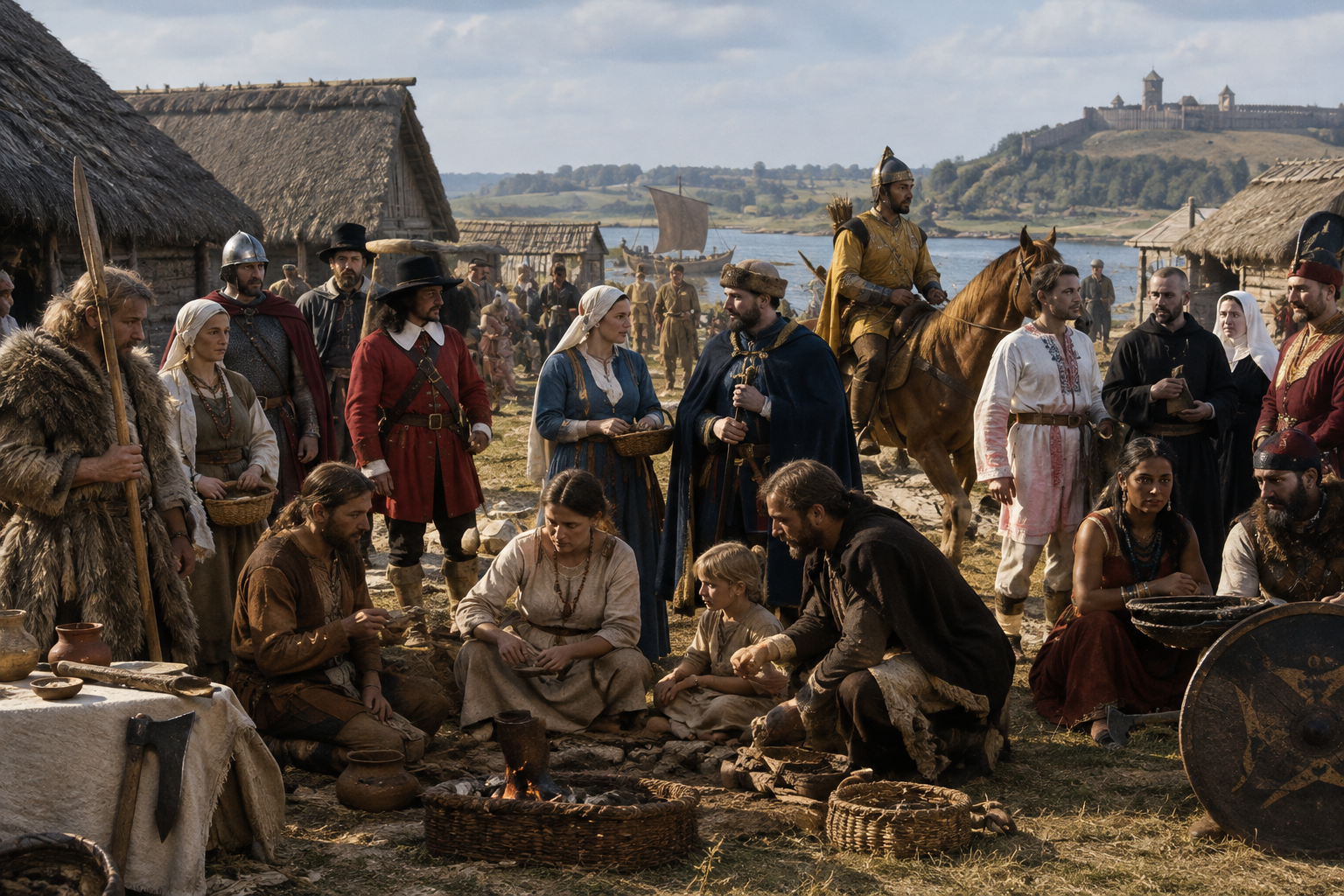
Captain William West, who died at Jamestown in 1610, is an unexpectedly good place to begin with haplogroup I. He belongs to the first brutal decade of permanent English colonisation in Virginia, when status, kinship, and survival were tangled together in a tiny and dangerous settlement. Ancient DNA recovered from remains identified as the high-status colonist sample I4652 places one early modern man in the long paternal story of haplogroup I, a lineage whose roots lie deep in prehistoric Europe and whose branches keep appearing in very different archaeological worlds.
That contrast is the real interest here. Haplogroup I is not the mark of one people, kingdom, or migration. It is a very old European Y-chromosome lineage, and because Y-DNA follows only a direct paternal line, it tells us something precise but limited: one thread of father-to-son descent, not a person's whole ancestry. In the material gathered here, that thread turns up among Mesolithic foragers in Ukraine, early and middle Neolithic communities around the Baltic and North Sea, medieval men in Germany, Poland, England, and Sweden, and finally an English officer buried at the edge of England's Atlantic world.
The Jamestown individual I4652, identified as Captain William West, shows haplogroup I persisting into the early colonial period. This is not especially surprising in itself; haplogroup I remained part of the Y-DNA landscape of north-western Europe into the modern era. What gives the case its force is the historical setting. Here is a named man from the first years of English America, standing at the end of a paternal line that had already been present in Europe for many millennia.
Researchers investigating high-status burials at Jamestown brought together archaeology, history, and archaeogenomics in a particularly elegant way, as discussed in this study of the Jamestown remains. For anyone with haplogroup I today, the point is not that Jamestown proves an exact family connection. It is that the lineage was still moving through major historical events, carried not by abstractions but by individuals whose lives were caught up in colonisation, war, and Atlantic expansion.
Colonial DNA at St. Mary's City
If Jamestown gives us the late chapter, the much earlier samples from Vasilevka in Ukraine show just how deep this lineage runs. Two individuals, NEO545 and NEO549, are dated to around 8879 BC. That places haplogroup I in the world of post-glacial hunter-gatherers, long before metalworking, cities, or written history.
One must be careful here. A broad assignment to haplogroup I does not make these men ancestors of every later carrier, nor does it collapse all later branches into one undifferentiated block. Still, their presence matters enormously. It shows that haplogroup I was already established among forager populations in eastern Europe in the early Holocene, making it one of the most ancient clearly attested paternal lines in the European record.
The wider genomic picture of these northern and eastern European forager populations has been transformed by large ancient-DNA studies, including work on the Baltic and adjacent regions such as this landmark study. The recurrent appearance of haplogroup I in such contexts helps explain why later European prehistory does not look like a simple replacement of one male lineage by another. Some old paternal lines endured, even as economies, languages, and ancestry profiles shifted around them.
Several of the most revealing samples here come from Denmark and nearby Baltic contexts. NEO13 from Hedegaard Bislev, dated to around 7561 BC, and NEO3 from Vaengese II in East Jutland, dated to around 4142 BC, place haplogroup I in both Mesolithic and later Ertebolle-related settings. These are not the same cultural world. Between them lies the long and complicated transition from foraging lifeways to farming.
Then there are the Neolithic Danish samples from Saksild Rude in East Jutland, NEO41 at around 3581 BC and NEO43 at around 3442 BC, along with NEO702 from Jorlundegard on Sjaelland, dated to around 3321 BC. Taken together, they show haplogroup I surviving well into farming societies in Scandinavia. That does not mean every early farmer in Denmark carried I, nor that the Neolithic was simply local continuity dressed in new pottery. It means some paternal lines associated with earlier northern populations remained part of the genetic mix as agriculture spread and local societies changed.
Another sample, Kretuonas5 from Neolithic Lithuania around 4400 BC, extends that picture eastward into the Baltic zone. Seen across these finds, haplogroup I looks less like a single event and more like a durable northern European presence, adapted to successive social worlds.
Denmark's Forager-Farmer Transition
One particularly evocative sample is I18067 from Pommeroeul in Belgium, dated to around 2916 BC. The site is notable not just because it adds another occurrence of haplogroup I in Neolithic north-western Europe, but because Pommeroeul has been discussed in relation to the manipulation and reassembly of human remains. In other words, this is not simply a skeleton in a grave; it belongs to a site where the treatment of ancestors seems to have been an important social act.
That matters because Y-DNA can sometimes tempt us into over-neat stories about biological descent alone. Pommeroeul reminds us that ancient communities also made ancestry culturally. Bones could be curated, moved, and recontextualised. A paternal lineage such as I was biologically inherited, yes, but it was also embedded in ritual behaviour, memory, and the deliberate construction of the dead within the living community.
An archaeological discussion of the site can be found in this study of Pommeroeul. It is a useful reminder that when haplogroup I appears in the Neolithic record, it does so in human settings that were socially inventive and often rather complicated.
By the early Middle Ages, haplogroup I appears in a quite different archaeological landscape. The sample G23 from Lauchheim Mittelhofen in Merovingian Germany, dated around 700 AD, places it within the post-Roman societies of western and central Europe. DUN003 from Dunum in Lower Saxony, around 840 AD, does something similar for a Saxon context. These are centuries of political fragmentation, Christianisation, and regional identity-building, yet the paternal line is still there.
In the Piast-period samples from the Polish lands, PCA0385 from Santok and PCA0241 from PoznanSrodka, both around 1100 AD, haplogroup I appears again in the orbit of an early medieval state. That is useful evidence against any attempt to box this lineage into a purely Atlantic or purely Scandinavian story. Its documented carriers belong to a broad swathe of European societies, including the emerging polities of the Slavic west.
Further west and north, ATP_PSN_231 from medieval Cambridge, dated around 1250 AD, and three men from Vasterhus in Sweden - mbv321, mbv210, and mbv221, all around 1313 AD - show that the lineage remained established in medieval Christian populations around the North Sea and Baltic worlds. That pattern fits the broader historical picture rather neatly: haplogroup I does not vanish with the coming of farming, or states, or Christianity, or even the great medieval re-ordering of Europe.
A few other samples show how widely dispersed branches of haplogroup I could be by later prehistory and history. MGS004b from an Avar-period grave at Moedling-An der Goldenen Stiege in the Vienna Basin, dated around 650 AD, places the lineage in a frontier zone shaped by steppe empires, post-Roman populations, and local European communities. gur017 from Nazarlebi in Georgia, around 1000 BC, and R11668 from Beniamin in Armenia, around 1125 BC, hint at the presence of branches connected to haplogroup I well beyond its strongest European heartlands.
The sample UKR070 from a Golden Horde era hill fort in Donetsk, around 1350 AD, is especially worth noting. The medieval steppe was not a sealed ethnic world. It was a contact zone, and ancient DNA repeatedly shows that such regions brought together lineages with very different histories. Haplogroup I in that setting is not evidence that the Golden Horde was "European" in any simplistic sense. It is evidence that men carrying old European paternal lines could be present in the mixed societies of the north Pontic frontier.
The most distinctive thing about haplogroup I in this collection is its staying power. It appears among very early hunter-gatherers in Ukraine, among Mesolithic and Neolithic people around Denmark and the Baltic, in Neolithic Belgium, in early medieval Germany and Poland, in medieval England and Sweden, and in an English officer at Jamestown. That does not make all these men one people. It makes them evidence for a paternal lineage that remained part of European history through enormous cultural change.
For someone researching haplogroup I today, that is the responsible lesson: your direct paternal line may connect most strongly with an old and persistent European background, especially in northern and central parts of the continent, but its historical carriers belonged to many different societies. Archaeology gives that line its human scale.
Comments