Haplogroup G2a2b2a1a1a2a

– 5 min read


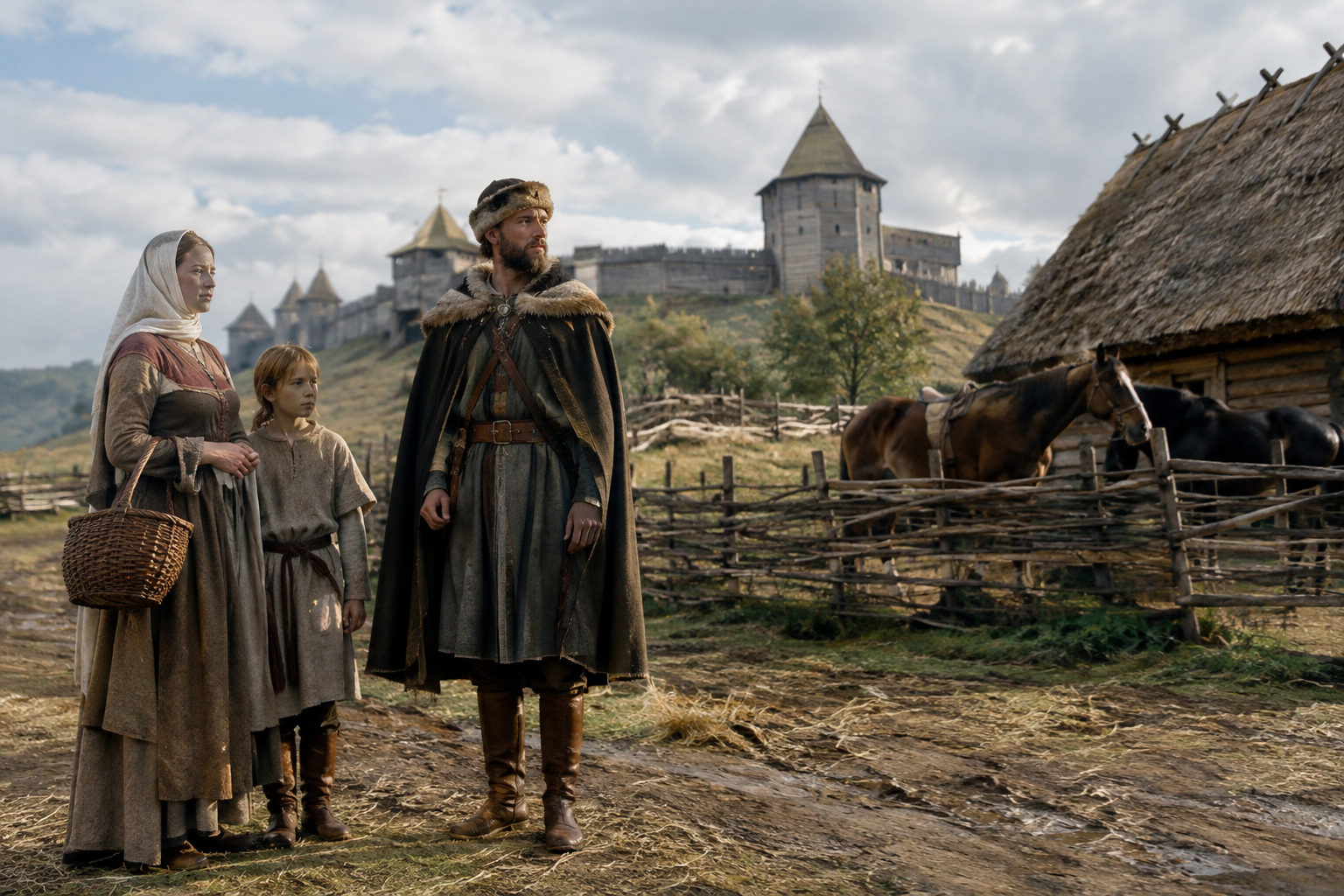
At Korolivka in western Ukraine, one medieval man has become a surprisingly useful guide to a very old paternal line. The individual identified as KRW005, dated to around AD 1250 and associated with the Principality of Halych-Volhynia, carries the Y-DNA haplogroup G2a2b2a1a1a2a. That may look like an intimidating string of letters and numbers, but in practice it gives us something rather concrete: a direct paternal line turning up in a documented medieval polity on the eastern edge of Latin Christendom and the wider Slavic world.
That matters because haplogroup G is one of the great old lineages of western Eurasia, often discussed in connection with early farmers and the Neolithic spread into Europe. But G2a2b2a1a1a2a is not "all of G," and it should not be treated as a shorthand for a whole people or language. Y-DNA traces one narrow father-to-son line, not a person's complete ancestry. What KRW005 offers, then, is not a grand ethnic label, but a sharp little piece of historical evidence: this paternal branch was present in a medieval frontier principality with deep links to the Carpathians, the forest-steppe, and the political world of Rus'.
The Principality of Halych-Volhynia was no backwater. In the 12th and 13th centuries it sat in a zone of movement and negotiation between Central Europe, the Rus' lands, the steppe, and the Black Sea sphere. A man buried at Korolivka around AD 1250 belonged to a society shaped by princely politics, trade routes, warfare, ecclesiastical ties, and the aftershocks of Mongol expansion.
That is precisely why KRW005 is so interesting. A paternal lineage like G2a2b2a1a1a2a in this context does not demand a dramatic migration tale all by itself. Instead, it shows that medieval populations in western Ukraine could include lineages with much deeper roots in the wider European and Near Eastern past, preserved through centuries of demographic change. In regions like this, political borders shifted often, but families endured locally, intermarried, moved short distances, and occasionally arrived from farther afield.
An ancient DNA study connected with these remains is linked through the research project archive at https://www.ebi.ac.uk/ena/browser/view/PRJEB81250. Even when a project link is more useful as a research trail than as a narrative in itself, it anchors the sample in a real scientific context rather than legend or genealogy-by-wishful-thinking.
Paleogenetics of Princess Maria
Anyone with G2a2b2a1a1a2a is sitting inside a lineage with formidable time depth. The wider haplogroup G, especially branches of G2a, is famously associated with many of Europe's early farming populations. Across the Neolithic, G2a lineages appeared repeatedly from Anatolia into the Balkans and onward into much of Europe. That does not mean every later G2a branch can be mapped neatly onto one uninterrupted migration route. Still, it does mean that this is a lineage with an unusually long archaeological shadow.
By the medieval period, however, Europe was no longer a Neolithic world, nor even a Roman one. Paternal lines had been thinned, reshuffled, and regionally transformed by Bronze Age expansions, Iron Age population mixtures, imperial systems, epidemics, and local marriage patterns. So when a branch like G2a2b2a1a1a2a appears in AD 1250 Ukraine, the sensible historical question is not, "Which famous tribe does this prove?" It is, "How did an old paternal line survive into a later, highly mixed society?"
Part of the answer is simple human continuity. Many paternal lines persist quietly for millennia without becoming numerous or politically conspicuous. They may endure in villages, market towns, monasteries, military communities, or noble households; archaeology rarely lets us distinguish among these with certainty unless the context is exceptionally rich. KRW005 is valuable precisely because he shows one such line alive in a documented medieval landscape rather than only in prehistory.
It is tempting to imagine medieval principalities as tidy ethnic containers. Archaeology is usually much less obliging. Halych-Volhynia occupied a contact zone between the Carpathian basin, Polish lands, other Rus' territories, and the steppe-facing south. Merchants, clerics, soldiers, craftspeople, and marriage partners all moved through this world. A Y-chromosome lineage found here may reflect local continuity, older regional diversity, or movement across neighboring regions that left little mark in written sources.
That wider setting makes western Ukraine especially important for DNA history. It is one of those places where population history cannot be reduced to a single event. The area absorbed influences from early farming expansions, later Indo-European-speaking populations, medieval Slavic polities, and steppe-connected political upheavals. A lineage such as G2a2b2a1a1a2a therefore sits at an intersection of very long-term and very local history.
This is also why one sample should not be overworked. KRW005 does not stand for all men of Halych-Volhynia, let alone all medieval Ukrainians. But one securely placed sample can still be revealing. It tells us that the paternal makeup of the region was not a simple matter of a few dominant later lineages. Older branches remained part of the living population.
When readers encounter a G2a branch, they often think first of Europe's first farmers, and with good reason. Recent work on ancient populations has repeatedly shown how important those Neolithic communities were in shaping the continent's early genetic landscape. For the broader background to that deep ancestry, MyTrueAncestry's discussion of the Mesolithic-Neolithic transition is a useful reminder that farming spread through complicated regional encounters rather than a single uniform wave.
Yet the real fascination here is not merely that G2a is old. It is that a descendant branch could still be turning up in a medieval polity centuries after the rise of Kievan Rus', the Christianization of the region, and the great political shocks of the 13th century. Continuity in Y-DNA does not mean social continuity in any simple sense. The men carrying such lineages may have spoken different languages over time, belonged to different political formations, and lived under very different religious systems. The chromosome stayed on; almost everything else could change.
Mesolithic-Neolithic Transition
That is one of the great lessons of archaeogenetics. Lineages are durable, but identities are historical. A man in medieval Korolivka with G2a2b2a1a1a2a was not a "Neolithic farmer walking about in armor," nor a fossil from the distant past. He was a medieval individual of his own time, in a Christian principality, in a region of forts, courts, settlements, and contested frontiers.
With some haplogroups, MyTrueAncestry can point to broad clusters of ancient cases across many centuries. Here the evidence is more focused. That might seem limiting, but there is value in precision. KRW005 gives this branch a firm medieval anchor in a place that matters historically, rather than leaving it floating as an abstract position on a phylogenetic tree.
For family historians, that is often the most useful kind of evidence. Not because it proves descent from a prince, a tribe, or a named dynasty, but because it shows the branch embedded in a real human setting: western Ukraine, around AD 1250, in the orbit of Halych-Volhynia. If your paternal line falls within G2a2b2a1a1a2a, that does not narrow your story to one medieval grave. It does, however, place your direct male line within an ancient branch that remained present in eastern Europe's medieval borderlands long after the first great population transformations of prehistoric Europe.
Ancient DNA and Archaeogenetics
The most distinctive thing about G2a2b2a1a1a2a, as the current evidence stands, is not royal glamour or numerical dominance. It is endurance. In KRW005 from Korolivka, we can see a direct paternal line with very old roots still present in a 13th-century principality shaped by Slavic politics, Central European connections, and steppe-era disruption. For anyone researching this haplogroup, that is the responsible takeaway: your Y-DNA points to one durable male line that survived immense historical change and remained part of the medieval population mosaic of eastern Europe.

Comments