Haplogroup G2a2b2a1a1a1a1a
– 5 min read


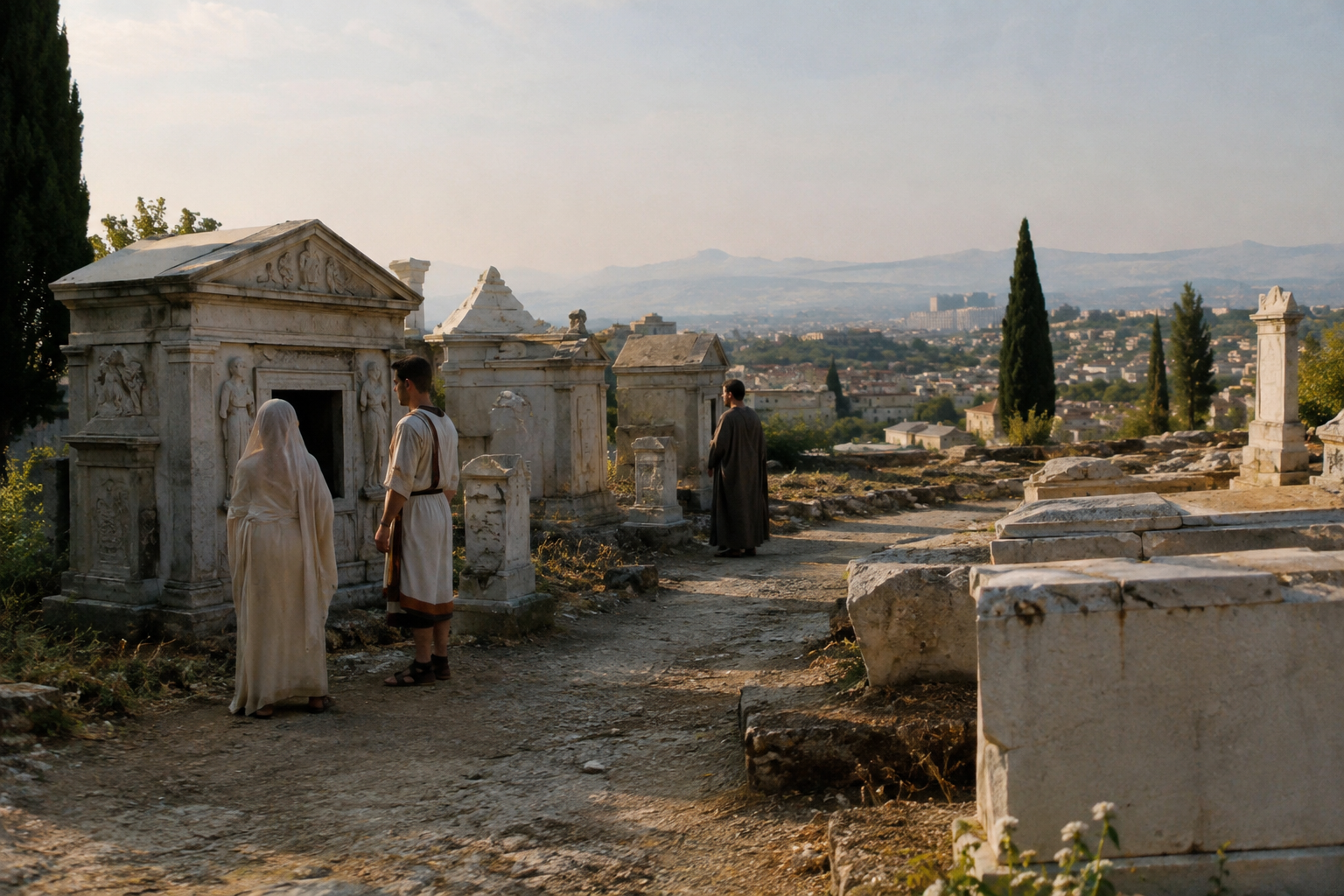
In the Roman world of around AD 200, a man buried in a Hellenic Roman necropolis and identified today as R1545 carried the Y-DNA haplogroup G2a2b2a1a1a1a1a. That is a forbiddingly technical label, but the setting is wonderfully human: a cemetery in the Greek-speaking eastern Mediterranean under Roman rule, where local traditions and imperial structures had long since become entangled.
What makes this sample interesting is not that one burial can stand for an entire population; it cannot. It is that this paternal line appears in a place where history itself was layered. By the second century AD, "Greek" and "Roman" were not neat opposites. They were political, cultural, and family realities lived at once. A direct paternal lineage like G2a2b2a1a1a1a1a follows only one ancestral thread, but even that single thread can show how old Mediterranean lines persisted inside the Roman imperial world.
Haplogroup G is one of the old and well-known Y-chromosome lineages of western Eurasia, especially important in discussions of early farming populations and later Mediterranean history. The branch in this article, G2a2b2a1a1a1a1a, is much narrower. That matters. A very specific subclade should not automatically inherit every grand claim ever made about haplogroup G as a whole.
So the safest thing to say is also the most useful: sample R1545 places this paternal branch in a Hellenic Roman funerary context around AD 200. It shows that the lineage was present within the mixed social world of the Roman east. It does not by itself prove ethnicity, language, citizenship status, or descent from any named ancient people. Y-DNA traces one direct male line, not the total ancestry of the person who carried it.
For readers interested in how Roman-period genetics can leave a long afterlife in later populations, this companion article is particularly relevant.
The phrase "Hellenic Roman necropolis" deserves a moment's attention. It signals a burial ground belonging to a society that was both local and imperial. By AD 200, the eastern Mediterranean was full of cities where Greek language, civic habits, cult practice, and family memory continued under Roman administration. Cemeteries from such places are often where ancient DNA becomes especially valuable, because inscriptions and architecture may tell us about public identity, while genomes hint at biological relationships and wider population history.
R1545 belongs to that kind of evidence. Even when details of grave furnishing or kinship are not available, the basic context matters. This was not a prehistoric cave burial or an isolated mountain tomb. It was a burial in a settled, urbanized, literate world connected by shipping lanes, military service, trade, slavery, marriage, and pilgrimage. A paternal lineage found here sits within that dense web of movement.
That is one reason Roman-period genomes are so fascinating. They do not simply map "locals" versus "outsiders." They often reveal populations already shaped by centuries of interaction. In the Greek east, that interaction long predated Rome and then accelerated under the empire.
There is a larger historical backdrop to this. Haplogroup G, especially branches within G2, is famous in archaeogenetics because it appears in many early European and Anatolian farming contexts. That does not mean every later G lineage can be read as a straightforward fossil of the Neolithic. Populations change, split, move, and recombine across millennia. Still, when a branch of G turns up in a Roman-era eastern Mediterranean burial, it raises a sensible historical question: are we seeing part of the long survival of lineages deeply rooted in the farming worlds of the Aegean and nearby regions?
The answer, at present, has to be cautious. One sample cannot settle it. But the possibility is historically plausible. The eastern Mediterranean was not a blank slate written on by Rome. It was a region with very old demographic foundations, overlaid by later migrations and imperial mobility. A line such as G2a2b2a1a1a1a1a fits comfortably in that sort of landscape: old in the broad sense, but still very much alive in a later, urban imperial society.
A major ancient DNA study of Roman-era population change, published in Science, helped make precisely this kind of question central to the field: not who was "purely" one thing or another, but how mobility and continuity coexisted across the Roman world.
Continuity is one of those words historians must handle with care. It can mean continuity of place, continuity of custom, continuity of ancestry, or continuity of political institutions, and these are not the same thing. R1545 gives us evidence for continuity of a paternal line in a Hellenic Roman setting, but only at one point in time. Even so, that is valuable, because Roman cemeteries often show that old regional ancestry did not vanish under imperial rule.
In fact, one of the more striking lessons of archaeogenetics is that empire rarely erases the past cleanly. Instead, it rearranges it. Some communities absorb newcomers. Some preserve local family lines for centuries. Most do both at once. The result is not a tidy ethnic diagram but a crowded human history in which lineages survive by being part of changing societies, not by standing apart from them.
This is particularly relevant in the Greek world, where identities had already been developing for many centuries before Rome arrived. A man like R1545 may have lived in a community that thought of itself through city, language, law, religion, region, family, and empire all at once. His Y-chromosome cannot tell us which of those identities he emphasized, but it does remind us that beneath the public labels were long-running family histories.
Readers who want a broader look at ancient DNA in Greek contexts may enjoy this piece on another Greek historical setting.
When people hear "Roman Empire," they often picture movement first: soldiers transferred across provinces, merchants in harbors, enslaved people uprooted from one shore to another, officials sent where the state required them. All of that is true. But mobility is only half the story. Empires also depend on stable households, inherited property, neighborhood cemeteries, and local marriage networks.
That balance between movement and rootedness is probably the best way to think about a lineage like G2a2b2a1a1a1a1a in a Hellenic Roman necropolis. It need not represent some dramatic long-distance migrant at the moment of burial. It may just as easily belong to a family line that had been established in the region for generations, even as the people around it participated in the wider Roman Mediterranean. The interesting point is not exoticism. It is persistence within connectivity.
There is a useful parallel here with other studies of Mediterranean communities in which genetics reveals mixed backgrounds without dissolving local identity. Sicily, for example, repeatedly shows how deep regional continuity and outside connections can coexist in the same historical landscape.
For a present-day tester belonging to G2a2b2a1a1a1a1a, the most responsible takeaway is not a fantasy of instant identification with one ancient nation. It is something subtler and, in truth, more interesting. The known ancient evidence places this paternal branch in a Roman-period Greek-speaking burial context, suggesting that at least one line within the haplogroup was part of the long-lived populations of the eastern Mediterranean under empire.
That does not pin your paternal ancestors to one city or one ethnicity. But it does place your lineage in a world where local Mediterranean roots and imperial-era mobility met each other every day. R1545 is a small piece of evidence, yet a vivid one: a man from around AD 200, buried in a Hellenic Roman necropolis, carrying a paternal line that still survives to be tested now.
If you want to explore another study of population continuity and change in the Greek-speaking south of Italy, this related article is well worth a look.
Comments