Haplogroup G2a1a1a1a1b

– 5 min read


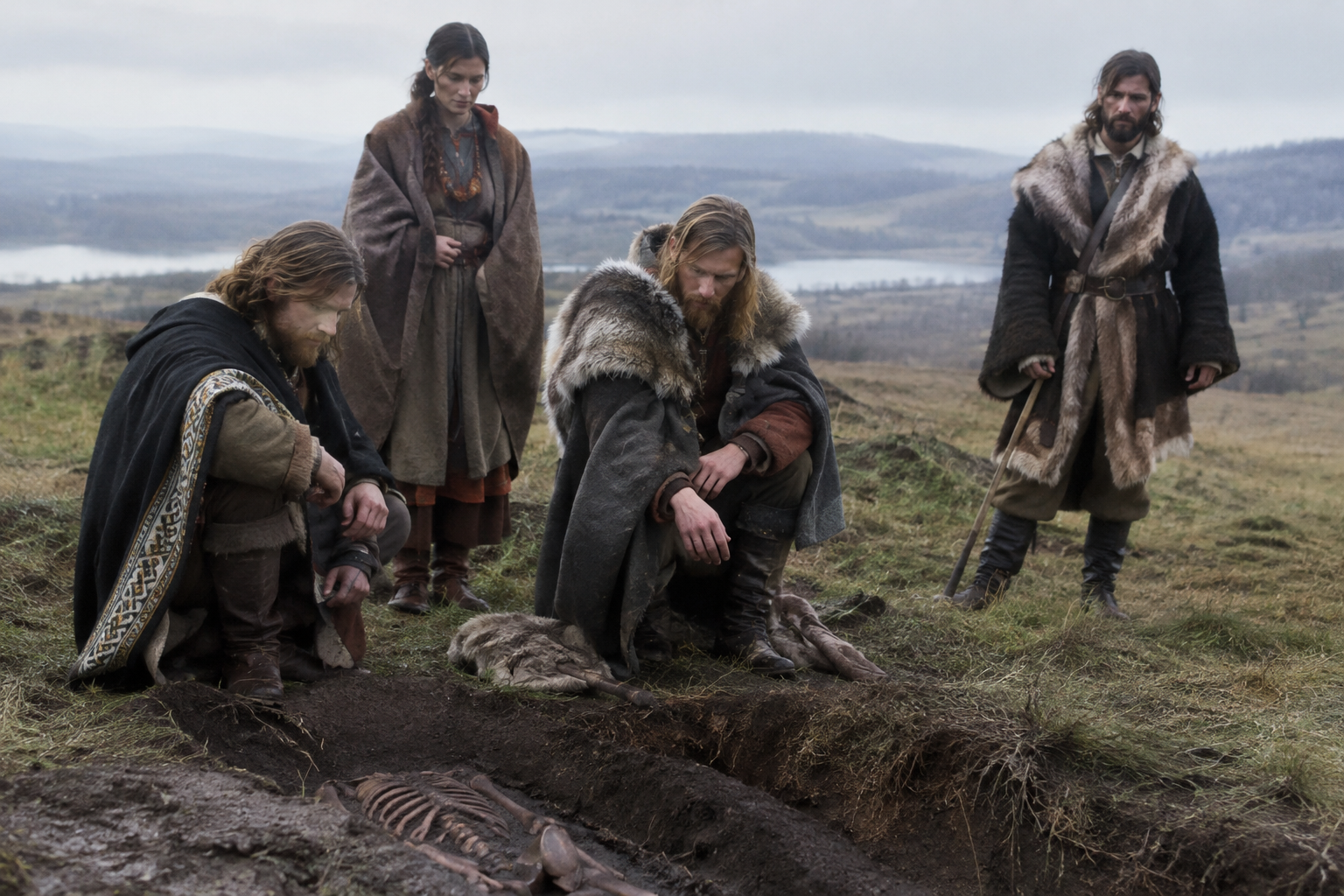
At Marvele in Lithuania, an outlier burial dated to around AD 216 stands out for a reason that is easy to miss if you look only at artefacts or chronology. The individual identified as CGG017685, from the Iron Age flat-burial cemetery at Marvele, has been associated with the Y-DNA haplogroup G2a1a1a1a1b - a notably uncommon paternal line in this northern setting.
That matters because Y-DNA traces one direct paternal line only: father to son to son, across many generations. It does not define a person's whole ancestry, language, or identity. But when the same narrow branch appears again in the North Caucasus a couple of centuries later, it gives us something historically interesting to examine: not a tidy ethnic label, but a line of men moving through, or surviving within, the complicated world between the Baltic and the Caucasus in Late Antiquity.
The Marvele cemetery belongs to a broad Iron Age world in which eastern Baltic communities were tied into trade, exchange, and movement far beyond what older nationalist maps liked to imagine. A burial dated to roughly the early third century AD is already sitting in a period of contact - Roman imports circulating north, regional social change, and shifting local communities. Within that setting, CGG017685 is interesting not because one burial can explain Lithuania, but because this paternal lineage is not what most readers would instinctively expect in an eastern Baltic cemetery.
The label "outlier" is important too. In ancient DNA work it usually signals that an individual does not fit neatly into the main genetic pattern of the burial group or local comparison set. That does not by itself prove recent migration, still less a dramatic life story. But it does tell us that this man's ancestry, or at least his paternal line, deserves to be placed in a wider map than the cemetery fence.
A recent ancient DNA study examining populations across this broader region is relevant here because it reflects the sort of evidence that keeps overturning the old picture of neatly bounded ancient peoples. Iron Age and Migration Period communities were often more mixed, mobile, and locally variable than the labels in textbooks suggest.
The strongest pattern in this small set of evidence comes from Zaragizh in the North Caucasus, where two men dated to around AD 425 are linked to the same haplogroup branch: CGG022002, described as an Alan Migration Period individual from Russia, and CGG021996, another Migration Period individual from Zaragizh in the North Caucasus.
Now, one has to be careful here. "Alan" is a historical and archaeological label tied to the Iranian-speaking nomadic and semi-nomadic groups known from Late Antique sources and from steppe and Caucasus archaeology. A Y-chromosome lineage is not the same thing as Alan identity. But the fact that this branch appears twice at Zaragizh suggests that G2a1a1a1a1b was not just a one-off stray in the region. It had some real presence there in the fifth-century North Caucasus.
This is where the history becomes more compelling. By the fifth century AD, the North Caucasus was a contact zone under pressure and opportunity alike: Alans, late Sarmatian-descended groups, local Caucasus populations, and the wider aftershocks of Hunnic-era movement all intersected there. A paternal line found in that world and also seen earlier in Lithuania hints at the sort of long-distance connections that the archaeology of the period increasingly reveals - connections made by alliance, mobility, intermarriage, raiding, resettlement, or service in larger confederations.
At a broad level, haplogroup G is an old West Eurasian paternal lineage with a deep prehistoric history. Some branches of G are famous in early farming contexts, especially in Neolithic Europe and the Caucasus. But that wider background must not be lazily pasted onto G2a1a1a1a1b as if a narrow late branch automatically carries the whole story of the parent haplogroup with it.
What we can say more responsibly is narrower and more interesting. This particular branch appears here in a small but suggestive arc: one Iron Age case in Lithuania, then two Migration Period cases in the North Caucasus. That distribution does not mean the lineage "came from" one place with certainty. Nor does it prove a single migration route. But it does place the branch in human landscapes where frontiers were porous and paternal lines could travel surprisingly far without needing mass migration behind every appearance.
The deeper lesson is methodological. Ancient Y-DNA is often most useful not when it confirms a grand origin myth, but when it interrupts one. A lineage that looks geographically unexpected can mark a marriage network, a mercenary career, the absorption of outsiders, or simply the survival of an older local thread that later became rare.
The chronological gap between Marvele around AD 216 and Zaragizh around AD 425 is not huge in ancient terms - roughly two centuries. Yet it sits across a historically turbulent stretch of time. Northern and eastern Europe were not sealed worlds. Goods, styles, people, and probably small groups of warriors or dependants moved across river routes, forest-steppe corridors, and frontier zones linking the Baltic, Pontic, and Caucasus regions.
That does not mean the man at Marvele was an Alan, or that the men at Zaragizh had any direct genealogical tie to him. It means that G2a1a1a1a1b appears in exactly the sort of regions where ancient DNA keeps showing that identities were historically real but biologically untidy. Communities could speak one language, bury their dead according to local custom, and still carry paternal lines with deeper or more distant histories.
This matters particularly for the Migration Period, a phrase that can sound as though whole "peoples" marched around Europe in single-file genetic blocks. They did not. The fifth century was full of mixed groups, layered loyalties, and recruited followers. The North Caucasus especially was a zone where steppe and mountain worlds met, and where older lineages could persist inside changing political formations.
Three ancient individuals are not enough to map the full history of a haplogroup. But they are enough to show why this branch deserves attention. CGG017685 from Marvele suggests that the lineage had reached, or persisted in, an eastern Baltic setting by the early third century AD. CGG022002 and CGG021996 at Zaragizh show it again in a fifth-century North Caucasus context linked with Alan-era mobility.
In other words, the value of this evidence lies less in certainty than in pattern. G2a1a1a1a1b is not appearing here in one isolated grave and vanishing. Even in this modest dataset, it surfaces in historically connected but culturally distinct regions. That makes it a good example of how paternal lineages can slip across the tidy boundaries imposed by later maps.
For readers exploring their own paternal ancestry, this haplogroup currently points less to a single famous dynasty than to a frontier world of movement and mixture. The best-supported insight is that G2a1a1a1a1b was present in both an Iron Age Baltic burial and Migration Period North Caucasus burials, suggesting a lineage with roots in the wider eastern European-Caucasus contact zone rather than a neatly local story.


Comments