Haplogroup G1a1a1a1a

– 5 min read



One of the clearest ancient signposts for Y-DNA haplogroup G1a1a1a1a in this set of evidence comes from Iron Age Ljubljana, in present-day Slovenia, where sample I5692x is dated to around 600 BC. A related record, I5692, is described more broadly as Illyrian Slovenia and dated to around 300 BC. That is already enough to make the case interesting: this is not a lineage appearing in an obvious eastern steppe burial or a famous imperial tomb, but in the western Balkans, in a region where archaeology often reveals local continuity mixed with long-distance contacts.
That matters because haplogroup G is a large and old Y-chromosome family, while G1a1a1a1a is a much narrower paternal branch within it. Y-DNA follows one direct male line only, so it does not define a whole people or an individual's entire ancestry. But when a specific branch turns up in excavated Iron Age burials from Slovenia, it gives us something concrete: a paternal thread tied to real communities living between Alpine, Adriatic, and Balkan worlds.
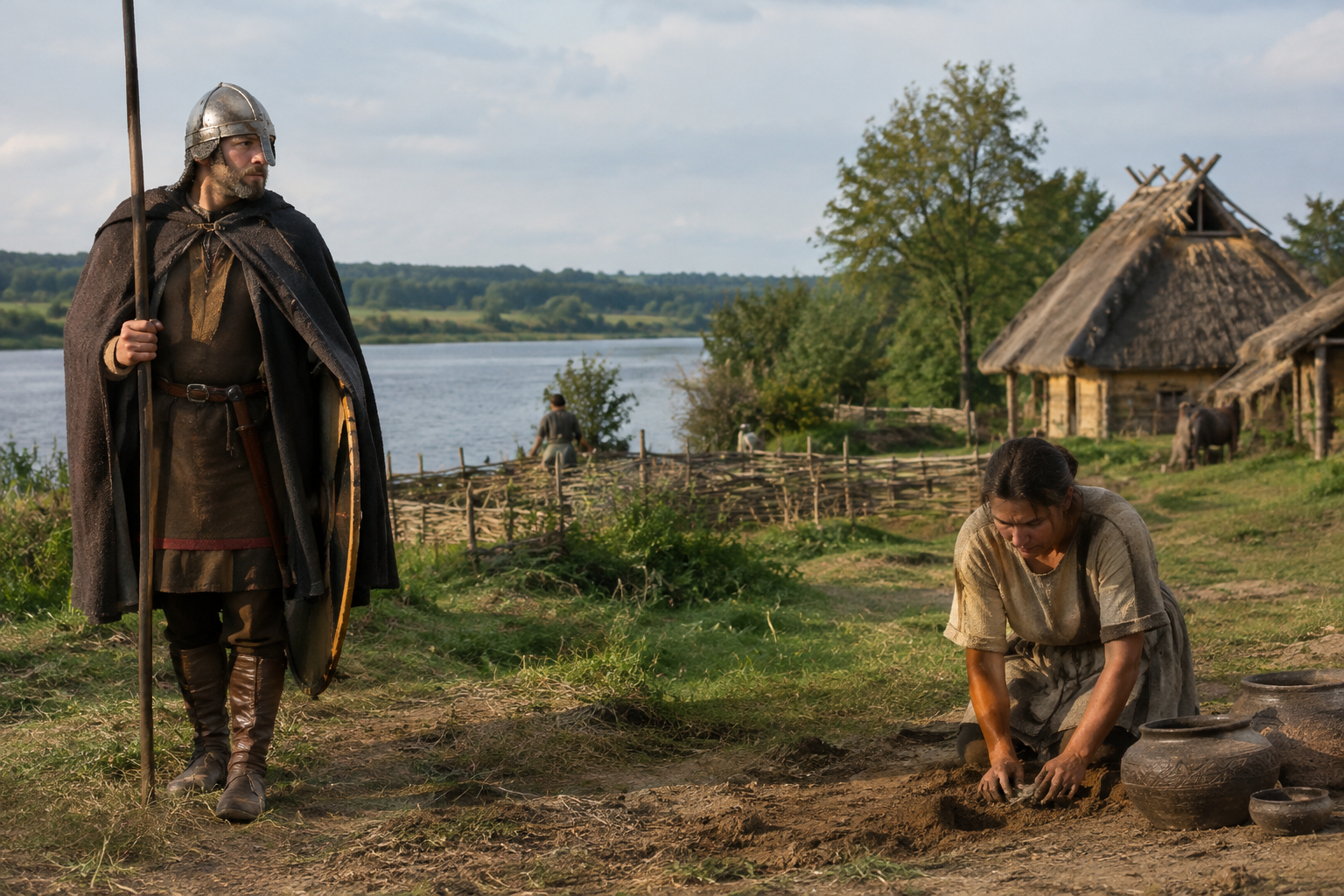
Ljubljana in the Iron Age was not a backwater. The wider region sat in a corridor linking the eastern Alps, the northern Adriatic, the Danube basin, and the western Balkans. Communities here were shaped by exchange as much as by local tradition, and that makes any ancient Y-lineage from the area especially worth noticing.
Sample I5692x, dated to around 600 BC, places this branch in the earlier Iron Age horizon of the region. The later sample I5692, dated to around 300 BC and labeled Illyrian Slovenia, suggests that the same paternal signal may have persisted locally across several centuries. We should be cautious: two samples do not prove an unbroken dynasty, a tribe-wide marker, or a single family line ruling the district. What they do suggest is that this branch was present in the male population of Iron Age Slovenia across a substantial stretch of time.
That small continuity is often the most revealing sort. Ancient DNA does not always hand us grand migrations with banners attached. Sometimes it shows the quieter truth that a lineage could remain embedded in one regional population while political labels, trade networks, and material culture changed around it.
The description attached to I5692 uses the term Illyrian. That is useful, but it needs handling with care. In archaeology and ancient history, such labels may refer to a cultural or regional context rather than a neat biological category. The western Balkans in the first millennium BC were home to communities that classical authors later grouped under broad names, but the people buried in one cemetery were not automatically a genetically uniform population.
So the value of I5692 lies less in proving "the Illyrian haplogroup" - which would be far too crude - and more in anchoring G1a1a1a1a in a documented Balkan Iron Age context. That gives the lineage historical texture. It places it in a world of hillforts, exchange routes, local elites, and shifting identities, not in an abstract phylogenetic tree floating free of geography.
This is particularly important in the Balkans, where older narratives often tried to match genes directly to ancient ethnonyms. Ancient DNA has made that habit much harder to defend. The better question is not "Which tribe was this haplogroup?" but "In which communities, at which times, and under what archaeological circumstances do we actually find it?"
Haplogroup G1a1a1a1a is not one of the best-known paternal lines in European ancient DNA discussions. That is part of why these Slovenian finds stand out. They hint that some paternal branches now thought of as unusual in Europe could once be present, if lightly represented, in communities far from where modern distributions might lead us to expect.
Slovenia is exactly the sort of place where such evidence matters. It sits at the meeting point of cultural zones rather than neatly inside one of them. A paternal lineage found there in the Iron Age could reflect older Balkan inheritance, movement through Alpine corridors, links toward the Pannonian basin, or a much deeper history still obscured by the patchiness of ancient sampling. With only the present evidence, it would be reckless to choose one route and declare victory.
What we can say is that the branch was present in an Iron Age population that lived within reach of several major spheres of interaction. That makes G1a1a1a1a in this context a reminder that the ancient Balkans were not genetically simple. They were layered, local, and connected all at once.
The chronological spacing between I5692x and I5692 is one of the most useful features of this evidence. Around 600 BC, the region belonged to the early Iron Age world that followed the upheavals of the Late Bronze Age. By around 300 BC, the political and cultural setting had changed considerably, with new influences circulating across the Balkans and the northern Adriatic.
Yet the appearance of the same reported haplogroup branch in both contexts suggests that at least one paternal line endured through those changes. This does not mean the population was static. Archaeology across Iron Age Europe repeatedly shows mobility, exchange, marriage connections, and status competition. But it does show that continuity and change can coexist. A community may adopt new material styles or enter new political networks without replacing every local paternal line.
That broader point is increasingly familiar from ancient DNA work across Europe. Historical transformation often looks dramatic in texts and artifacts; genetically, it can be a more uneven story, with some lineages disappearing, others arriving, and still others persisting quietly through centuries of upheaval.
These Slovenian samples are best read against the wider expansion of ancient DNA research in southeastern and central Europe. The key point is not that one study has solved the entire history of this branch, but that ancient genomes are steadily giving us named individuals, approximate dates, and real archaeological settings in which rare paternal lineages can be observed rather than guessed at. One research gateway associated with these sample records is available here: https://dataverse.harvard.edu/dataset.xhtml?persistentId=doi:10.7910/DVN/7RVV9N.
That kind of evidence is especially valuable for a branch like G1a1a1a1a. Modern distributions alone can be misleading, because drift, founder effects, later migrations, and sheer bad luck can all thin out a lineage in one place and preserve it in another. Ancient DNA cuts through some of that fog by showing where a branch actually was, at least at particular moments in time.
For someone researching a present-day paternal line, the strongest supported insight here is modest but meaningful. G1a1a1a1a is attested in Iron Age Slovenia, including sample I5692x around 600 BC and the later I5692 around 300 BC, in a western Balkan setting shaped by both local continuity and wider connections. That does not turn every modern carrier into an "Illyrian" in any simple sense, but it does place this branch within the lived history of ancient Balkan communities before Roman rule.
In other words, this is a lineage with a documented foothold in one of Europe's great contact zones. Its value lies not in grandiose claims, but in the fact that it can already be seen in real Iron Age people, in a real landscape, centuries apart.
Comments