Haplogroup HIJK

– 5 min read


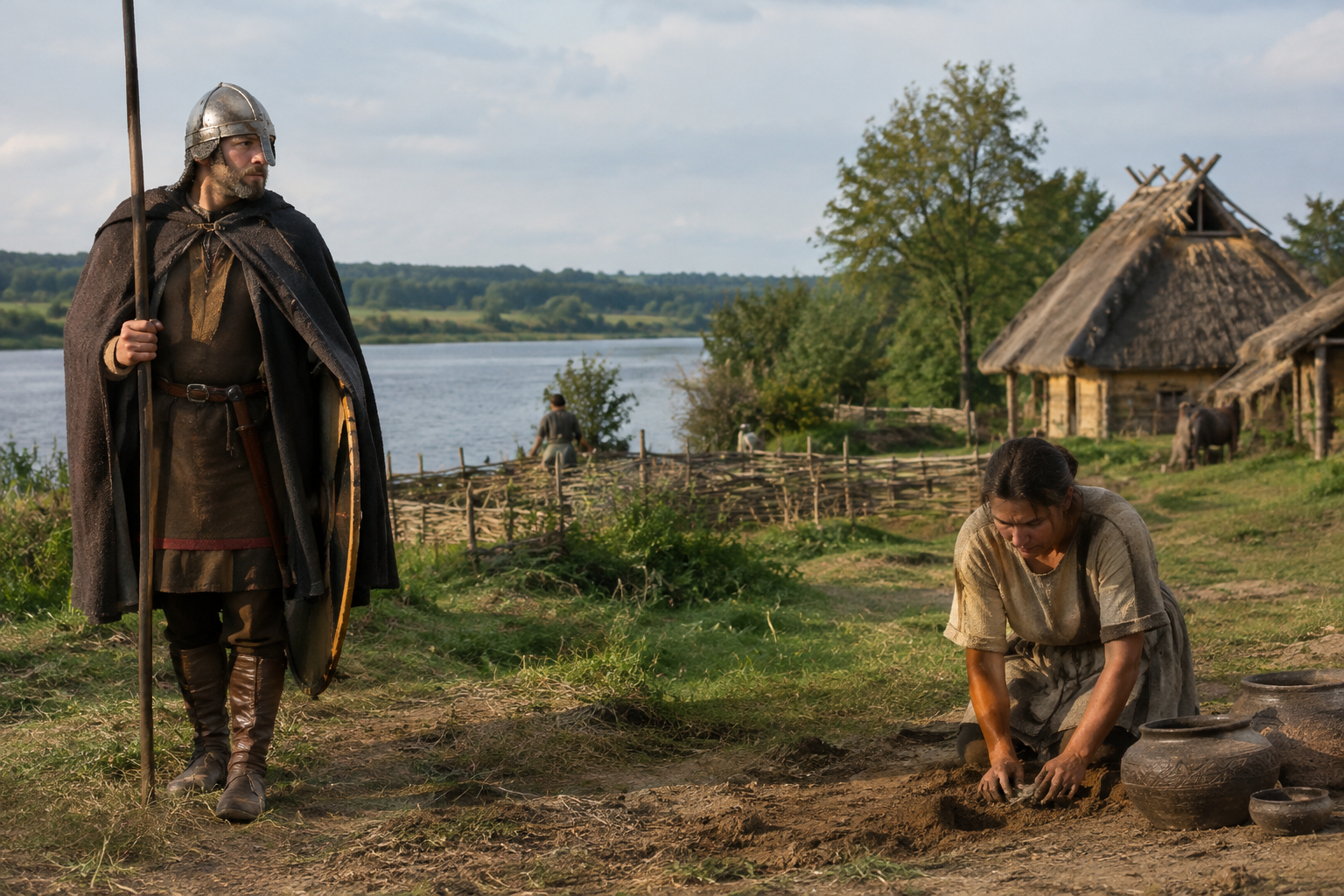
One of the stranger places to begin the story of Y-DNA haplogroup HIJK is not in deep prehistory at all, but in a medieval burial from Western Pomerania. An individual labeled DZ22, dated to around AD 1300 at Dzwonowo, belongs to a world of frontier settlements, Christian cemeteries, and the shifting social landscape of the southern Baltic. On its own, that grave does not tell us where the lineage began. What it does show is something more useful: a very old paternal branch still turning up, quietly, in the lived populations of medieval Europe.
That matters because HIJK is not a neat, recent family signature. It is one of the great upper branches in the Y-chromosome tree, ancestral to several major paternal lineages found across Eurasia and beyond. In practical terms, Y-DNA tracks one direct male line only, not a person's whole ancestry. But with a branch as old and foundational as HIJK, even a small number of ancient detections can illuminate how broad human history and local archaeology intersect.
The Dzwonowo individual sits in a region where identities were never simple. Western Pomerania in the High Middle Ages was a contact zone: Slavic-speaking communities, German eastward settlement, ecclesiastical institutions, and Baltic-facing trade networks all overlapped there. A paternal assignment at the level of HIJK is broad, but the archaeological setting is still valuable because it anchors the lineage in a real historical community rather than an abstract migration map.
There is also a cautionary point here. Medieval burial grounds in Poland and neighboring regions are often drawn into arguments about ethnicity, deviance, or social status too quickly. A broader archaeological discussion of unusual burials in the region can be found in research on atypical burials in early medieval Poland, but a single Y-chromosome assignment does not magically convert one grave into proof of a tribe, dynasty, or migrant colony. What it does offer is one paternal thread inside a complicated population history.
Seen this way, DZ22 is useful precisely because he is so ordinary in historical terms. He reminds us that very ancient Y-chromosome branches did not vanish once more derived lineages became common. They remained embedded in later populations, carried by men whose lives were shaped less by grand migrations than by parish, field, market, and lordship.
The other ancient sample is far older and archaeologically more dramatic. I10449, from Tantareni in Moldova, is dated to about 1950 BC and associated with the Corded Ware Culture. Now we are in the Bronze Age borderlands of eastern Europe, in a landscape tied to pastoral mobility, new social forms, and the long aftermath of steppe expansions that transformed much of the continent.
This is where HIJK becomes especially interesting. In ancient DNA work, broad Y-chromosome labels sometimes appear because the DNA is too limited for a finer assignment, or because reporting standards differ between datasets. So one must be careful: a sample reported under HIJK is not automatically evidence for every later descendant branch. Still, placing a HIJK-associated male inside the Corded Ware horizon tells us that this deep paternal ancestry was present within one of the most discussed archaeological formations of Bronze Age Europe.
A major ancient DNA study of Eurasian population history, published in Science, has helped sharpen the broader genetic picture around such Bronze Age populations. The significance is not that one lineage explains the whole Corded Ware phenomenon; it plainly does not. The significance is that even within cultures often discussed in sweeping genetic terms, the paternal record can preserve unexpected depth and variety.
Corded Ware and Battle Axe DNA
With a haplogroup like HIJK, the temptation is to tell an enormous story too fast. HIJK is an early macro-branch in the paternal tree, upstream of several lineages that later spread widely across Eurasia. That does not mean every man assigned to HIJK in an ancient dataset belonged to the same recent population, spoke the same language, or shared the same historical identity.
In fact, the two samples here are useful because they resist exactly that kind of simplification. One comes from a Bronze Age Corded Ware setting in Moldova; the other from a medieval cemetery in Pomerania. Between them lies more than three millennia of demographic change: the rise and fall of Bronze Age networks, Iron Age reorganization, Roman-era transformations, the migration period, Slavic expansions, Christianization, and medieval colonization.
So HIJK in this context is best understood as a very old paternal umbrella, glimpsed at two different moments rather than traced as an unbroken local dynasty. The value of that perspective is almost archaeological in itself. It forces us to think in layers, not labels.
The contrast between Tantareni and Dzwonowo is the heart of the article. The Moldovan sample belongs to a prehistoric cultural horizon often associated with mobility and far-reaching interaction. The Pomeranian sample belongs to a later world of villages, churchyards, and increasingly documented local societies. Same broad paternal umbrella; utterly different historical settings.
That contrast says something important about ancient DNA interpretation. Y-chromosome survival is not a story of straight lines marching across maps. A lineage can pass through repeated episodes of expansion, contraction, absorption, and regional reshuffling. Sometimes it appears in archaeologically conspicuous horizons such as Corded Ware; sometimes it surfaces in later, far more ordinary burials that would never be famous without genetics.
For readers interested in how steppe-facing and Black Sea regions repeatedly reworked population history, there is useful context in MyTrueAncestry's piece on the wider zone of interaction around the Pontic world.
And for those thinking specifically about the long Bronze Age background, the Moldovan case belongs to a bigger pattern in which archaeology and genomics must be read together. Cultural names are not chromosomes. Yet when the two line up carefully, they can show how real communities participated in continent-scale changes without ever becoming genetically uniform.
It is easy to dismiss a broad haplogroup call as too vague to matter. But sparse evidence has its own use. HIJK is so deep in the Y-tree that its appearances in ancient remains highlight the limits of our current resolution as much as the spread of the lineage itself. In other words, these samples show both what we know and where the tree still needs finer archaeological anchoring.
This is particularly true in eastern and central Europe, where many later populations were built from repeated mixtures rather than single-origin replacements. A Bronze Age paternal signal in Moldova and a medieval one in Pomerania do not form a tidy migration arrow. They do, however, place HIJK within two major historical environments: one tied to prehistoric transformation, the other to the making of medieval regional societies.
North Pontic ancestry and migration
For someone researching a present-day paternal line, HIJK points not to a single people or kingdom but to a very old branch whose descendants participated in many different historical worlds. The best lesson from I10449 at Tantareni and DZ22 at Dzwonowo is that one paternal lineage can appear in radically different settings: Bronze Age communities shaped by major prehistoric change, and medieval populations living in the settled, documented landscapes of Europe. That is less glamorous than a dynastic legend, perhaps, but far more interesting historically.

Comments