Haplogroup I1a2a2a4b

– 5 min read


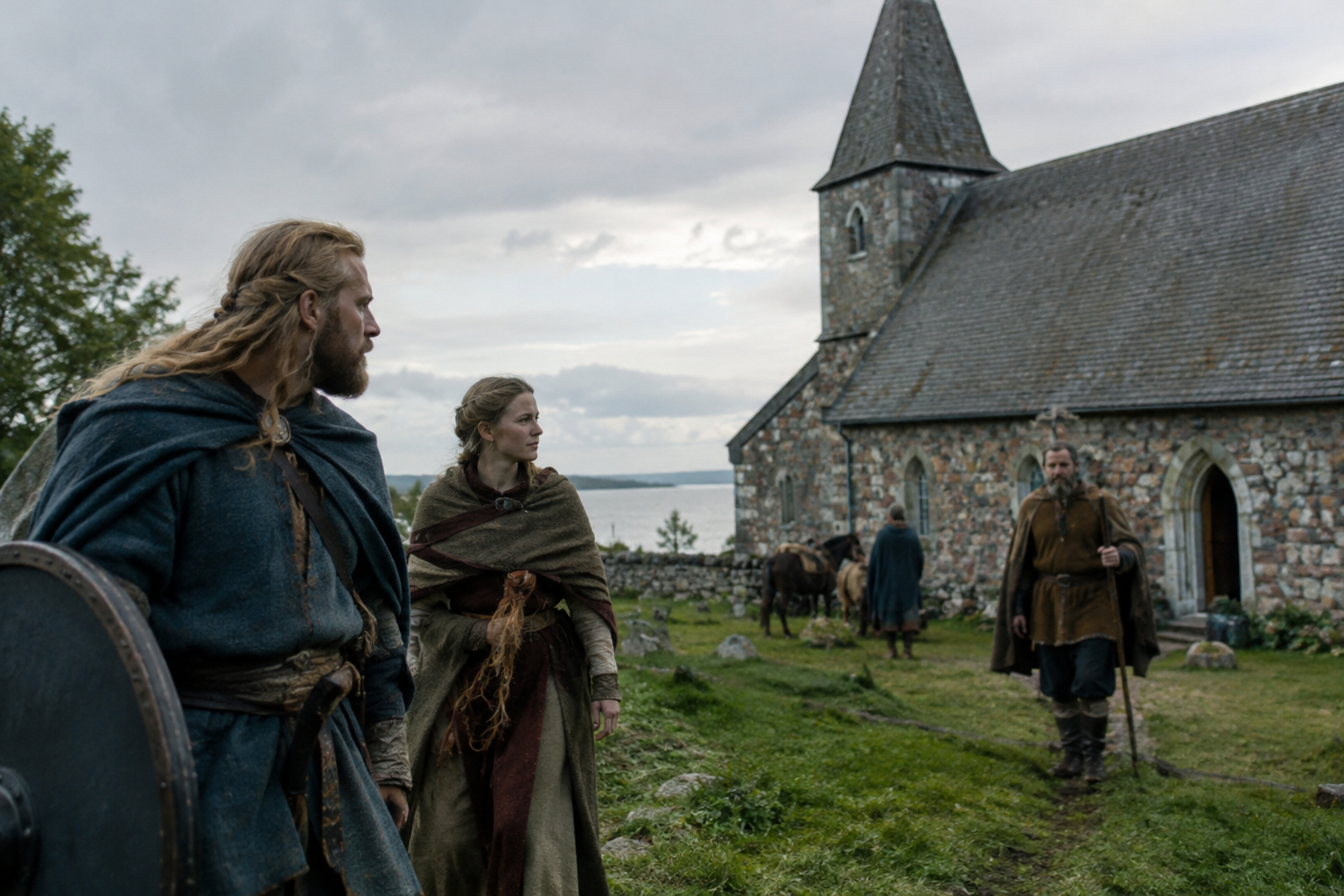
At St Martin's Church in Skanninge, in Ostergotland, archaeologists and geneticists found something rather more intimate than a grand Viking legend: a Christian burial community from around the turn of the 11th century, where family ties could be traced through DNA. One of the men from this setting, sample A017-004, dated to about 1005 AD, has been associated here with the Y-DNA haplogroup I1a2a2a4b. That makes him a useful starting point, because he stands at a historical crossroads where old Scandinavian paternal lines appear inside a new religious landscape.
This matters because Y-DNA follows one direct paternal line only: father to son to son. It is not a summary of a whole person's ancestry, still less a label for culture or identity. But in the right archaeological setting, a branch like I1a2a2a4b can still illuminate something specific: the persistence of paternal lines in southern Scandinavia during the late Iron Age and Viking Age, and their appearance in communities adapting to profound social change.
Skanninge is one of those places where the archaeology of conversion becomes visible in human terms. By the early 11th century, this part of Sweden was not an empty stage waiting for Christianity to arrive; it was already densely connected to trade, kingship, and regional power. Burials at St Martin's Church belong to that emerging Christian world, and research on these graves has shown that the cemetery can also preserve close biological relationships among the people buried there. A study of the site can be found here.
For a haplogroup article, the interest is not that A017-004 was "a Viking" in some cinematic sense, but that he belonged to a local community living through institutional and religious reordering. If the reported link to I1a2a2a4b is correct at this resolution, then this branch was present in central southern Sweden just as older burial customs were giving way to churchyard burial. In other words, the paternal line did not vanish when the social script changed.
That is worth pausing over. Archaeology often tempts us to divide periods too neatly: pagan versus Christian, Viking versus medieval. Real communities were less tidy. A Y-line like I1a2a2a4b may pass straight through those textbook boundaries, reminding us that lineages can endure while languages, beliefs, and burial customs shift around them.
The second ancient individual linked here to this haplogroup is VK71 from Tollemosegard, Denmark, dated to about 700 AD. That places him earlier than the Skanninge man, in the Late Iron Age, before the formal Christian cemetery world seen at St Martin's. Even with sparse detail, this is an important contrast. It suggests that the branch associated with I1a2a2a4b was present in southern Scandinavia across several centuries and in more than one regional setting.
Denmark around 700 AD was not merely a prelude to the Viking Age; it was already a world of expanding political complexity, maritime contact, and regional identities. A male line found there and again later in Sweden does not prove a single family migration, still less a dynasty. But it does support a modest and historically sensible point: this paternal branch belongs within the Scandinavian Iron Age and Viking Age sphere, rather than appearing as some isolated or accidental intrusion.
A broader ancient DNA study frequently used in discussions of Viking-Age population history is available at this research preprint. For the present article, the value of that wider scholarship is context rather than certainty about one grave: Scandinavian populations of this period were mobile, mixed, and regionally varied, yet some paternal lines clearly persisted across that busy landscape.
The larger haplogroup behind this branch is I1, a well-known paternal lineage with a strong historical presence in Scandinavia and northern Europe. That broader background helps make sense of why both A017-004 in Sweden and VK71 in Denmark fit a recognisably Scandinavian pattern. But one must be careful here. The article haplogroup is not simply I1 in general; it is the narrower branch I1a2a2a4b, and the history of a parent lineage should not be lazily pasted onto every descendant twig.
What can be said with confidence from the evidence given is smaller, but still interesting. This branch is represented here by two ancient males from southern Scandinavia, one in late Iron Age Denmark and one in early 11th-century Sweden. That is enough to place the lineage in a historically meaningful zone: the Scandinavian world of the centuries around the Viking Age, where local continuity and long-distance contact existed at the same time.
That combination is often the most historically revealing. People moved by sea, traded, raided, married, converted, and founded towns, yet many paternal lines remained rooted in the same broad region for generations. The story of I1a2a2a4b, on present evidence, looks less like a single dramatic migration than like durable male-line continuity within a changing North.
It is easy, from a modern map, to separate Denmark and Sweden too sharply. For the periods represented by VK71 and A017-004, the waters between them were highways, not barriers. The Kattegat and Baltic linked communities, elites, traders, and kin networks. So when the same narrow haplogroup appears on both sides of that world, it fits the archaeology rather well.
This is also why the churchyard at Skanninge is such a revealing endpoint for the article. By about 1005 AD, we are not looking at a remote frontier but at a region increasingly woven into Christian kingship and European political culture. Yet the paternal line attached here to I1a2a2a4b still sits squarely within a Scandinavian setting. The continuity is biological, while the surrounding institutions are changing fast.
That is often how ancient DNA is most useful to historians. Not as a magic ethnic label, and not as a shortcut to saga romance, but as one strand of evidence that can be laid alongside cemeteries, settlement history, and changing religious practice. Here, the strand points toward a paternal line at home in southern Scandinavia before and during the era when Viking-age societies were becoming medieval ones.
If your Y-DNA falls under I1a2a2a4b, these ancient samples do not identify your surname, your kingdom, or your nearest famous ancestor. What they do offer is something more grounded: a glimpse of your direct paternal line in documented Scandinavian contexts, from late Iron Age Denmark to an early Christian cemetery in Sweden around the end of the Viking Age. That is a small but real piece of history, and a rather good one.
For this haplogroup, the distinctive signal is continuity across transformation. The men represented by VK71 and A017-004 lived in different centuries and different social worlds, yet both belong to the same broad Scandinavian story. For anyone tracing this paternal branch, that is the most responsible conclusion: I1a2a2a4b is not just northern in the abstract, but already visible in the lived archaeology of southern Scandinavia's late Iron Age and Viking Age communities.


Comments