Haplogroup E2(xE2b)
– 5 min read


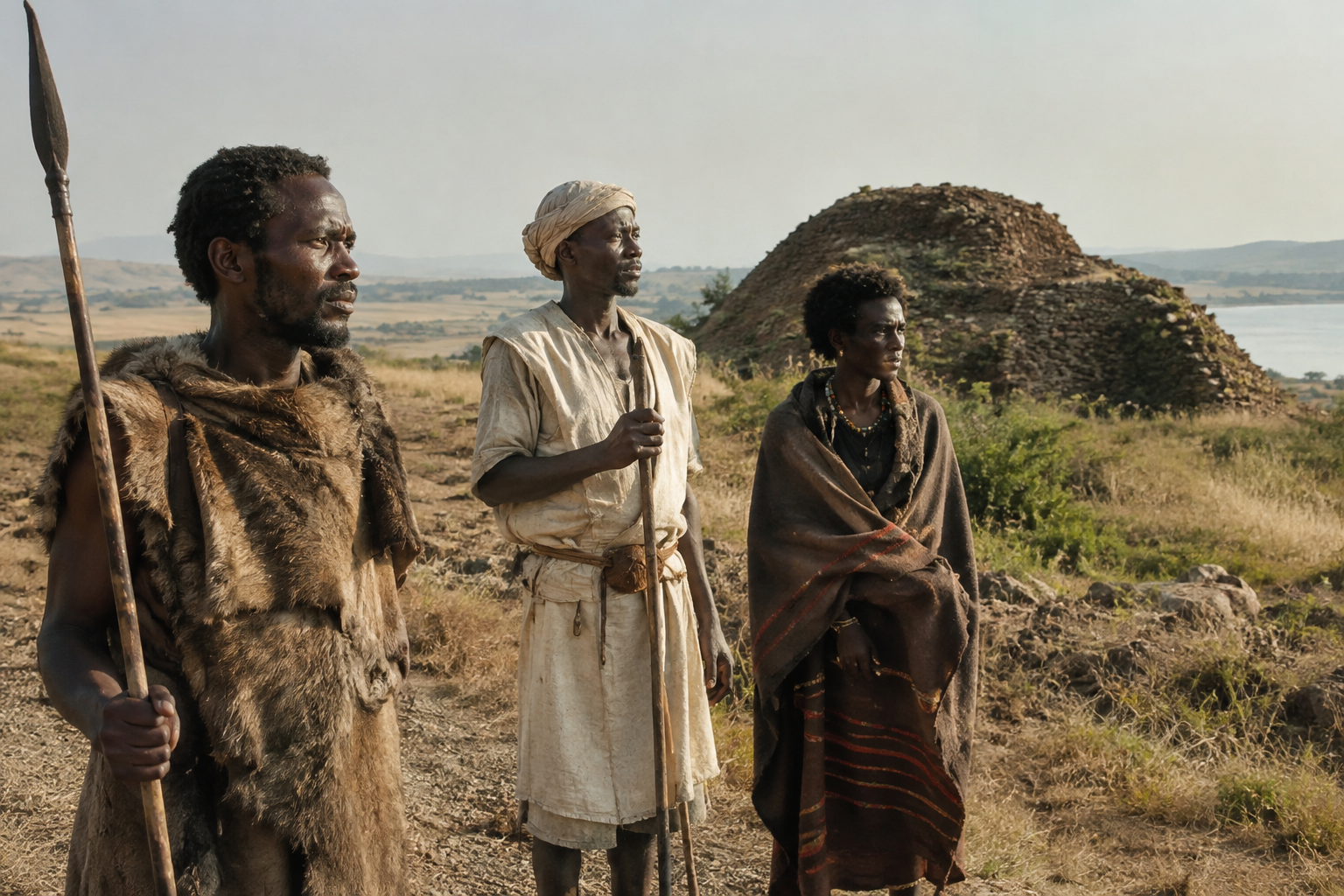
At Prettejohns Gully in Kenya, one ancient male dated to around 2000 BC, sample I12533, offers a rare and useful glimpse of the Y-DNA branch E2(xE2b). That label is already a clue to the difficulty of the story. It places the individual within the broader E2 paternal line, while also telling us that he does not belong to the E2b branch. In other words, this is not a neat dynastic badge or a tidy ethnic stamp. It is a narrow paternal signal emerging from a very specific archaeological setting in eastern Africa.
The interest of E2(xE2b) here is not grandeur but continuity and location. Among the few ancient samples linked with this branch in the material at hand, all three come from Kenya: the much earlier Prettejohns Gully individual and two later men from the first and early second millennia AD, I8892 from Ilkek Mounds and I8901 from Kisima Farm. That small cluster does not map a whole people, but it does suggest that this paternal line, or closely related ones within broader E2, formed part of the male landscape of eastern Africa across a very long span of time.
The earliest of these men, I12533, is identified as coming from Prettejohns Gully in Kenya and dated to roughly 2000 BC, with a Cushitic-associated archaeological classification in the supplied material. That matters because eastern Africa in the third and second millennia BC was not static. Herding economies, new regional contacts, and changing settlement patterns were reshaping landscapes from the Rift Valley to neighboring zones.
Y-DNA can only tell us about one direct paternal line, but in an archaeological context like this it becomes valuable because it is anchored to a place and a period. A man carrying E2(xE2b) at Prettejohns Gully was part of that early pastoral horizon in Kenya, not an abstract node on a tree diagram. His lineage shows that branches inside broader haplogroup E were present among populations involved in eastern Africa's deep pastoral past.
A major ancient DNA study on eastern and southern Africa, published in Science, helped establish just how complicated these population histories were. The larger lesson from such work is that archaeology, language, subsistence, and paternal lineage do not line up in one simple column. A Cushitic-associated context does not mean every man had the same Y-chromosome, and one Y-chromosome does not define the total ancestry of the community.
It is worth pausing over the notation. E2(xE2b) means a lineage assigned somewhere within E2, excluding E2b. That is a careful scientific way of speaking, and it should make us careful readers too. It does not automatically identify a named modern subclade, nor does it license grand claims about exact origins, migrations, or ethnic identities beyond what the evidence can support.
For family historians, this is familiar territory. Ancient DNA often preserves only part of the paternal picture at usable resolution, especially in older material. The significance lies in the fact that this branch appears in ancient Kenyan individuals from very different periods, hinting that E2-related paternal lines had a durable place in regional populations.
Leap forward more than two and a half millennia and E2(xE2b) appears again in Kenya at Ilkek Mounds, where sample I8892 is dated to around AD 920. Even with sparse details, the setting itself is historically suggestive. By the early medieval period, eastern Africa was a zone of movement and mixture: pastoral communities, farmers, and trading networks all intersected across the interior as well as the coast.
The Ilkek Mounds sample is important because it shows that the branch was not confined to a single early pastoral episode. Whatever social and cultural changes occurred between 2000 BC and the 10th century AD, one line within broader E2 still turns up in the same broad region. That is not proof of unbroken descent from one known man to another; it is, however, a sign of long-term paternal persistence.
Archaeologically, this is the sort of finding that tempers tidy migration stories. Populations do move, of course, but ancient eastern Africa was also a place where lineages could remain locally embedded while languages, economies, and political relationships shifted around them. The Y-chromosome here suggests endurance amid change rather than a dramatic one-off intrusion.
The third sample, I8901 from Kisima Farm in Kenya, is dated to around AD 1020. In historical terms that places him broadly alongside the Ilkek Mounds individual, but not in the same exact context. This is why multiple nearby finds matter: they let us see that a paternal branch was not a single isolated case.
With Kisima Farm and Ilkek Mounds together, the early second millennium AD begins to look less like a random blip and more like a regional pattern. Two separate Kenyan contexts, close in time but distinct in place, both preserve men associated with E2(xE2b). That does not make the branch dominant, but it does make it visible.
There is also a wider historical point here. Around this period, eastern Africa was anything but cut off. Inland and coastal societies were linked by exchange, ecological adaptation, and local political change. Yet lineages visible in ancient DNA remind us that connectivity does not simply erase older regional roots. Some paternal branches endure through adaptation rather than isolation.
Ancient DNA and Archaeogenetics
One temptation with haplogroups is to turn them into arrows on a map: this branch came from here, then moved there, then became this people. The evidence for E2(xE2b) in this case is both more modest and, in its way, more interesting. All three supplied ancient examples come from Kenya, but they belong to widely separated periods and at least two different archaeological settings.
That concentration makes Kenya the proper center of this article. It is better to stay with the evidence than to bolt on distant historical claims that the samples do not actually prove. The branch appears in an early pastoral or Cushitic-associated context at Prettejohns Gully, then later in first-millennium and early-second-millennium AD individuals from Ilkek Mounds and Kisima Farm. The simplest responsible conclusion is that E2(xE2b) formed part of the long-duration paternal diversity of eastern Africa.
This is also a useful example of how ancient DNA changes historical storytelling. The point is not to assign one lineage to one culture forever. The point is to see real men, in real sites, carrying paternal lines through periods of economic and social transformation.
For someone researching a present-day paternal line, E2(xE2b) is interesting less because it promises a famous ancestor than because it anchors one branch of Y-DNA in ancient Kenya across an impressive timespan. The standout evidence is the combination of an early sample from Prettejohns Gully around 2000 BC and later medieval-era men from Ilkek Mounds and Kisima Farm. Taken together, they suggest a paternal line with deep regional roots in eastern Africa, surviving through major cultural change while never standing in for the whole ancestry of the people who carried it.

Comments