Haplogroup E1b1b1a1b1a10a2b1a
– 5 min read


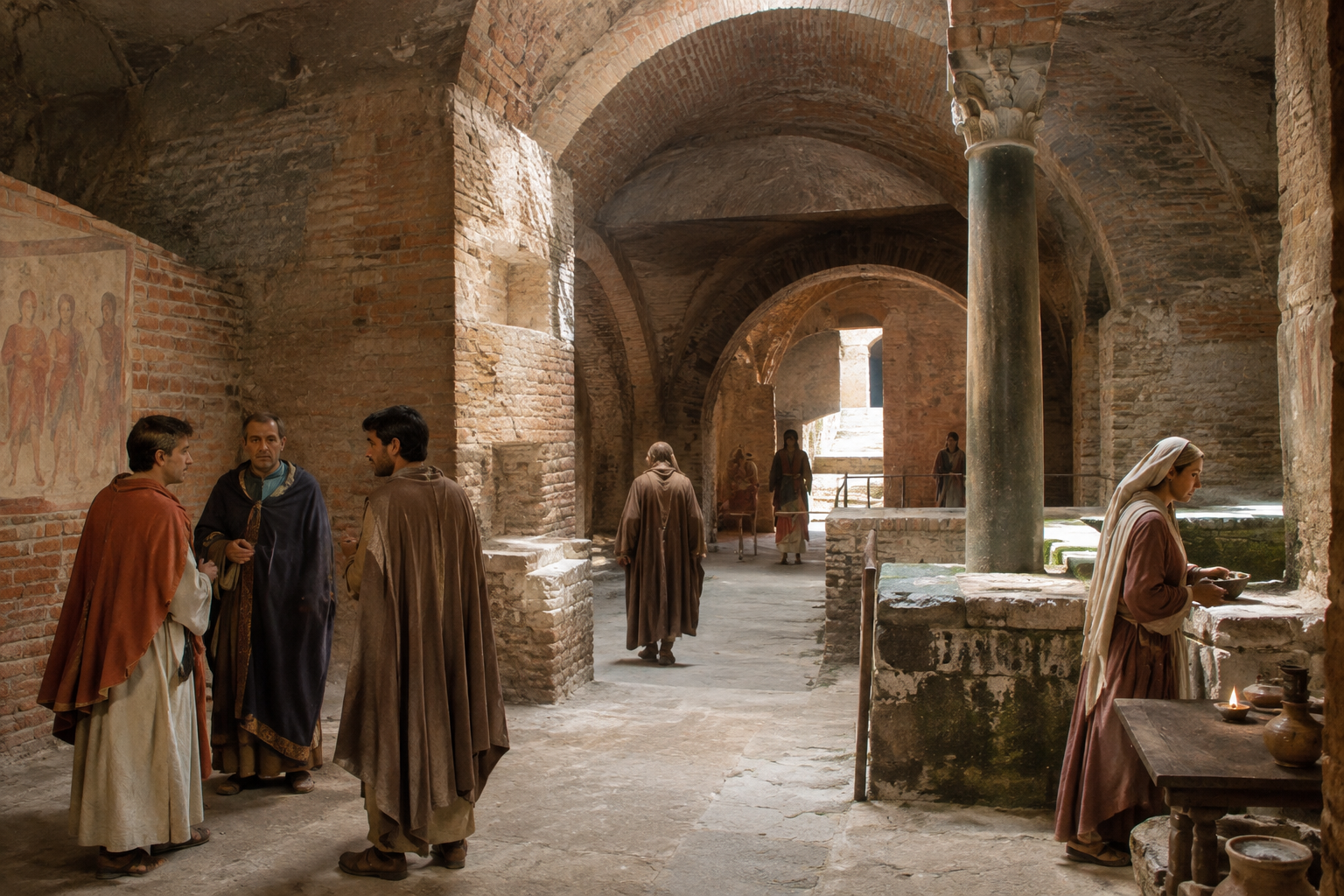
In around AD 500, a man now known as R107 was buried at Crypta Balbi in Rome, in the unsettled centuries after the western Roman Empire had ceased to exist as an imperial state. He is one of those ancient individuals who matter precisely because he is not an emperor, not a famous general, and not wrapped in legend. He is useful because he stands in the middle of an urban world that was changing fast, yet still drawing people, families, and lineages into the old capital.
R107 is associated here with the Y-DNA haplogroup E1b1b1a1b1a10a2b1a, a very specific paternal branch within the much larger E1b1b1 family. That distinction matters. Y-DNA traces one direct male line only, not a person's whole ancestry, but even a single paternal line can tell us something about movement, continuity, and the sheer variety of men living in late antique Rome.
Crypta Balbi is one of the best places in Rome for watching history pile up in layers. Originally part of the monumental city of the early empire, the area continued to be used and reused long after classical Rome had changed beyond recognition. By AD 500, this was no pristine imperial capital. It was a lived-in, adaptive, late antique city, where older public spaces could become workshops, housing, refuse zones, and burial grounds.
That is what makes R107 so interesting. He belongs to a period when Rome was still immensely important, but politically fragmented and demographically mixed. Ancient DNA has steadily made it harder to imagine late Roman and early medieval cities as neatly bounded communities. Instead, urban centres such as Rome emerge as places where lineages from different parts of the Mediterranean and beyond could end up side by side.
A major ancient DNA study of Rome and central Italy, published in Science, helped establish just how dramatic population change could be across the city's long history. The broad lesson is not that every individual was a newcomer, but that Rome repeatedly absorbed people from very different genetic backgrounds. A lineage like E1b1b1a1b1a10a2b1a fits neatly into that wider picture of complexity.
The long label E1b1b1a1b1a10a2b1a can look forbidding, but its historical value lies in scale. The deeper parent branches of E1b1b1 are widespread and have long histories across parts of Africa, the Mediterranean, and southwest Eurasia. A narrow terminal branch, however, is not the same thing as the whole family tree. One must be careful not to project the grand history of all E1b1b1 lineages onto one late Roman individual in Rome.
So what can responsibly be said? First, the presence of this branch in a late antique Roman context underlines the cosmopolitan character of the city. Second, it reminds us that paternal lines visible in today's testers could have been present in Italy during periods of imperial contraction and social reorganisation, not just during the high empire. Third, it is a warning against tidy ethnic labels. A Y-chromosome branch is not a shortcut to "Roman," "Gothic," "Greek," or any other historical identity.
That caution is particularly important in the fifth and sixth centuries, when written sources often sort people into political blocs - Romans, Goths, easterners, provincials - while the archaeology and the genetics reveal much messier human realities.
AD 500 is an excellent moment for studying paternal ancestry because it sits just after the formal end of the western empire in AD 476, but before the city ceased to be a major node in Mediterranean life. Rome had endured sack, war, court politics, and shrinking state structures, yet it was still inhabited, buried in, repaired, and remembered. People did not vanish with the emperors.
An individual like R107 therefore belongs to a Rome that was both diminished and connected. Supplies still moved. Clerics, artisans, labourers, migrants, and local families still made lives there. The city's population may have been smaller than in imperial centuries, but it was not isolated. A paternal lineage preserved in one burial can be a faint but useful sign of those enduring links.
That larger late antique and early medieval fluidity is easier to appreciate when set beside evidence from elsewhere in Europe, where cemeteries of the same broad era also show movement, mixing, and unexpectedly diverse origins.
One of the commonest mistakes in popular ancestry writing is to treat a haplogroup as if it must point to one dramatic migration and one fixed homeland. But urban archaeology keeps spoiling that sort of story. Cities, especially Roman cities, gathered soldiers, traders, enslaved people, freed families, administrators, pilgrims, and descendants of earlier migrants over many generations. Their descendants could remain long after the original movement was forgotten.
That is the useful historical setting for E1b1b1a1b1a10a2b1a at Crypta Balbi. We do not need to invent a single route or a single ancestral episode for R107. It is enough to recognise that Rome was the sort of place where paternal lines with deeper connections across the Mediterranean world could become thoroughly embedded in local society.
Other MyTrueAncestry features on Roman-period and post-Roman populations have shown much the same thing in different settings: imperial frontiers, provincial towns, and burial grounds all tend to complicate old assumptions about who belonged where.
There is also a quieter point here, but an important one. A lineage found in late Roman Rome need not represent a fleeting visitor. By the fifth and sixth centuries, many families in Italy would already have carried mixed backgrounds accumulated across centuries of empire. The old Roman world had been integrating people for a very long time.
That helps explain why late antique and early medieval burials so often resist simple labels. The genetics may show affinities reaching beyond one region; the archaeology may place the individual firmly in a local cemetery; the historical moment may be one of political rupture. All three things can be true at once. R107 is valuable because he sits exactly in that overlap.
For readers interested in how Roman-era ancestry continued to shape western Mediterranean populations, Iberian evidence offers a useful comparison: not because it proves anything directly about Crypta Balbi, but because it shows how long Roman-period demographic change could echo afterward.
The most distinctive thing about E1b1b1a1b1a10a2b1a in this case is not some romantic claim of a named tribe or dynasty. It is the simple, solid fact that this paternal branch appears in a documented late antique burial from Rome itself, in the form of R107 from Crypta Balbi around AD 500. For anyone researching this line today, that is a reminder that a direct paternal ancestry can belong to the deeply entangled human world of the late Roman Mediterranean, where local continuity and long-distance connection lived together in the same city streets.
Comments