Haplogroup E1b1b1a1b1a10a1a1

– 5 min read


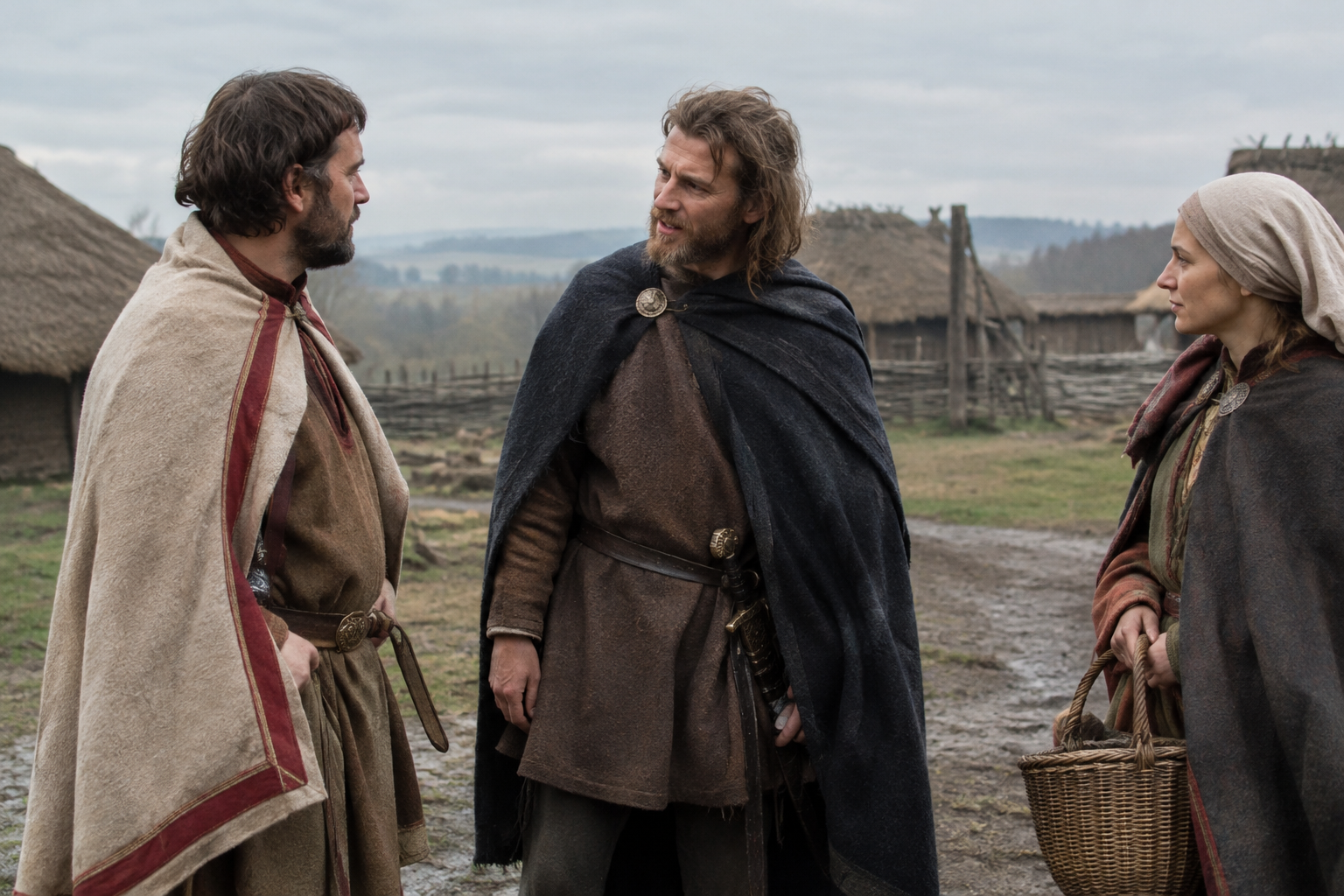
One of the more arresting finds for the Y-DNA haplogroup E1b1b1a1b1a10a1a1 comes not from the Mediterranean or North Africa, where the broader E1b1b family is often discussed, but from early medieval Bavaria. The ancient individual Alh_157, dated to around AD 600 at Altheim, Germany, is described as a Merovingian Period Bavaria Roman Migrant. That combination alone is enough to make an archaeologist stop and look twice: a paternal line associated here with a man living in a Bavarian community during the Merovingian age, yet identified in a Roman-migrant context.
This is exactly the kind of case that shows why a narrow Y-chromosome lineage must be handled carefully. Y-DNA tracks one direct paternal line only. It does not by itself define a person's whole ancestry, language, or identity. But when a branch such as E1b1b1a1b1a10a1a1 turns up in a documented early medieval burial connected to movement out of the Roman world and into post-imperial Bavaria, it becomes historically valuable. It gives us a small but vivid glimpse of how Roman and post-Roman populations overlapped rather than neatly replacing one another.
By around AD 600, Bavaria was not some sealed-off "Germanic" pocket. It sat in a landscape still shaped by the long afterlife of Rome: roads, military traditions, Christian networks, and generations of movement across the old frontier zones. In that setting, a sample like Alh_157 matters because it points to paternal diversity inside a Merovingian-period population that older, simpler histories might have imagined as more uniform.
The label "Roman Migrant" is itself historically suggestive. It does not mean we can narrate the life story of Alh_157 or assign him a fixed ethnic badge. What it does suggest is that researchers saw this burial in the context of mobility connected to the Roman world, whether through family origin, community background, or broader ancestry patterns. In other words, this was a man living in Merovingian Bavaria whose paternal line did not fit a narrow stereotype of local continuity.
An ancient DNA study examining this wider frontier world has helped reframe the period as one of blending and local complexity rather than simple invasion and replacement; the broader research context can be explored in this scientific study.
The haplogroup in this article is E1b1b1a1b1a10a1a1, a very specific terminal branch. That is important, because readers will often know the wider parent haplogroup E1b1b has a deep history spanning parts of Africa, the Mediterranean, and southwest Eurasia. But the broad map of E1b1b cannot simply be pasted onto this much narrower subclade.
With the evidence here, the responsible claim is modest and interesting at the same time. We have an early medieval individual, Alh_157, from Altheim, in whom this paternal line is reported. That does not prove where the branch first arose, nor does it let us draw a single migration arrow from one ancient homeland to Bavaria. What it does show is that this line had become part of the human traffic moving through the late Roman and post-Roman provinces of central Europe.
That matters because the Merovingian period is so often told in blunt categories: Romans here, barbarians there, migrants arriving in blocks, locals staying put. Ancient DNA keeps spoiling those tidy schemes. A direct paternal lineage like this one can survive inside communities that were culturally mixed, politically changing, and genealogically far more tangled than the labels suggest.
The really useful thing about Alh_157 is not just the haplogroup call, but the historical setting that makes such a finding believable. By AD 600, people in Bavaria could descend from soldiers, traders, officials, craftspeople, dependants, and families who had moved over generations through the old Roman provinces. Some had roots in the Danubian world, some farther west or south, and some came through the long social networks created by the Empire before its political structures fragmented.
So when a paternal line like E1b1b1a1b1a10a1a1 appears in this context, we do not need a melodramatic one-off explanation. The late Roman and early medieval centuries already provide the mechanism: mobility. The frontier was porous; military service moved men and families; towns and estates drew newcomers; post-imperial kingdoms inherited populations that were already mixed.
That is one reason MyTrueAncestry readers may also find the evidence from Iberia useful. Early medieval western Europe repeatedly turns out to have been more cosmopolitan than older national histories allowed.
It is tempting to imagine early medieval cemeteries as the resting places of neat descent groups, each one matching a tribe named in later texts. Archaeology and genetics are much less obliging. Merovingian Bavaria contains evidence for varied origins, shifting affiliations, and communities assembled from multiple streams of ancestry. A single Y-lineage does not define that whole picture, but it can mark one strand within it.
In the case of Alh_157, the interest lies in the contrast between place and lineage. Altheim sits in what many readers would instinctively file under early medieval German history. Yet the classification of this individual as a Roman migrant reminds us that "Bavaria" at this date was not a closed ethnic box. It was a post-imperial society built from inherited Roman populations, incoming groups, and the children of both.
That wider pattern also connects with work on language spread and mobility in early Europe. Genes do not equal language, of course, but ancient population movement gives us the human background against which linguistic change took place.
Germanic Languages and Genomics
There is a larger archaeological point here. We often meet the Roman Empire in monuments, emperors, and armies. But the biological legacy of Rome is often quieter: individuals in provincial cemeteries whose ancestry records movement that texts barely notice. Alh_157 belongs in that category. He is not evidence for an emperor's policy or a named migration in the chronicles. He is evidence for the ordinary human aftermath of empire.
That aftermath could be remarkably durable. The old imperial world did not vanish in AD 476, and neither did the families shaped by it. Communities across western and central Europe retained people whose ancestors had moved under Roman rule, or whose own lifetimes bridged Roman and successor worlds. A paternal line such as E1b1b1a1b1a10a1a1 turning up in Merovingian Bavaria fits that long continuity far better than any idea of sharp civilizational rupture.
If you are interested in how Roman-period population movements continued to leave a mark long after formal imperial control weakened, Iberian case studies make a useful comparison.
Roman Hispania's Genetic Legacy
With the present evidence, E1b1b1a1b1a10a1a1 is best understood here through one sharp archaeological snapshot: a man in Merovingian-period Bavaria, Alh_157, linked to a Roman migrant context around AD 600. That does not turn the branch into a specifically Bavarian lineage, nor does it reduce it to any single ethnic label. It does, however, place this paternal line inside the mixed and mobile populations that connected the late Roman world to early medieval Europe.
For someone researching this haplogroup today, that is the real value of the ancient evidence. It suggests that your direct paternal line may belong to the long human story of Mediterranean-connected, Roman-connected, or post-Roman movement into central Europe, where identities were layered and local histories were built from many ancestries at once.
Comments