Haplogroup E1b1b1a1a1c1a

– 5 min read


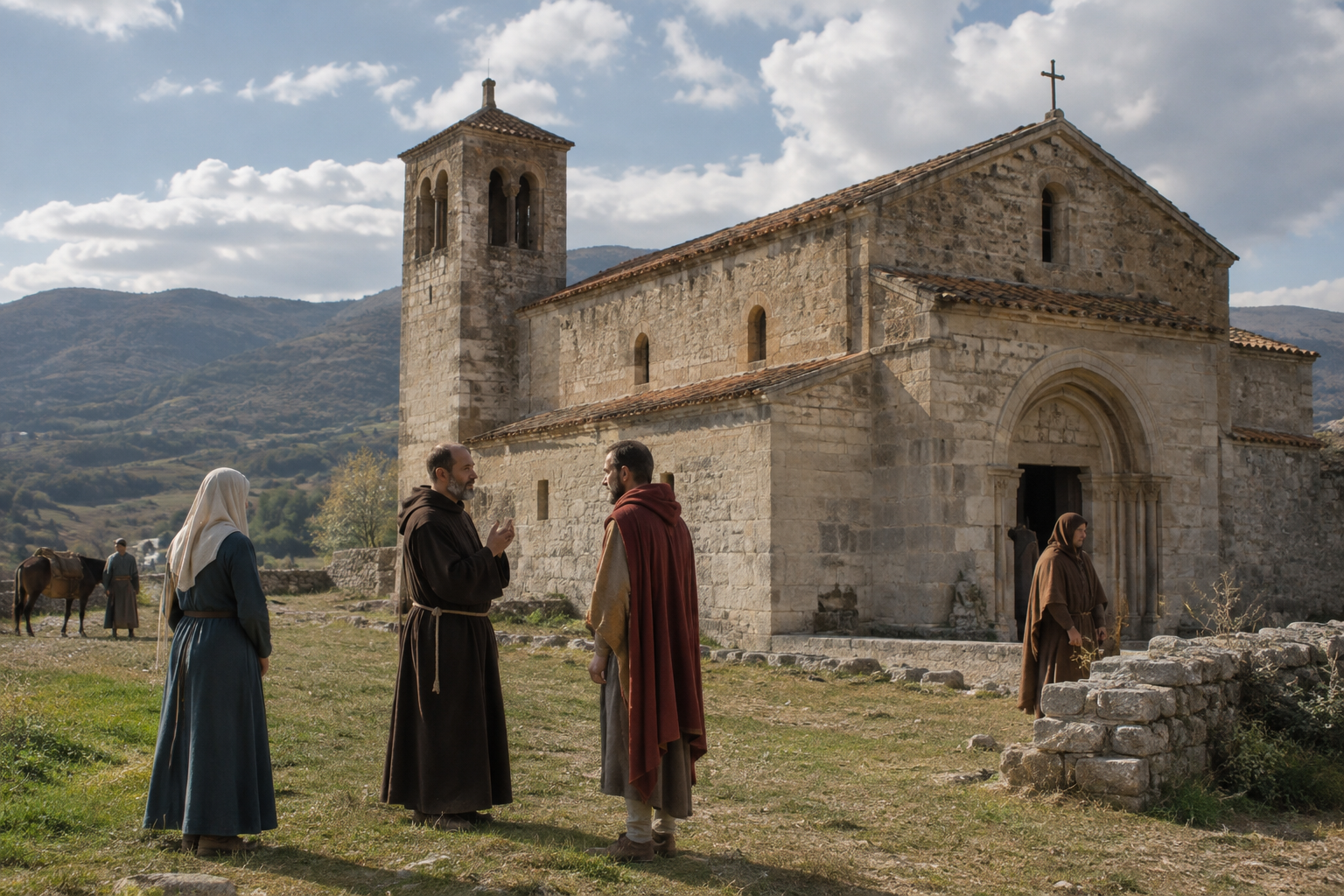
In the cemetery of Santa Maria in Civitate at Amiternum, in Abruzzo, one man buried in the High Middle Ages has become unusually important for the history of a paternal line. The sample ASM_S23, dated to about 1087 AD, is associated with the Y-DNA haplogroup E1b1b1a1a1c1a. That is a very narrow paternal branch, and its appearance in medieval central Italy is a useful reminder that Italy's male lineages were never the product of one single ancient source.
Amiternum is a fine place to encounter that complexity. This was an old city with a long Roman history, but by the medieval period its population belonged to a changed world of bishops, churches, local lordship, and shifting connections across the central Apennines. A man like ASM_S23 was not a "haplogroup in motion"; he was a medieval person in a real community. Yet his Y chromosome preserves one direct paternal thread, and that thread belongs to a branch ultimately nested within the wider E1b1b family, a lineage with deep roots in parts of the Mediterranean, Balkans, and North Africa, but with many distinct sub-branches that followed their own separate histories.
The key evidence here is modest but solid: one ancient male from Santa Maria in Civitate, the church and burial complex at Amiternum, carrying the article's featured branch. We should be careful with scale. One individual does not define all of Abruzzo, all of medieval Italy, or the whole history of E1b1b1a1a1c1a. What he does show is that this paternal line was present in a documented medieval population of central Italy.
That matters because Amiternum sits in a region where continuity and movement overlapped for centuries. Roman urban life had transformed, Lombard and then Norman-era political structures had altered the landscape, and ecclesiastical sites often became focal points for local burial communities. Ancient DNA from such contexts helps move the discussion away from vague ideas of "Italians" as a timeless block and toward what archaeologists actually see: layered populations, local continuity in some places, and repeated episodes of mobility in others.
A related MyTrueAncestry article on the same site gives a broader sense of the setting around this burial community.
It is worth slowing down over the label itself. E1b1b1a1a1c1a is not the same thing as the whole of E1b1b. The broader parent lineage is widespread and old, but narrow downstream branches can have much more specific and much less obvious histories. Without a larger set of securely published ancient comparanda for this exact subclade, it would be reckless to assign ASM_S23 to a single neat migration story.
What Y-DNA can tell us, in a disciplined way, is that one direct male line in medieval Amiternum belonged to this branch. It does not tell us his language, social rank, or total ancestry, and it certainly does not turn him into a proxy for everyone buried nearby. But paternal line evidence is still powerful, because it can reveal lineages that written history never noticed at all.
That is especially relevant in Italy, where the deeper genetic picture has repeatedly shown contacts across the Adriatic and the wider Mediterranean. If your own paternal line falls under E1b1b1a1a1c1a, the Amiternum evidence suggests that branches of this lineage were already woven into medieval Italian society, not standing outside it.
Central Italy often frustrates tidy historical storytelling. People want sharp breaks: Roman, then barbarian, then medieval. The archaeology is less obliging. Sites like Amiternum show that settlement history in the peninsula was a matter of reuse, adaptation, and long local memory. Churches rose amid older urban landscapes; cemeteries accumulated around sacred places; communities reassembled rather than simply vanished.
That makes a lineage like E1b1b1a1a1c1a interesting here. In some popular discussions, E1b1b gets pushed too quickly into a single origin narrative, usually with more certainty than the evidence deserves. But medieval Italy was connected in many directions at once: to the Balkans, to Byzantine spheres, to older Roman Mediterranean routes, and in some regions to later movements from the Islamic world or the Norman south. A branch found in Abruzzo could reflect older regional persistence, movement within Italy, or ancestry introduced generations earlier from elsewhere in the Mediterranean. The sensible answer, for now, is not to choose one romance over another, but to keep the setting open and historically realistic.
Readers interested in how Italian ancient DNA keeps revealing local complexity may also want this broader regional piece.
One of the useful things about ancient DNA from churchyard cemeteries is that it cuts across the grander identities that dominate textbooks. A burial like ASM_S23 was not necessarily an elite, not necessarily a foreign arrival, and not necessarily a man anyone bothered to record in writing. Yet he belonged to the human fabric of medieval Amiternum just as much as bishops, lords, or monks.
This is where archaeology does its best work. Rather than asking whether a haplogroup is "really Italian," we can ask what kind of community preserved it. At Santa Maria in Civitate, the answer is a Christian burial landscape in High Medieval Abruzzo. That is already a historically rich statement. It places the lineage inside a lived medieval world of local parishes, inherited Roman geography, and central Italian population history.
More broadly, studies of medieval Italian cemeteries have been showing that paternal and overall ancestry patterns could vary quite a lot even within relatively small regions. That does not make the record confusing; it makes it human. Communities were built from many kinds of kinship, marriage exchange, and movement over centuries.
For another example of how medieval Italian populations resist simplification, this post on Sicily is a useful comparison from a very different but equally connected part of the peninsula.
The main scholarly backdrop for this case is an ancient DNA study of the Amiternum population, published in iScience. Even without overclaiming details beyond the burial information at hand, the value of that work is clear: it places named individuals from a real archaeological site into a genetic framework that can be compared across time.
That comparison is the larger prize. A single Y-chromosome result becomes much more informative when set beside other burials from the same region, earlier Roman-period populations, and neighboring parts of Italy and the Adriatic world. The result is not a simple family tree of nations. It is a map of persistence and mixture, in which some lines endure locally while others arrive, spread, or disappear.
If you belong to E1b1b1a1a1c1a, the most careful historical takeaway is this: your direct paternal line fits comfortably within the kind of Mediterranean complexity that medieval Italy so often preserves. The Amiternum sample ASM_S23 shows this branch present in a documented High Medieval community in Abruzzo, embedded in the ordinary history of central Italy rather than floating outside it. That does not identify an ancestor by name, but it does give the lineage a real archaeological foothold in a specific place and period.


Comments