Haplogroup R1b2b2

– 5 min read


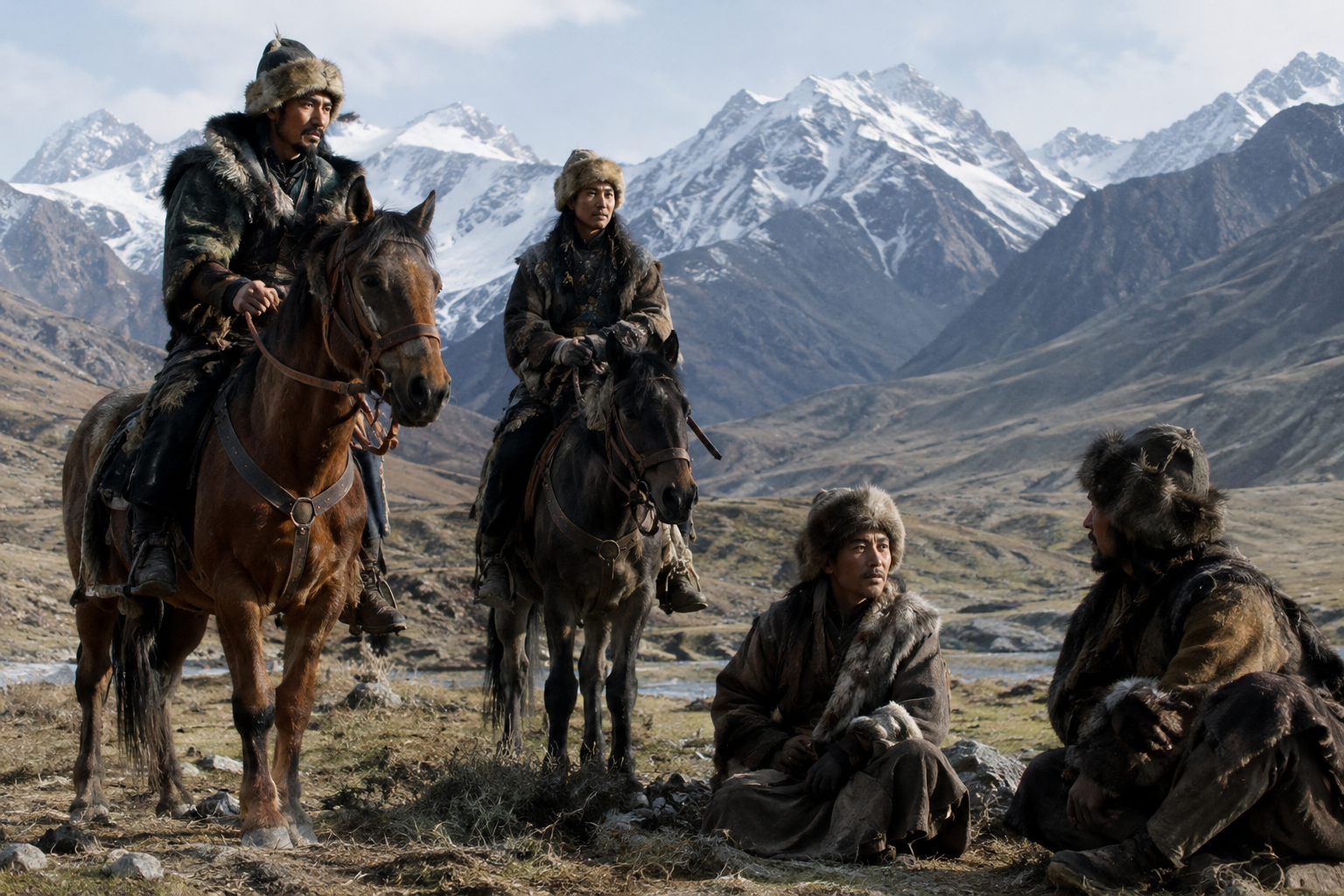
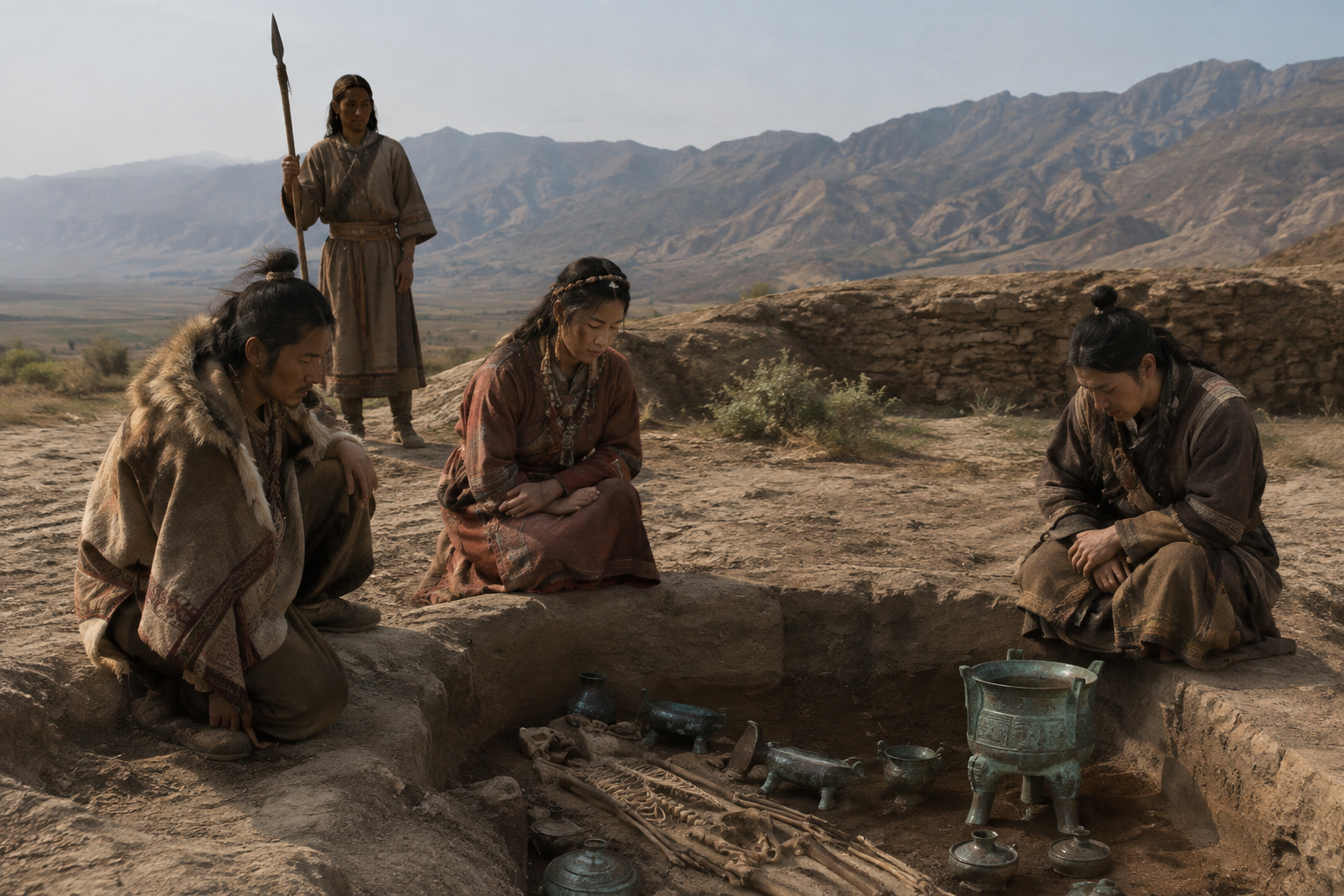
In the Tian Shan of Kyrgyzstan, one ancient male known as DA81 offers a small but arresting glimpse into the paternal history of haplogroup R1b2b2. He is dated to about AD 289, in the Hunnic period, and that setting matters. The Tian Shan was not a quiet edge of the ancient world. It was a corridor of herders, traders, migrants, and political confederations, a place where steppe empires brushed up against oasis societies and mountain routes.
That makes DA81 interesting not because one skeleton can stand for an entire people - it cannot - but because a Y-chromosome lineage attached to a direct paternal line appears here in a historically mobile landscape. Y-DNA traces one narrow line of descent, father to son, not a person's whole ancestry. Even so, when a branch such as R1b2b2 turns up in a Hunnic-period individual from the Tian Shan, it places that paternal line inside one of late antiquity's most connected regions.
The sample we have here is sparse in description but rich in context: DA81, Kyrgyzstan, Tian Shan, around AD 289. That date falls in a period when the great inner Asian steppe zone was politically fluid. Groups later labelled Hunnic, along with many other communities, moved through and reshaped the worlds between Mongolia, the Altai, Semirechye, the Tian Shan, and farther west.
Archaeology in this wider region has repeatedly shown that such periods were not biologically uniform. Cemeteries associated with steppe elites, mobile pastoralists, and frontier populations often contain people of varied ancestry backgrounds. That broader point is important for reading DA81 responsibly: his R1b2b2 lineage is evidence for one paternal strand present in the Tian Shan during the Hunnic period, not a badge of exclusive ethnic identity.
An ancient DNA project archived at this research record is associated with the sample's study context. Without over-claiming details not given in the sample notice itself, the important point is that DA81 belongs to a growing body of evidence showing how late Iron Age and early historic Inner Asia brought together lineages with quite different deeper histories.
The awkward-looking label R1b2b2 belongs to the larger and very widespread Y-haplogroup R1b, one of the major paternal lineages found across much of western Eurasia. But this is where caution is needed. A broad parent lineage may have a huge geographic spread and a long, complicated history; that does not mean every one of its smaller branches followed the same route or had the same historical role.
So for this article, the safest statement is the best one: R1b2b2 is reported here in association with a Hunnic-period male from the Tian Shan. That places this paternal branch within the human traffic of Inner Asia by late antiquity. It does not by itself prove that the lineage originated there, nor that all men in the cemetery, the region, or the Hunnic world shared it.
This is a familiar lesson in archaeogenetics. Ancient populations were often mixtures of locals, newcomers, and descendants of earlier contacts. A single Y-line can persist across language shifts, changes of political allegiance, and dramatic cultural transformations. In other words, a paternal lineage can travel through history wearing many different historical costumes.
Why does the Tian Shan matter so much here? Because these mountains are less a barrier than a set of channels. Valleys and passes linked eastern Central Asia, the steppe belt, and the oases of the Silk Road. Long before the medieval caravans that dominate popular imagination, communities in and around the Tian Shan were already exchanging animals, metals, ideas, and genes.
By the centuries around AD 300, that network had become especially dynamic. Political formations rose and fragmented; mounted elites could project power over remarkable distances; and communities in mountain and steppe zones were pulled into wider systems of alliance and conflict. A paternal lineage found in this setting may reflect older Bronze or Iron Age steppe processes, more recent mobility, or local continuity folded into new imperial worlds. The key point is not certainty about one route, but recognition of a contact zone.
That wider pattern fits well with other MyTrueAncestry coverage of the region's mobility and mixture, including work on the steppe and adjacent Central Asian corridors.
The phrase "Hunnic period" is useful, but it can also mislead if we imagine a single neatly bounded biological population. Historians and archaeologists have spent decades untangling the label "Hun," and the answer is usually more complicated than old textbook stories allowed. Political confederations can absorb many peoples. Material culture can spread faster than family lines. Names used by outside chroniclers can flatten enormous local variation.
That is exactly why a sample like DA81 matters. He reminds us that the Hunnic world was made up of actual individuals, buried in real places, carrying lineages inherited through generations that long predated any one confederation. Ancient DNA has been especially powerful in showing that steppe polities often contained striking diversity rather than a single biological core.
Readers interested in that broader question may find a useful comparison in MyTrueAncestry's discussion of Hunnic and post-Hunnic complexity farther west.
Although this article's direct evidence centers on one Hunnic-period individual, the deeper background almost certainly reaches further back into the steppe past. Across Central Asia, Iron Age populations such as Saka and related groups already showed a complicated blend of ancestries and lineages. Later historical populations did not appear from nowhere; they were built from earlier communities, rearranged through migration, conquest, alliance, and marriage.
That makes R1b2b2 in DA81 historically plausible in a very broad sense. Not because we can draw a straight line from one named ancient culture to one later polity, but because the steppe repeatedly recycled and redistributed paternal lines across new social formations. The late antique Tian Shan was one of the places where those older legacies were still very much in motion.
Another useful regional comparison is MyTrueAncestry's look at movements and mixture around the Black Sea and steppe frontier, where similarly complex historical labels meet equally complex genetic realities.
For someone researching a present-day paternal line, R1b2b2 should be read as a lineage with deep roots somewhere within the wider history of Eurasia, but one that cannot be reduced to a single tribe, kingdom, or migration tale. The ancient evidence highlighted here places this branch - or an associated reporting of it - in Hunnic-period Kyrgyzstan, in the person of DA81. That is a valuable clue, because it anchors the lineage in a real late antique context at the crossroads of Inner Asia.
What it suggests, responsibly, is not a dramatic claim of descent from "the Huns," but a paternal connection to the mobile, mixed, and historically consequential populations of the Eurasian steppe world. And sometimes that is the more interesting story anyway: not a tidy legend, but a line that passed through one of the most connected landscapes of the ancient world.
Comments