Haplogroup N1a1a1a1a2a1a1a1b

– 5 min read


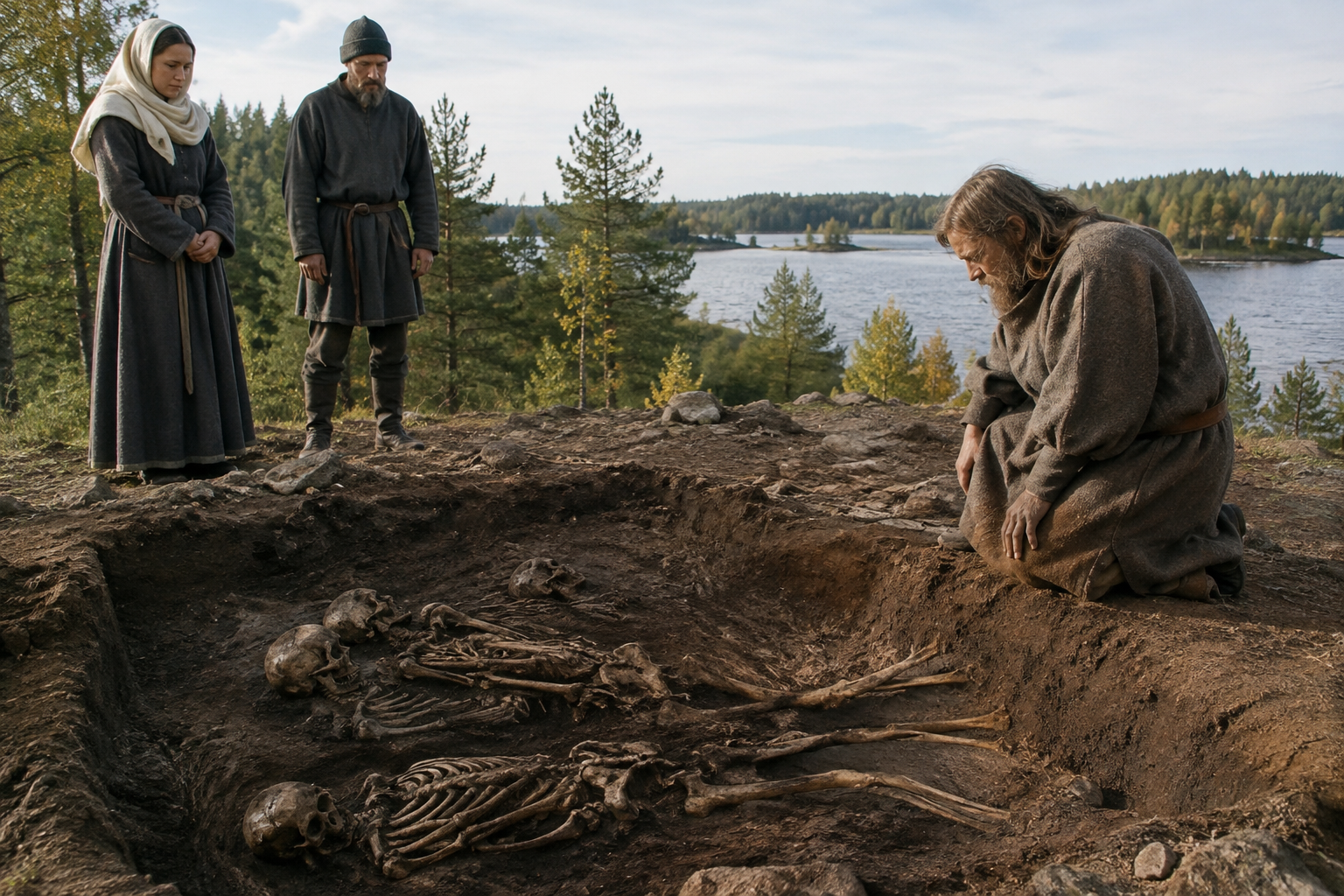
At Valkeakoski in southern Finland, a medieval triple burial at Toppolanmaki has become an unexpectedly useful window into one very narrow paternal line: N1a1a1a1a2a1a1a1b. The individual recorded as TOM006, dated to around 1160 AD, matters not because he was a king or a saga hero, but because he belongs to a burial setting that lets archaeologists and geneticists ask a grounded historical question: what did paternal ancestry look like in Finland at the point where local communities were living through the early medieval centuries, with all their regional contacts, shifting identities, and uneven incorporation into wider Baltic and Scandinavian worlds?
That is the right scale for this haplogroup. N1a1a1a1a2a1a1a1b is not a shorthand for an entire people, language, or culture. Y-DNA traces one direct paternal line only. But when a lineage this specific turns up in an excavated medieval burial from Finland, it gives us something much better than myth: a securely placed man in a real cemetery context, in a region where archaeology and ancient DNA are beginning to sharpen the picture of population history.
The key evidence here is straightforward but important. TOM006 comes from the Medieval Hame Finland Triple Burial at Valkeakoski Toppolanmaki, in the historical region of Hame. The date, around 1160 AD, places the burial in the later part of Finland's early medieval world, before the full weight of later Swedish state structures had settled across the region.
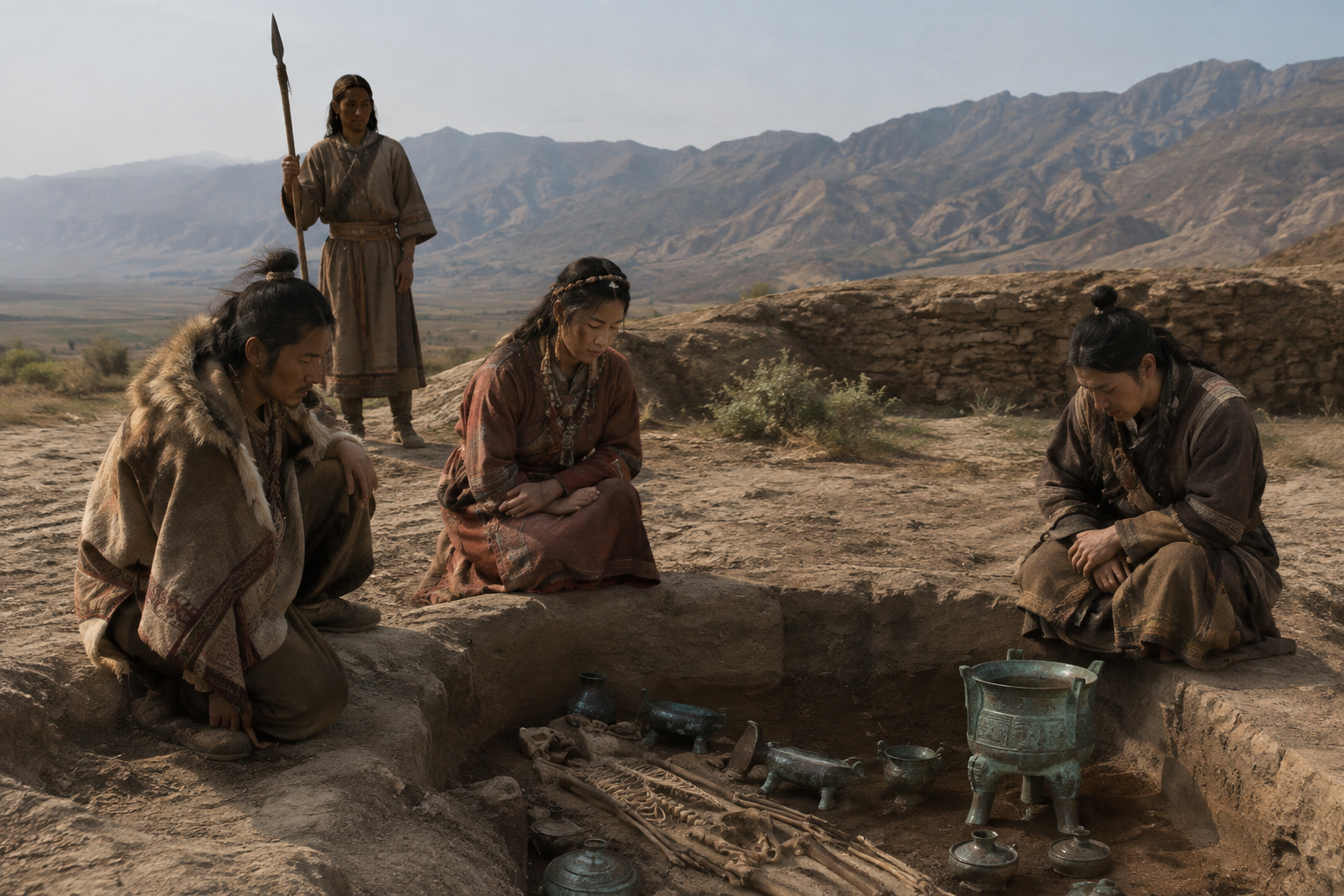
A triple burial immediately catches the eye because it suggests a social story, though one we must not overwrite. Co-burial can reflect family ties, epidemic mortality, conflict, practical burial decisions, or local ritual habits, and the safe point is simply that TOM006 was buried in a multi-person setting rather than as an isolated individual. That alone makes him useful. Ancient DNA from burials like this can reveal not just broad ancestry patterns but how medieval communities were structured at the level of households, local kin groups, and neighboring populations.
Research on early medieval Finland has started to show just how regionally varied that world was. Rather than a single neat population block, the evidence points to communities with different mixtures of local continuity and outside connection. That is precisely why a narrow Y-line such as N1a1a1a1a2a1a1a1b is interesting here: it places one paternal branch inside the lived reality of medieval inland-southern Finland, not in a speculative prehistoric migration map floating free of archaeology.
The wider Y-haplogroup N is well known across northern Eurasia, and some of its branches are especially associated in modern populations with Uralic-speaking regions and northeastern Europe. But one must be careful here. The article's branch, N1a1a1a1a2a1a1a1b, is a very fine subdivision, and a fine subdivision should not be burdened with every grand claim ever made about haplogroup N as a whole.
What can be said responsibly is narrower and more useful. TOM006 shows that this paternal line, or a classification directly associated with it, was present in medieval Finland. That places the branch within a historical population that was neither isolated from the outside world nor simply interchangeable with its neighbors. Finland in the 12th century sat within overlapping zones of contact reaching toward the Baltic, Scandinavia, Karelia, and the forested east.
In practical genealogical terms, that makes N1a1a1a1a2a1a1a1b a lineage anchored in the documented human geography of northern Europe rather than a purely modern testing category. It is one strand of paternal descent visible in a medieval society whose identities were local, layered, and changing.
It is tempting to describe medieval Hame as a frontier, but that can be misleading if it conjures an empty edge waiting to be filled. In reality, this was already an inhabited and socially connected region with its own burial traditions, settlement networks, and long-term ties across Finland and the Baltic. The men buried at Toppolanmaki were part of that world.
The date around 1160 AD is especially suggestive because it falls into a period often discussed in relation to Christianization, regional consolidation, and intensifying links with Sweden and other Baltic powers. Yet archaeology keeps reminding us that these transitions were not instant switches. Burial customs, language communities, local allegiances, and ancestry patterns could all move at different speeds.
That is where ancient DNA helps. It does not replace archaeology; it sharpens the scale. A burial like TOM006's allows researchers to ask whether a medieval Hame community shows continuity with earlier local populations, stronger eastern or western affinities, or a mixture that reflects both. A recent ancient DNA study on early medieval Finland is relevant precisely because it treats these cemeteries as evidence for regional population structure rather than as props for a single national origin story.
Medieval Finland Archaeogenetics
A single isolated skeleton can tell us a great deal, but multiple burials are especially valuable because they let several kinds of evidence speak to one another. If the preservation is good enough, archaeologists can compare sex, age, ancestry, kinship, and sometimes disease history within one grave context. Even when only part of that picture is available, the context is richer than a lone data point.
For TOM006, the importance lies less in any dramatic claim about the three individuals and more in the fact that the burial raises structured historical questions. Were the people interred there close relatives? Did they share the same broader ancestry profile? Does the paternal line represented by N1a1a1a1a2a1a1a1b sit within a locally common pattern, or does it stand out against other lineages in medieval Finland? Those are the kinds of questions that have made cemetery-based genomics so productive in recent years.
We have seen elsewhere in northern Europe how powerful this approach can be when graves are studied not as curiosities but as communities in miniature. The same logic applies in Finland: the value of TOM006 is multiplied by the fact that he belongs to a specific burial cluster with a date and place, not just an abstract haplogroup label.
One of the most interesting things about medieval Finland is that it does not fit comfortably into older, simpler models of European history. It is not merely a remote extension of Scandinavia, nor just a passive recipient of eastern influences. The genetic evidence increasingly suggests a landscape with deep local roots and strong regional variation.
That matters for understanding N1a1a1a1a2a1a1a1b. A paternal lineage found in Hame around 1160 AD does not need to be made exotic to be historically important. Quite the reverse: its significance may lie in continuity, in the survival of male lines through periods of religious change, shifting trade routes, and emerging political hierarchies. Medieval cemeteries preserve precisely those quiet survivals.
There is also a larger northern Eurasian background to haplogroup N that makes Finland a particularly informative setting. Studies of Finnic and neighboring populations have long pointed to the importance of Y-chromosome variation in reconstructing population history across the forest zone of northeastern Europe. But ancient samples are what stop that history from becoming too abstract. They pin lineages to actual centuries and actual burials.
The clearest supported insight from this branch is modest but solid. N1a1a1a1a2a1a1a1b is not just a modern testing result; it is a paternal line documented in a medieval burial from Hame, Finland, through the individual TOM006 at Valkeakoski Toppolanmaki. That places the lineage within the real social landscape of 12th-century Finland, where local communities were shaped by both continuity and contact across the Baltic north.
For someone researching this haplogroup today, that does not prove descent from one buried man, one village, or one named historical people. What it does offer is a firmer historical footing: this paternal branch belongs in the archaeology of medieval Finland, where the dead still have the good sense to complicate our tidy stories.
Comments