Haplogroup E1b1a1a1a2a1a3b1d1c

– 4 min read


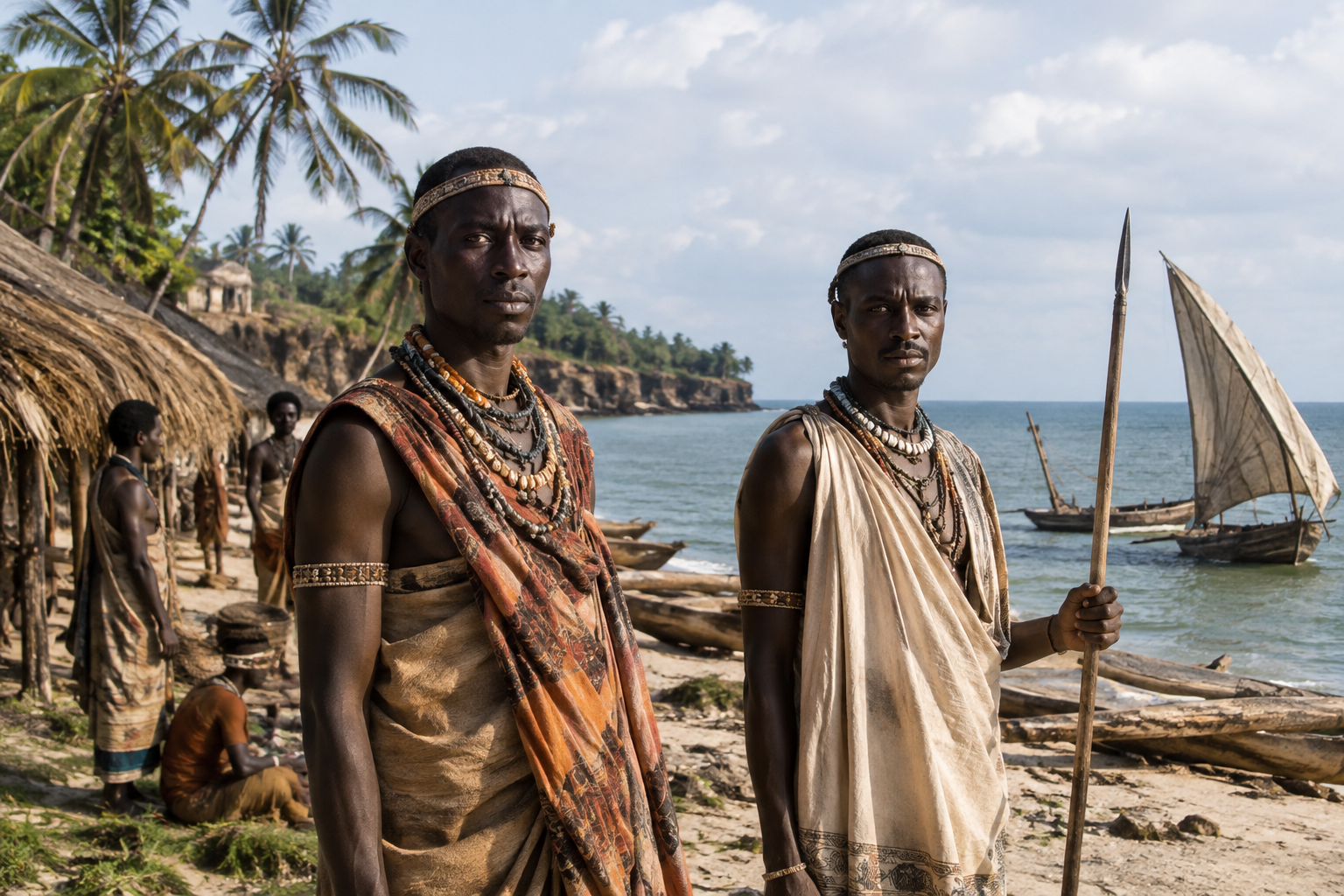
At Makwasinyi in Taita Taveta County, inland from the Swahili coast of Kenya, two men dated to around AD 1550 and AD 1750 carry the Y-DNA lineage E1b1a1a1a2a1a3b1d1c. They are known in the ancient DNA record as I13875 and I17402. That is already enough to make the site interesting: this is not a single isolated result, but a repeated paternal signal appearing in a medieval to early modern community on the East African coastland frontier.
What makes that worth pausing over is the setting. Makwasinyi sits in a region shaped by movement: African farming communities, long-established Indian Ocean trade, Islamic coastal towns, and hinterland connections all met here. A Y-chromosome lineage follows only one direct paternal line, not a person's whole ancestry, but in a place like this even one line can tell us something important about continuity, kinship, and the local male population over time.
The two ancient individuals linked here to E1b1a1a1a2a1a3b1d1c come from the same broad archaeological locality, Makwasinyi, and from two different centuries. I13875 is dated to about AD 1550, while I17402 is dated to about AD 1750. That span covers a period when the East African coast was anything but static: Portuguese intervention, older Swahili commercial networks, Islamic cultural influence, and inland political shifts all formed part of the background.
Yet the repeated appearance of the same paternal branch suggests that not every part of this history was defined by replacement. Some male lines persisted locally across generations. That may sound modest, but it matters. Too often, coastal East African history is told only through ports, merchants, and outsiders. Makwasinyi reminds us that inland and near-coastal communities were not simply passive recipients of outside influence; they had their own demographic depth.
An ancient DNA study examining this region is available at https://www.biorxiv.org/content/10.1101/2022.07.10.499442v1. Even without over-claiming from a single preprint link, the sample pattern itself fits a larger archaeological picture in which East African coastal societies were mixed, connected, and yet also locally rooted.
East African Coastal Life on the Edge
The haplogroup name here is extremely specific: E1b1a1a1a2a1a3b1d1c. That is not the same thing as the whole of E1b1a, still less the whole of haplogroup E. In practical terms, this means we should be careful. The broader E1b1a family is strongly associated with many populations in sub-Saharan Africa, especially in histories connected with the spread of farming languages and communities, but a narrow terminal branch like this one has its own much more particular history.
With only two ancient samples in the present record, both from Makwasinyi, the responsible conclusion is not that this branch "belongs" to one people or one migration. Rather, it shows that a very specific paternal line was present in coastal Kenya in the late medieval and early modern period. That is a concrete finding, and it is more useful than a grand theory pretending to explain everything.
I13875 and I17402 should be read together, but not simplistically. Two men from the same site carrying the same fine-scale paternal lineage could point to local continuity, perhaps within an extended patrilineal network, or simply to a branch that was not unusual in that community. What it does not prove is that they were close relatives, members of a ruling family, or representatives of the whole region.
Still, repetition is valuable. Ancient DNA often gives us one lonely datapoint and then falls silent. Here, instead, the lineage appears at Makwasinyi around AD 1550 and then again around AD 1750. That makes the branch archaeologically visible across roughly two centuries of major change in East Africa.
In historical terms, those two dates sit across an era of intense coastal entanglement. By the 16th century, the Swahili coast was already part of a long-standing Indian Ocean system. By the 18th century, regional power balances had shifted again. Through all this, the paternal line represented by E1b1a1a1a2a1a3b1d1c remained present at Makwasinyi.
One of the most useful lessons from East African archaeogenetics is that contact and continuity can coexist. Coastal settlements were linked to Arabia, Persia, India, and the African interior. Material culture, religion, language, and trade all moved. But genes do not always move in the same way, or at the same scale, as goods and ideas.
The Makwasinyi evidence is a good example of that distinction. A site may stand within a world of maritime exchange without its male population being wholly replaced by incoming groups. A recurring African paternal lineage in this setting is therefore historically meaningful. It points toward enduring local ancestry within a cosmopolitan environment.
That broader caution has appeared in other ancient DNA work as well: populations at culturally mixed sites often turn out to be biologically varied in ways that do not fit neat ethnic labels. For a parallel discussion of how burial communities can hold diverse origins without collapsing into a single tidy story, see the MyTrueAncestry post on Ancient DNA reveals diverse origins at a 7th-century Madrid burial site.
There is a temptation, when faced with a very long Y-DNA name, to imagine that the real story lies only in the code. But archaeology keeps dragging us back to place. Makwasinyi matters because it anchors this lineage in a real community in coastal Kenya, over a real span of time, during a historically dynamic period.
That makes the site useful in two ways. First, it offers direct evidence that this paternal branch existed in East Africa by the late medieval period. Second, because the branch appears more than once, it hints that the lineage was not a fleeting arrival represented by a single man. It had some staying power in the local population.
For readers interested in how African DNA evidence can illuminate deeper population history from a different angle, the MyTrueAncestry article on African Maternal DNA Diversity and Population History provides a useful companion on the mtDNA side.
If your Y-DNA falls under E1b1a1a1a2a1a3b1d1c, the strongest evidence here is quite specific: this branch is attested in Makwasinyi, Kenya, in individuals dated to around AD 1550 and AD 1750. That does not pin your lineage to one named ethnic identity or one documented family. What it does suggest is that this paternal line was part of the lived history of East African communities shaped by both local continuity and wider Indian Ocean connections.
In other words, this is not a branch floating in abstraction. It appears in real people, at a real site, across centuries when the coast was changing fast. That combination of persistence and contact is what gives the Makwasinyi evidence its force.
Comments