Haplogroup J1a2a1a2d2b2b2c4d2a2a5a
– 5 min read


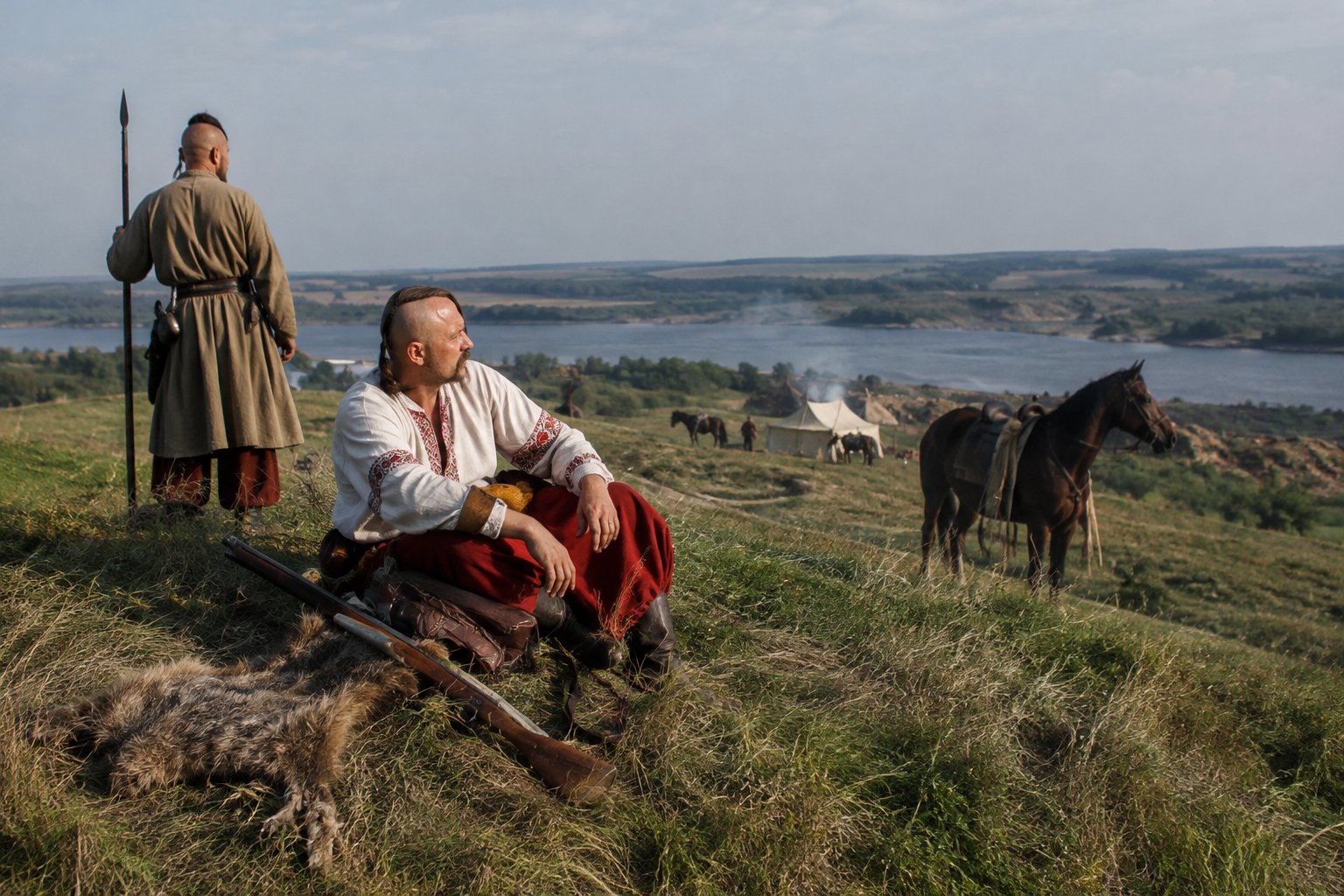
At Mamay-Gora in Zaporizhzhia, on the lower Dnipro in medieval Ukraine, one excavated man dated to around AD 1450 carries an unusually specific paternal label in modern reporting: J1a2a1a2d2b2b2c4d2a2a5a. He appears in the record as UKR020, and that single identifier is enough to make the find interesting. Not because one burial can stand for a whole people, plainly it cannot, but because it places a very narrow Y-chromosome branch in one of the great crossroads of eastern European history.
The lower Dnipro was never a quiet backwater. It sat between steppe and sown land, between Black Sea routes and the forested north, between nomadic confederations, Slavic-speaking communities, Crimean networks, and wider Eurasian exchange. A direct paternal lineage like this one tracks only one line of descent, father to son, yet even that thin line can be historically revealing when it turns up in a place as mixed and strategic as medieval Zaporizhzhia.
Mamay-Gora is important less for a single glamorous discovery than for its setting. The site lies in a region that archaeologists and historians often describe as the North Pontic zone: the broad northern hinterland of the Black Sea, where movement was constant and identities were rarely simple. By the fifteenth century, this was a landscape shaped by the legacies of the Golden Horde, the rise of Crimean Tatar power, trade through Black Sea ports, and the shifting frontier worlds that later fed into Cossack history.
An ancient DNA study examining mobility in Ukraine from the Bronze Age to the early modern period has treated this wider region precisely as a zone of long-term contact rather than a sealed ethnic block. That framing matters here, because a lineage such as J1a2a1a2d2b2b2c4d2a2a5a is best understood not as a badge of one medieval identity, but as evidence of how male lines could appear, persist, or be introduced within a remarkably connected frontier. The relevant research context can be found here: North Pontic crossroads: Mobility in Ukraine from the Bronze Age to the early modern period.
That broader regional perspective is especially useful because the sample information for UKR020 is spare. We know the location, the approximate period, and the reported association with this branch. We do not, on the evidence given here, have a securely detailed biography, a list of grave goods, or a fully published social profile for this individual. So the responsible question is not "who exactly was he?" but "what does his paternal line add to the known history of this region?"
The full label J1a2a1a2d2b2b2c4d2a2a5a is a very fine-grained branch within the larger Y-DNA haplogroup J1. That distinction is crucial. The wider J1 family has a deep and geographically broad history across parts of West Asia and adjacent regions, but it would be careless to pour all of that vast background straight into this one late medieval Ukrainian result. A narrow branch is not automatically a map of the whole parent haplogroup.
What can safely be said is that the paternal line reported for UKR020 fits the historical character of the North Pontic world: a place where ancestry from different directions could meet. In the late medieval lower Dnipro, one should expect precisely this sort of complexity. Political rule, raiding, marriage, trade, military service, slavery, resettlement, and religious networks all moved people across this zone long before modern borders tried to tidy it up.
That is why one medieval J1 lineage in Ukraine should not be treated as an anomaly needing some dramatic single-event explanation. It may reflect recent mobility in the medieval period, or older layers of contact carried forward through generations. Ancient DNA is very good at showing that such possibilities existed; it is less good, especially from a lone sample, at choosing one tidy historical story among them.
A date around AD 1450 places UKR020 in a particularly revealing moment. This was after the Mongol imperial age had transformed Eurasian communications, after centuries of movement across the steppe, and during the period when the Black Sea littoral remained deeply entangled with Turkic, Slavic, Caucasian, and Mediterranean worlds. A paternal line of this sort appearing in Zaporizhzhia is therefore historically plausible in several different ways.
That is worth stressing because readers sometimes imagine medieval eastern Europe as if every village were genetically self-contained. The archaeology and written history of the Pontic zone say the opposite. Frontier settlements and burial grounds in this region often belonged to populations living amid traffic, conflict, and negotiation. A lineage like J1a2a1a2d2b2b2c4d2a2a5a sits comfortably inside that picture of a lived borderland.
There is also a useful chronological point here. By the fifteenth century, the North Pontic region had already absorbed many earlier demographic layers: Bronze Age populations, Iron Age steppe groups, classical-era Black Sea connections, medieval Slavic expansions, and the aftereffects of steppe empires. A late medieval Y-chromosome result is therefore a window onto the end of a long process, not its beginning.
If one looks beyond this single burial, the wider Black Sea and steppe world repeatedly turns up genetic evidence for mixed origins and shifting affiliations. That does not prove that every J1-bearing man in the region came by the same route, of course. But it does make UKR020 look less like an outlier and more like part of a larger pattern in which paternal lines from different geographic backgrounds became woven into local communities.
For MyTrueAncestry readers, that is often the most useful historical lesson. Y-DNA branches are not little ethnic flags pinned to a map forever. In contact zones, the same direct male line can pass through different languages, religions, polities, and social worlds over time. A man buried in medieval Ukraine may carry a paternal lineage with a deeper history elsewhere, yet in archaeological terms he belongs first to the community and period in which he was buried.
That is one reason the North Pontic region keeps rewarding archaeogenetic study. It refuses simple categories. The old habit of dividing the past into neat civilizational boxes does not survive well when graves from the Black Sea hinterland begin yielding DNA.
Because the evidence here centers on one named individual, the right approach is careful rather than expansive. We should preserve the exact sample ID, UKR020, the place, Mamay-Gora, Zaporizhzhia, and the approximate date, around AD 1450. We should also keep clear the level of certainty: the article's haplogroup is the reported branch linked to this sample, but one burial does not establish the full history, frequency, or homeland of that subclade by itself.
Still, one good burial can do something valuable. It can anchor a discussion in a real excavated person and force us to see medieval Ukraine as it was: connected, exposed, and populated by people whose paternal histories did not always match modern national expectations. That is exactly the kind of correction ancient DNA is best at making.
Mixed origins in Late Antique Bulgaria
For someone researching the paternal line J1a2a1a2d2b2b2c4d2a2a5a today, the most defensible insight is not a claim of royal descent or a single dramatic migration. It is something more interesting, and more historically truthful: this branch is documented in a real medieval man from the lower Dnipro, in one of Eurasia's great contact zones. That places your direct paternal line, at least in one known case, inside the complicated human traffic of the North Pontic world, where steppe, river, and Black Sea histories met.

Comments