Haplogroup E1b1b1b2a1a4
– 4 min read


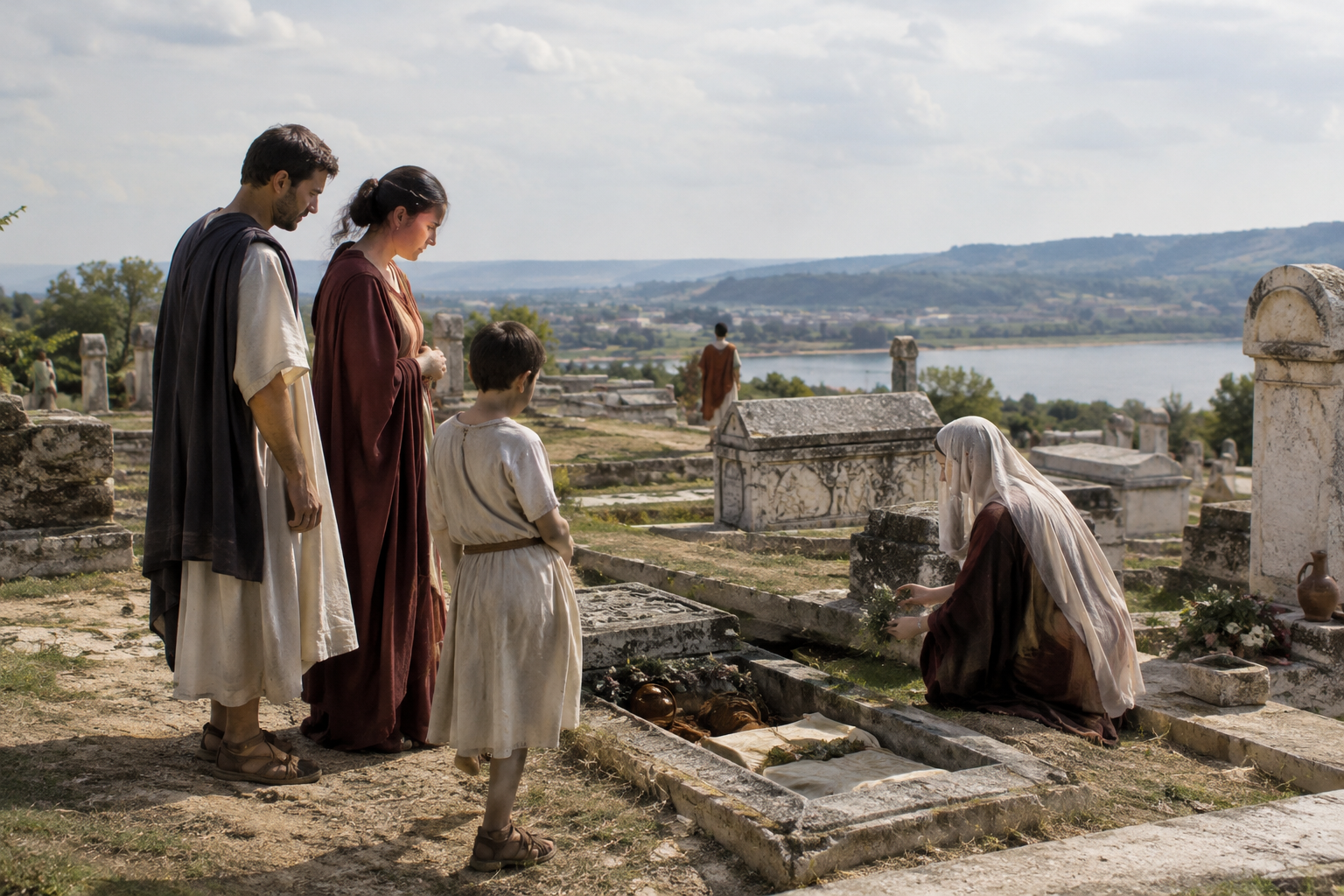
At Viminacium in Serbia, one man buried in the Late Roman period has become a particularly useful signpost for tracing the paternal line E1b1b1b2a1a4. The individual is sample I15526, dated here to around AD 200 and recovered from the Vise Grobalja necropolis, part of the vast cemetery landscape of a major Roman city on the Danube frontier.
That setting matters. Viminacium was not a quiet provincial backwater. It was a legionary centre, an administrative hub, and a place where soldiers, traders, migrants, families, and local communities all met under Roman rule. So when a Y-DNA branch like E1b1b1b2a1a4 appears there, the interesting question is not whether this was a "Roman" lineage in any simple ethnic sense. It is how one paternal line found its place inside a frontier city built on movement, empire, and mixture.
Viminacium lay in what is now Serbia, near the meeting zones of the central Balkans and the Danubian limes. In the second and third centuries AD it was one of the most important urban and military centres in the region, associated with the Roman province of Moesia and the great defensive and commercial system that ran along the Danube.
Sample I15526 comes from the Vise Grobalja Necropolis, a burial ground linked to that urban world. Even with sparse personal details, the archaeological context tells us a great deal. This was a cemetery serving a settlement connected to imperial administration and long-distance mobility, so the presence of E1b1b1b2a1a4 is best read within a mixed Late Roman population rather than as a marker of a single tribe, language, or political identity.
An ancient DNA study examining these Balkan and frontier-era burials helped show just how varied the region could be under Roman rule, with individuals reflecting different strands of local and wider imperial ancestry. That larger research frame is the right one for understanding I15526 rather than isolating him as an oddity or trying to force him into a neat ethnic box. See the research here: https://www.sciencedirect.com/science/article/pii/S0092867423011352.
Y-DNA follows one direct paternal line: father to son to son across generations. That makes it powerful for tracing deep male-line history, but limited as a guide to a person's entire ancestry. A man carrying E1b1b1b2a1a4 in Roman Serbia could still have had ancestors, in every other branch of his family tree, from many different parts of the Balkans and the wider empire.
It is also worth being precise about scale. E1b1b1b2a1a4 is a narrow sub-branch within the much wider E1b1b paternal family. The broader E1b1b clade has a long and complicated history across parts of Africa, the Mediterranean, and southeastern Europe, but those broad patterns should not simply be pasted onto this exact subclade without direct evidence. What the Viminacium find securely gives us is a documented appearance of this paternal line in a real Late Roman burial context on the Danube.
Modern readers sometimes imagine frontier provinces as edges of civilization, inhabited by a few soldiers glaring across a river. Archaeology gives a very different picture. The Balkans under Rome were dense with roads, forts, cemeteries, workshops, farms, and towns. They were also deeply connected to military service and state logistics, which meant constant circulation of people.
That makes Viminacium an especially revealing place to encounter E1b1b1b2a1a4. A paternal lineage found there may reflect local Balkan continuity, movement from elsewhere in the eastern Mediterranean, service-related mobility, or some combination of all three. In Roman contexts, those are not competing stories so much as overlapping ones. Empires gather people together, and cemeteries preserve the result.
With only one explicitly listed ancient carrier here, caution is essential. One individual does not define the whole city, still less the whole haplogroup. But a single securely placed sample can still be historically important when it sits in a site as rich and connected as Viminacium.
I15526 anchors E1b1b1b2a1a4 in a documented archaeological landscape: an urban necropolis in a Roman frontier province around AD 200. That is far more useful than a floating genetic label. It tells us that this line was present not in abstraction but among the populations living and dying in one of the empire's major Balkan centres.
This is one reason Roman-period DNA has changed the conversation so much. Instead of treating ancient populations as fixed blocks, it lets us see ordinary complexity: lineages appearing in garrison towns, port cities, cemeteries, and rural communities where identities were layered and local histories mattered. For the Roman world, that complexity is not a side note. It is the main story.
For someone researching this haplogroup today, the Viminacium evidence suggests a paternal line that could have participated in the dense human traffic of southeastern Europe and the Roman imperial sphere. That is a historically rich setting. The Balkans were a place where local communities, imperial institutions, and longer Mediterranean connections met repeatedly over centuries.
It also means that the most sensible historical frame for E1b1b1b2a1a4 is neither narrowly national nor romantically tribal. The better image is the Roman Balkans themselves: multilingual, militarized, urbanizing, and full of family histories that crossed provincial boundaries. Sample I15526 does not solve the whole origin story of the branch, but he does place it firmly inside one of antiquity's great contact zones.
The clearest thing we can say about E1b1b1b2a1a4 from the evidence here is that this paternal line was present in the Late Roman Balkans at Viminacium, represented by sample I15526 from the Vise Grobalja necropolis around AD 200. That does not turn the haplogroup into a single "Roman" identity, but it does place it in a real imperial community shaped by mobility, mixing, and local continuity. For descendants exploring this line today, that is a meaningful starting point: not a legend, but a man in a cemetery at one of Rome's great Danubian cities.
Comments