Haplogroup G2a2a1(xG2a2a1a2)
– 5 min read


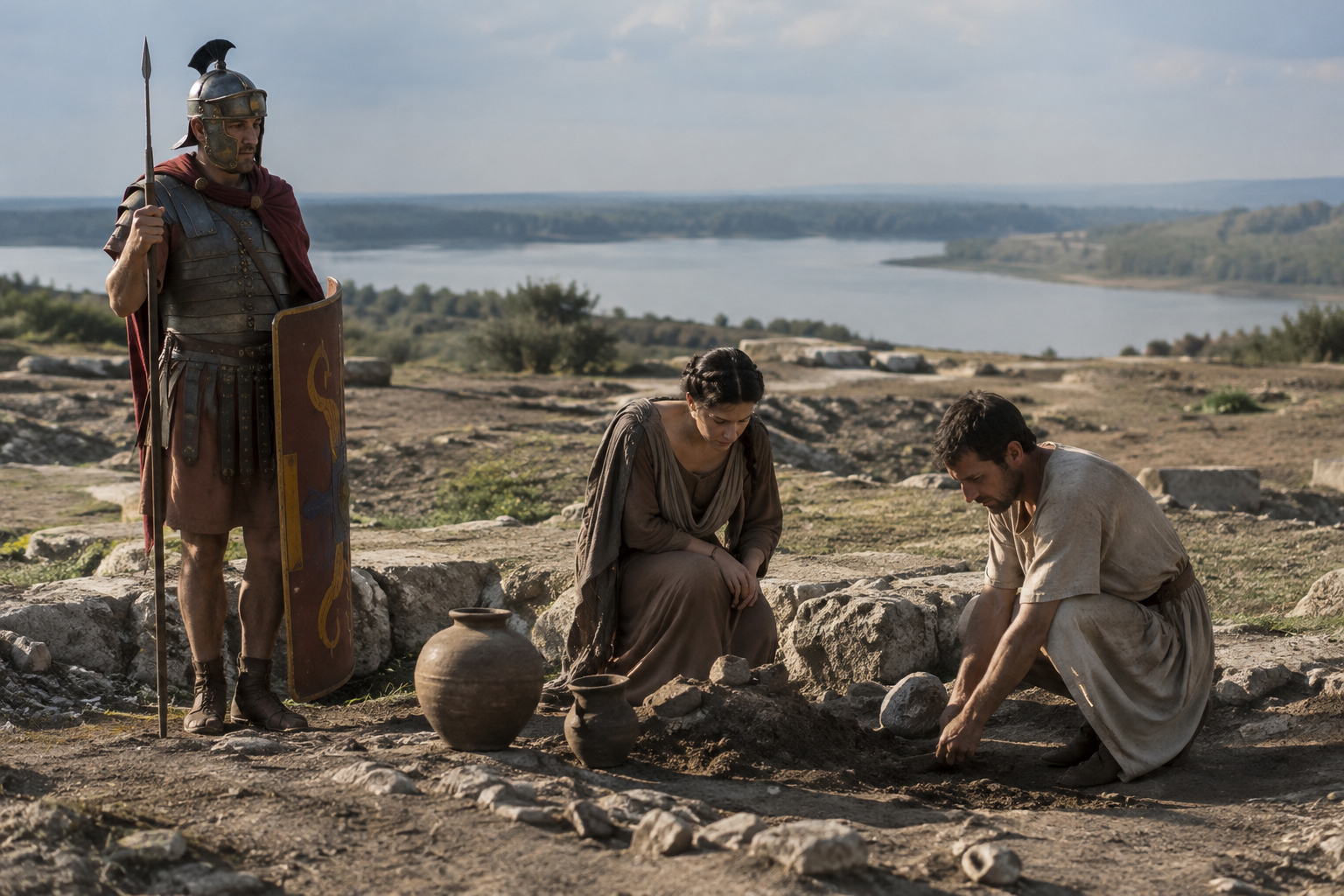
At the Late Roman site of Viminacium in Serbia, one man buried in the Pirivoj necropolis around AD 225 has become a small but telling witness to the complexity of empire. He is identified as sample I15510, and his Y-DNA was reported within the branch G2a2a1(xG2a2a1a2). That may look like a forbidding string of letters and numbers, but in historical terms it points to something rather human: one paternal line moving through a world where soldiers, merchants, officials, families, and local communities were all drawn into the Roman orbit.
Viminacium was no obscure outpost. It was one of the major centers of the Middle Danube, a legionary base and provincial capital in what is now Serbia. By the 3rd century AD, it stood in a frontier zone that was never simply Roman versus non-Roman. It was a place where local Balkan people, migrants from elsewhere in the empire, and newcomers from beyond the frontier could all end up living, serving, trading, and being buried in the same landscape. In that setting, G2a2a1(xG2a2a1a2) is interesting not because it lets us pin a single ethnicity onto one man, but because it joins archaeology and genetics in showing how mixed and mobile that world could be.
The haplogroup label here needs careful reading. G2a2a1(xG2a2a1a2) means a paternal lineage within the broader G2a family, but specifically excluding the downstream branch G2a2a1a2. In other words, this is not a fully resolved terminal twig so much as a defined position on a larger branch. That matters, because one should not pile onto it a whole dramatic migration story that the evidence does not actually support.
Still, the wider G2a family has deep importance in European prehistory. Branches of G2a are famously associated with some of the early farming populations who spread into Europe during the Neolithic. By the Roman period, however, any simple equation had long since broken down. A man carrying G2a2a1(xG2a2a1a2) in AD 225 was not a "Neolithic farmer" in any cultural sense. He was a Late Roman individual whose direct paternal line happened to preserve one much older strand within the very crowded genetic history of Europe and the Near East.
The real force of sample I15510 lies in the setting. Viminacium sat on the Danube frontier, in a corridor that linked the Balkans, Central Europe, and the wider Mediterranean. Armies moved through it; so did administrators, camp followers, traders, and displaced people. In the 3rd century, especially, this was an empire under pressure, with political upheaval, military recruitment, and frequent movement across provincial boundaries.
That is why one ancient Y-chromosome here is best read as part of a social landscape rather than as a badge of identity. Y-DNA traces only a direct paternal line. It does not tell us a person's full ancestry, first language, or legal status. But in a place like Viminacium, even one lineage can be revealing. It reminds us that Roman frontier populations were not genetically uniform blocs. They were assembled, over generations, from many different family histories.
An ancient DNA study of this wider Viminacium material, published in research on the ancient population of the Central Balkans and the Roman frontier, helped illuminate exactly that broader pattern: these cemeteries preserve evidence for striking diversity, shaped by local continuity as well as mobility from different parts of the empire and beyond it.
The Pirivoj necropolis is a burial ground, not a neat ethnic filing system. Archaeologists can date burials, place them in a site context, and compare them with wider Roman-period practices. Genetics can add ancestry profiles and paternal or maternal lineages. But neither discipline, on its own, turns an excavated person into a tidy textbook category.
That is especially important in the Balkans, where historical labels can become rather too eager. A burial in Roman Serbia is not automatically "Roman" in the sense of immigrant from Italy; nor is it automatically "native," "Illyrian," "Thracian," or anything else just because later readers may want a familiar name. Sample I15510 belongs first to the archaeological reality of Late Roman Viminacium. The haplogroup adds another layer: his direct paternal line was one of the many older lineages still present in this imperial crossroads.
If this branch catches the eye, it is partly because southeastern Europe has an unusually long genetic memory. The Balkans were central to the first spread of farming into Europe, and they remained central later as a meeting ground between Mediterranean, continental, and steppe-connected populations. So when a G2a lineage turns up in a Late Roman cemetery, it can hint at deep regional continuity even within a thoroughly imperial setting.
But continuity is not the same as isolation. A paternal line may endure in one region for millennia while the rest of a person's ancestry shifts repeatedly through intermarriage and migration. That is one reason Roman-period DNA is so valuable: it shows how old lines survive inside new social worlds. In the Balkans, this is particularly vivid, because the region was both a cradle of long-term settlement and a passageway for armies and empires.
Readers interested in those deeper regional roots may want to compare this with broader work on the Balkans before Rome, including Balkan Hunter-Gatherers Shaped Post-Ice Age Europe, which shows just how long and layered the human story of the region really is.
What makes I15510 especially useful is that he fits a pattern now seen across the Roman world. Ancient DNA has been steadily undermining the old habit of imagining ancient populations as stable, bounded, and obvious to the eye. Instead, cemeteries from Britain to Iberia to the Danube frontier keep showing mixtures of local ancestry, long-distance mobility, and family histories that do not line up neatly with modern national maps.
That does not make the Roman Empire some uniformly blended soup. Local histories still mattered. Frontier zones differed from old Italian towns; military sites differed from villages; one cemetery could differ from the next. But Viminacium is an excellent case of how imperial power created conditions in which multiple ancestral strands could coexist in one community. A branch like G2a2a1(xG2a2a1a2), already ancient by AD 225, could persist there alongside many others because Roman society was constantly drawing people together.
Roman genetic mixing in Hispania
For someone exploring a present-day paternal line, the most distinctive thing about G2a2a1(xG2a2a1a2) is not a promise of one famous people or one dramatic migration. It is the evidence of persistence. In the case of sample I15510 from Viminacium, this branch appears in a man living in a Roman frontier city where old Balkan population history and the vast connective machinery of empire met face to face. That is a rather fine historical setting for a Y-line: deep roots, but no simple story.
If your own paternal ancestry falls on or near this branch, the strongest lesson from Viminacium is that such a lineage could endure through enormous cultural change, from prehistoric farming worlds to the urban and military societies of Rome. The Y-chromosome marks one line of descent; archaeology shows the much larger world that line had to navigate.
Comments