Haplogroup CT

– 6 min read


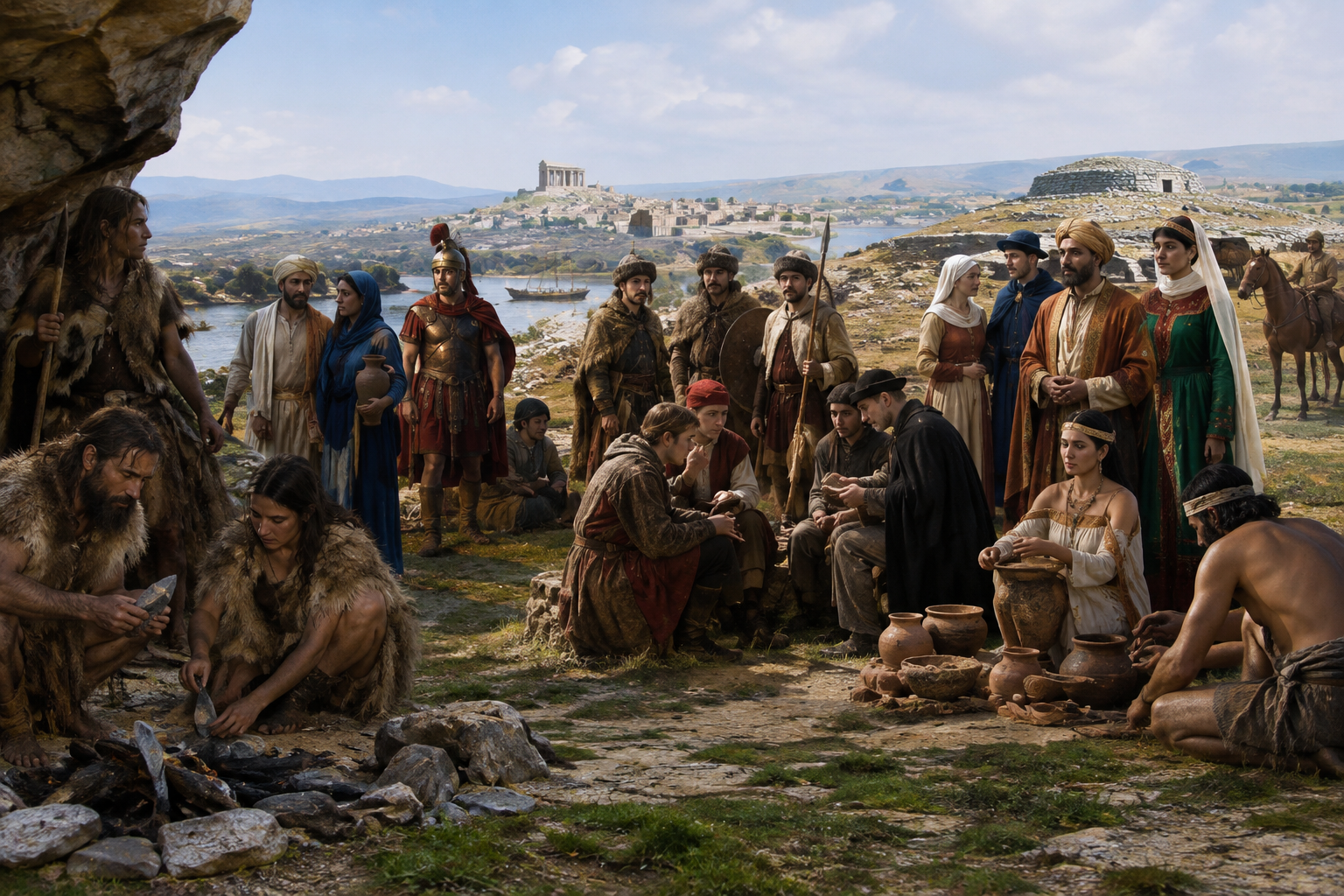
Haplogroup CT sits so high in the Y-chromosome family tree that writing about it is rather like writing about the foundation stones of a city instead of one particular medieval street. It is not a recent, local, or narrowly ethnic lineage. It is one of the great early branches in the paternal story of modern humanity, ancestral to most non-African Y-DNA lineages. That makes it historically fascinating, but it also demands caution: when we talk about CT, we are talking about a very deep paternal framework, not a neat badge for one people, one kingdom, or one dynasty.
That is worth stressing at the start. Y-DNA haplogroups trace one direct paternal line only: father to father to father. They do not describe a person's whole ancestry, culture, language, or identity. Still, ancient DNA has made CT especially interesting because it appears across an astonishing sweep of time and geography in the supplied material: from Natufian cave burials in the Levant to Bronze Age Bavaria, Iron Age Iberia, Roman Serbia, Migration Period Hungary, medieval Poland, Ireland, and even Funan-era Cambodia. If ever there were a haplogroup that reminds us how human history is about movement, mixture, and survival across millennia, this is it.
In phylogenetic terms, CT is an early major branch of the human Y-chromosome tree. Many later and better-known paternal haplogroups descend from it. So when CT appears in ancient or historical discussion, it often signals not a tight genealogical conclusion but a deep ancestral position. In some cases, ancient samples may be assigned only broadly to CT because preservation, coverage, or analysis could not refine them further. That matters because a broad assignment should not be treated as proof that two men from different centuries shared a recent paternal ancestor.
Even so, the spread of CT-assigned individuals tells us something important. It points to paternal lines that were already part of the populations expanding across western Eurasia and beyond in prehistory, and that later remained embedded in very different societies: foragers, early farmers, Bronze Age communities, Roman provincial populations, post-Roman mobile groups, and medieval townspeople.
Explore Archaeogenetics and Ancient DNA
Some of the most arresting evidence in the supplied material comes from the Levant. The Natufian-associated individuals from Raqefet Cave, I1685 dated to 9500 BC and I1690 dated to 7950 BC, place CT in one of the most discussed prehistoric landscapes in the world: the zone between hunter-gatherer life and the beginnings of more settled food-producing communities. Alongside them is I8554 from Ancient Jordan Amman Sahab, also dated to 7950 BC. These are not just dry sample labels. They come from a region central to debates about the early Holocene and the social worlds that preceded or accompanied farming.
From there, the story broadens dramatically. In Europe, CT appears in NEO7, the Bog Skeleton Denmark Sigersdal Mose dated to 3290 BC. It is a striking reminder that by the Neolithic, paternal lines within the broad CT umbrella were part of northern European populations as well. Another useful anchor is I3592 from Copper Age Alburg-Lerchenhaid Straubing Bavaria, dated to 2225 BC. Bavaria in the Copper Age sat within a world of changing exchange networks, shifting social hierarchies, and increasingly connected communities across central Europe.
And then we have I8571 from Bronze Age Tumulo Morterem Valencia Spain, dated to 1400 BC. By this point, CT-linked paternal lines are visible at the western Mediterranean edge of Europe too. What these sites collectively suggest is not a single migration event we can neatly draw on a map, but long-term persistence of deep paternal ancestry through successive prehistoric transformations.
Discover Denmark's Mesolithic-Neolithic DNA
Once we enter the first millennium BC and the Roman era, the samples become wonderfully historical in texture. I12042 from Iberian Iron Age Spain Ibiza Puig des Molins Spain, dated to 351 BC, places CT in the Balearic world at a time when Ibiza was tied into wider Phoenician and Punic networks. So too does I8038 from Carthaginian Era Mozia Western Sicily, dated to 400 BC. Mozia was one of those places where Mediterranean history becomes gloriously untidy: Phoenician, Punic, Sicilian, and later Greek and Roman worlds all overlapping.
Further east, I14636 from Achaemenid Empire Southeast Anatolia Batman Kuriki Hoyuk, dated to 550 BC, situates CT within the imperial borderlands of the Persian world. And then, improbably but importantly, there is I1680 from Funan Era Cambodia Angkor Borei Vat Komnou, dated to 156 AD. A broad CT assignment here is a reminder of just how deep and expansive this paternal branch is. It links no simple West-to-East tale; rather, it shows how one high-level Y-DNA node underlies lineages found across a vast portion of Eurasia.
The Roman and post-Roman samples are equally revealing. I15511 from the Late Roman Empire Viminacium Serbia Pirivoj Necropolis, dated to 225 AD, belongs to a city on the Danubian frontier where soldiers, traders, families, and administrators circulated through imperial space. In northern Europe, PCA0494 from Iron Age Pommerania Gdansk Wielbark, dated to 200 AD, places CT in a region often discussed in relation to Baltic and Gothic-era archaeology. None of this proves ethnic labels from DNA alone, but it does show paternal continuity and diversity across frontier societies.
Explore Ancient DNA from Mediterranean Islands
The medieval material brings the story from prehistory into documentary landscapes. In Hungary, RKF022 and RKF233 from Migration Period Hungary Rakoczifalva, both dated to 650 AD, and KFJ002 from Avar Period Hungary Kunszallas Fulop Jakab, also dated to 650 AD, show CT-associated paternal ancestry in the Carpathian Basin during one of the most mobile and politically unsettled periods in European history. This was a world of post-Roman reorganization, shifting alliances, and mixed communities rather than tidy folk migrations.
There is a western counterpart in KIL017 from Medieval Ireland Kilteasheen Roscommon Bishops Seat, dated to 650 AD. Ireland's early medieval ecclesiastical and dynastic landscape looks very different from Avar Hungary, yet broad CT appears in both. The same is true later in eastern Europe with the four Kingdom of Poland Skoki Wielkopolska Vovoidship individuals: Skoki_S49, Skoki_S52, Skoki_S54, and Skoki_S57, all dated to 1400 AD. By then we are in the late medieval world of Christian kingdoms, parish networks, and written records, but the paternal line marker still reaches back into a much older human story.
The Iberian evidence rounds this out beautifully. I12650 from Al-Andalus Period Spain Valencia Carrer Sagunto, dated to 1200 AD, shows CT in a medieval Islamic context in Iberia. Taken together with the earlier Valencia Bronze Age sample I8571, it hints at the long and complex population history of eastern Spain across prehistoric, classical, and medieval eras.
Read About Roman Hispania's Genetic Legacy
In this case, the supplied field for associated noble families and castles is effectively empty. That absence is actually a useful reminder of method. Haplogroup articles can sometimes tempt us into leaping from an ancient burial to a medieval lord in a castle. But without explicit family data, we should not invent noble associations, ancestral seats, or dynastic claims.
What we can say is more general and, in its way, more interesting. The regions represented by these CT samples - the Levant, the Danube frontier, Sicily, Iberia, Poland, Ireland, the Baltic, and Southeast Asia - are exactly the kinds of regions where later noble houses, bishoprics, fortifications, and kingdoms emerged on top of much older settlement histories. Castles and lineages belong to the late chapters of a far longer human occupation. Ancient DNA helps us see that the men who built medieval societies did not appear from nowhere. They were the latest inheritors of paternal lines already present through countless earlier transformations.
So if a later noble family from Hungary, Poland, Ireland, Sicily, or Iberia were ever associated with a descendant branch under CT, that would not be surprising in the broadest sense. But broad plausibility is not proof. A shared high-level haplogroup cannot confirm descent from a specific dynasty, just as a castle cannot certify a Y-chromosome lineage.
CT is historically important precisely because it is so deep. It does not tell a narrow tribal story. It tells a foundational one. In the supplied ancient DNA, it appears among Natufian-era Levantine individuals, Neolithic and Bronze Age Europeans, Punic and Achaemenid settings, Roman frontier populations, Migration Period communities, and medieval burials from Ireland to Poland and Islamic Spain. That breadth is the point.
For family historians, this can be both thrilling and humbling. Thrilling, because a paternal haplogroup can connect your direct male line to some of the oldest recoverable chapters of human history. Humbling, because the deeper the haplogroup, the less it can say on its own about recent identity, surname, or noble pedigree. Ancient DNA is at its best when combined with archaeology, geography, and written history, each correcting the other's fantasies.
If you would like to see how ancient DNA comparisons can illuminate your own paternal and overall ancestry, MyTrueAncestry lets you explore links to ancient individuals and historical populations across the world. Those matches can offer remarkable historical perspective, even if they do not by themselves prove direct descent from a particular person or family.
Comments