George Bähr

– 5 min read


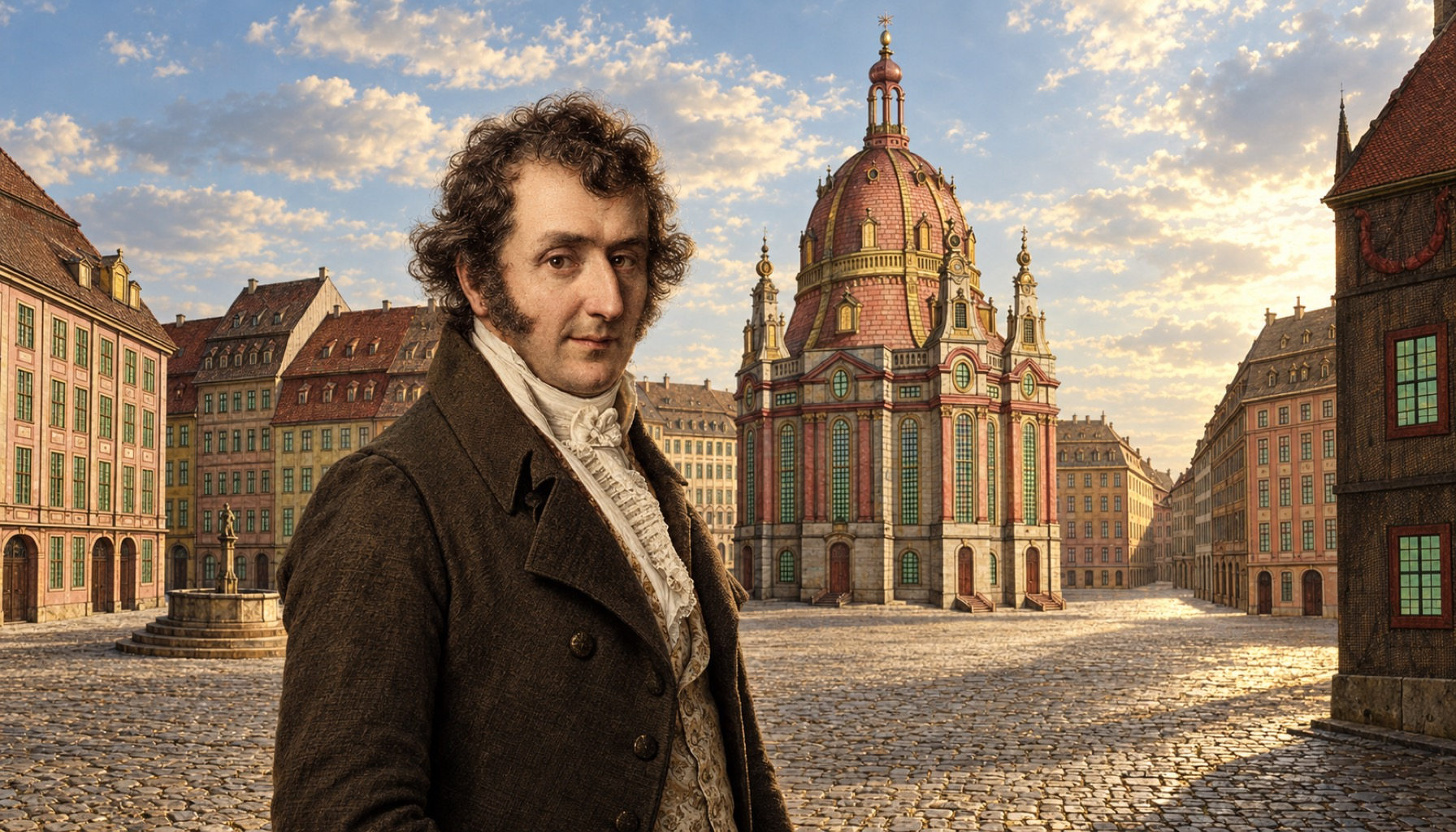
George Bähr was one of those figures who shaped a city so completely that his work became part of its identity. Born in Saxony in 1666, he rose from practical training as a carpenter and builder to become one of the most important German Baroque architects of his age. His name is inseparable from the Dresden Frauenkirche, the great Protestant church whose vast stone dome made it one of the most remarkable buildings in Europe.
He lived in the world of the Electorate of Saxony, in an era when Dresden was being transformed into a courtly and artistic centre under the Wettin rulers. This was the age of August the Strong, of Baroque spectacle, ambitious urban building, and confessional self-confidence after the upheavals of the seventeenth century. Bähr’s achievement belongs squarely in that setting: he was not simply designing a church, but helping to define the architectural language of Lutheran Saxony.
Bähr’s career is a reminder that early modern architecture was often built on craft knowledge as much as on drawing-room theory. Trained in timber construction and practical building, he developed increasingly bold ideas and eventually became Dresden’s master carpenter. That background mattered. The Frauenkirche was not merely elegant; it was structurally daring. Its enormous masonry dome, sometimes called the Steinerne Glocke or “stone bell,” was an engineering challenge as much as an artistic one.
The church became his masterpiece because it brought together liturgical function, urban theatre, and technical innovation. Protestant church architecture often placed great emphasis on preaching, visibility, and congregational space, and Bähr’s design answered that challenge on an extraordinary scale. He died in 1738, shortly before the church was fully completed, and so never quite saw the full afterlife of his creation. Yet that afterlife was immense. The Frauenkirche became one of Dresden’s defining landmarks and, even after its destruction in the twentieth century and later reconstruction, Bähr’s vision remained central to the city’s historical memory.
The biological sample associated with him is listed as George Baehr Architect Dresden Germany, dated to about 1738 AD. According to the research context provided by the Max Planck Institute for the Science of Human History, genetic analysis was carried out on remains associated with Bähr and generated hundreds of thousands of genome-wide markers. That is historically important because Bähr is not a shadowy prehistoric skeleton or a half-legendary nobleman, but a documented individual with a clear place in urban, architectural, and confessional history.
At the same time, one must be careful with language. The supplied information indicates that the remains were associated with George Bähr and used for genetic analysis, but it does not provide the full chain of identification in this summary. So the prudent description is that this is a strongly supported historical association rather than an identification we should embellish beyond the evidence given here. What makes the case compelling is the convergence of documentary history, burial context in Dresden, osteological remains, and genome-wide DNA data.
There is also a pleasingly archaeological aspect to all this. Bähr was a man of stone, timber, load-bearing walls, and structural calculation; now his own bones have become part of a modern investigation, read with methods no eighteenth-century master builder could have imagined.
See another identified German burial
The DNA findings reported for the Bähr-associated remains indicate a broadly Central European genetic background. Researchers also inferred light skin pigmentation and most likely brown eyes. These are not cinematic revelations, nor should they be treated as such. Rather, they add a modest but tangible biological layer to the portrait already supplied by records and history.
On the direct paternal line, the Y-chromosome haplogroup was reported here as R1b1a2a1a2, corresponding to the wider R1b-P312 branch mentioned in the historical summary. Y-DNA traces the direct male line only: father to son to son across many generations. It does not describe all of a person’s ancestry, only one very narrow lineage. Broadly speaking, branches of R1b-P312 are well documented across western and central Europe in both ancient and modern populations, but that does not make them an ethnic badge, nor does it tell us whether Bähr “belonged” to any particular tribe or people in a simple sense.
On the direct maternal line, his mitochondrial DNA was H35. mtDNA follows the direct maternal line: mother to child, then through daughters onward. Like the Y-chromosome, it captures just one thread in a far larger family tapestry. Haplogroup H and its sub-branches are widespread in Europe, and H35 in this context is best understood as a maternal lineage marker rather than a statement of identity.
What the genome adds, then, is not a dramatic rewrite of George Bähr’s life but a refinement. It places his biological ancestry comfortably within the Central European world in which the written sources already place him. It also gives a rare opportunity to compare a well-documented early modern individual with broader genetic datasets from older European populations.
Looking along Bähr’s direct paternal line, the R1b1a2a1a2 designation links him to a lineage with a deep time depth in Europe. Related ancient samples named in comparative datasets include George Baehr Architect Dresden Germany (Baehr) itself and individuals such as Piceni Italic Tribe Novilara Iron Age Adriatic Coast Italy (PN56), Migration Period Hungary Rakoczifalva (RKF266), Post Roman Arrabona Frigyes Laktanya Pannonia Prima Hungary (GYR002), and several Bronze Age Austrian individuals including UZH004, ULK011, UZH026, DSH027, PEB004, PEB012, PEB019, and DSH006. Other related examples include Late Imperial Roman Croatia Hvar Radosevic Palace (I33889), Ancient North Macedonia Vodovrati-Gradsko (I7233), and Thraco-Cimmerian Black Sea (MJ12). Such comparisons do not show descent from any one of these individuals. What they do show is that Bähr’s paternal line sits within a lineage spread through parts of prehistoric and historic Europe across many centuries and cultural settings.
For the maternal side, the H35-linked comparison is much narrower in the material supplied here, with George Baehr Architect Dresden Germany (Baehr) the named example. That limits how far one should generalize. Still, even a narrowly attested maternal assignment is useful because it anchors one specific line of Bähr’s ancestry and may become more informative as additional ancient and historical H35 samples are published in future research.
Explore Bronze Age Austria DNA
George Bähr is a particularly valuable case because he stands at the meeting point of text, monument, skeleton, and genome. We know who he was in history: a Saxon architect of the Baroque age, the mind behind one of Europe’s great Protestant churches. The DNA does not reveal his genius, his training, or the brilliance of the Frauenkirche’s design. Genetics cannot tell us how he thought about sacred space or how he persuaded patrons and builders. But it can test the biological profile of the remains associated with him, place him within a Central European genetic landscape, and recover a little of his physical ancestry from the bones of a thoroughly documented historical person.
That is what makes the study so interesting. It is not a fairy tale about DNA solving history all by itself. It is a good, sober example of different kinds of evidence working together: archival record, burial context, architectural history, osteology, and genome-wide analysis. In other words, very much the sort of thing historians and archaeologists like best when the evidence behaves itself.
If stories like Bähr’s fascinate you, MyTrueAncestry lets you compare your DNA with ancient populations and archaeological samples from the wider historical world that shaped Europe. You may discover genetic connections to lineages and populations linked to Central Europe, the Roman world, the Bronze Age, or later historical communities discussed in studies like this one.




Comments