Faroese Genomes Reveal Ancestry and Selection
– 4 min read


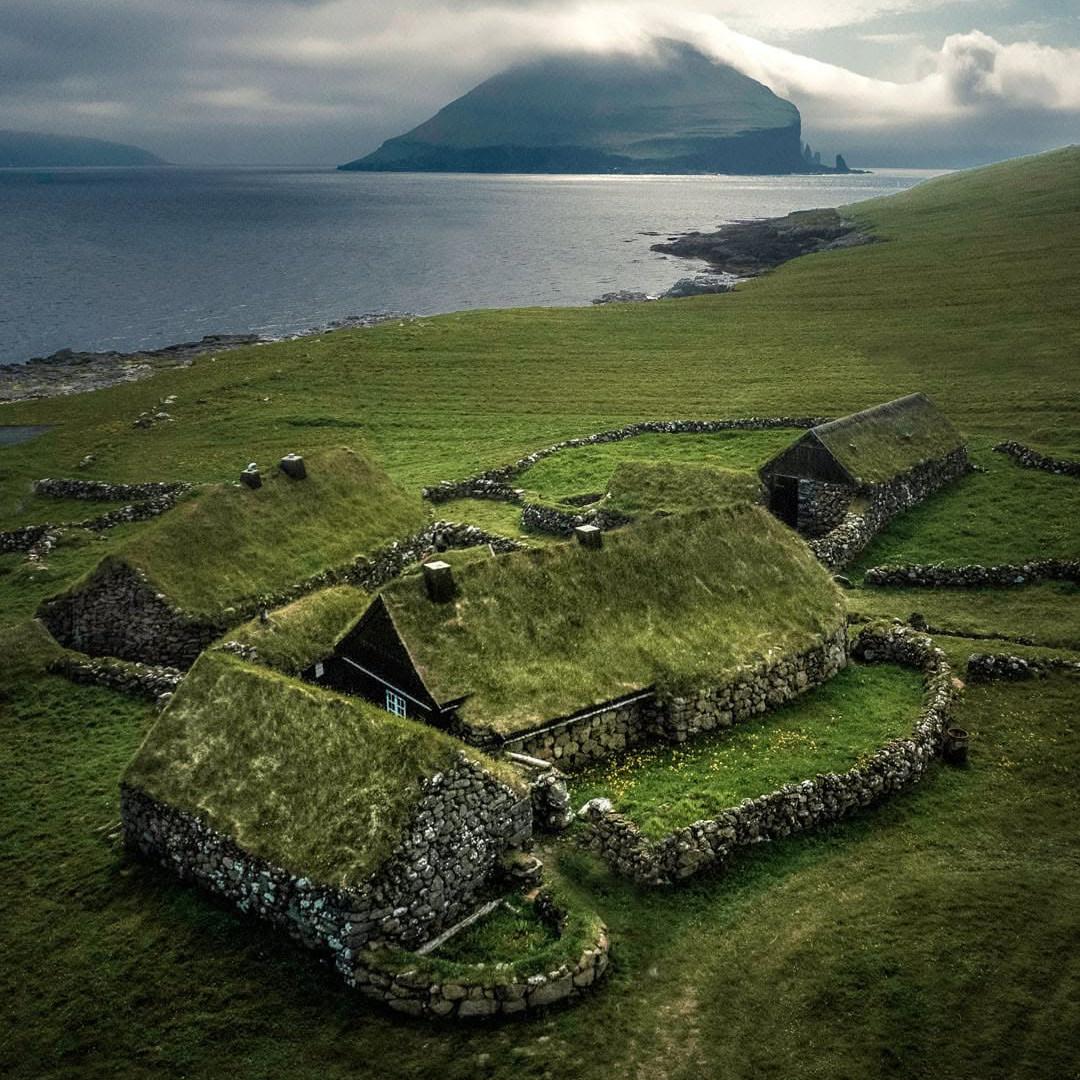
The Faroe Islands rise from the North Atlantic like steep, wind-cut giants, perched between Norway and Iceland. For centuries, people have asked who arrived first and what lives they made on these storm-battered islands. The answer is layered, and that is exactly what makes it thrilling.
Tradition favoured Viking settlers arriving in the ninth century. Yet archaeology disturbs neat stories. Buried ash, ancient graves, and traces of human activity suggest the islands may have been occupied before the Viking age began. Instead of one clean beginning, there may have been several.
The chapel site at á Bønhúsfløtu in Suðuroy is central to this mystery. A man buried there roughly 800 years ago stands out remarkably: his ancestry connects strongly with western Europe rather than Scandinavia, inviting comparison with old traditions of Irish monks at the site. One skeleton cannot solve everything, but one man in one grave can throw a shaft of light into a very dark corridor of history.
The burials at Sandur on Sandoy, though centuries later, matter equally. Their ancestry closely mirrors living Faroese people today, suggesting the islands' basic biological character was established long ago. Together, Suðuroy and Sandur reveal communities built from people of mixed backgrounds, arriving already shaped by earlier encounters across Britain, Ireland, and Scandinavia.
The first settlers remain partly elusive, but the ground has yielded enough to replace the simple Viking story with something richer: layered arrivals, mixed origins, and communities shaped by both movement and isolation. The dead stand as witnesses that settlement is not one event but a process, and that islands, for all their apparent loneliness, are often crossroads in disguise.
The most gripping figures in Faroese history are not kings or saga heroes but ancient individuals whose remains reveal who actually settled these islands. The standout is the man from á Bønhúsfløtu, dated around 800 years ago. His ancestry connects strongly with western Europe, the kind found in Iron Age Britain and France, rather than Scandinavia. He resists easy categories and is more compelling for it.
The later Sandur burials tell a complementary story. Their ancestry balances western and northern European roots almost equally, mirroring the modern Faroese population. This suggests the islands were settled by people already mixed before arrival, drawn from coastal Atlantic worlds where Scandinavian and western British or Irish connections had blended through marriage, trade, and travel.
Earlier research had hinted at differences between male and female ancestral origins, with more Scandinavian ancestry along paternal lines. Ancient individuals give these questions a human edge. These were not theoretical populations but real women and men living, moving, marrying, and dying on difficult northern islands, carrying complex pasts in their bones.
The Faroe Islands are a case study in what happens when a small number of people settle a remote place and remain relatively isolated for centuries. A few founding households arrive, have children, and those children marry within a limited pool. New arrivals come, but rarely. Century after century, descent lines cross and recross until a modern population emerges deeply connected through shared ancestry.
Living Faroese people show unusually long identical stretches of inherited DNA on both sides of their ancestry, signs that ancestors were related often enough for large matching blocks to remain. This signal is even stronger than in Finland, another famous founder population, suggesting the Faroes experienced a particularly powerful bottleneck.
A population of around 4,000 in the eighteenth century is small enough that almost everyone is linked in some fashion. Kinship is not abstract but a daily social fact. Burial grounds like Sandur embody this continuity physically, the resting places of generations shaped by the same narrow islands, the same food traditions, and the same restricted marriage network. Their mark is cumulative: centuries of endurance in a hard environment, producing a community unusually shaped by inheritance.
The Faroes are a place where people had to keep living under unusual conditions: cold seas, scarce sunshine, and a diet historically rich in animal and marine foods. Over generations, those pressures may leave traces in the body itself.
The adult ability to digest milk spread strongly across northern Europe and is linked to dairying. In the Faroes the signal appears weaker than in Britain, likely because traditional island diet relied more heavily on sheep fat, whale blubber, and cod liver than on cattle dairy. Less pressure, less intensification of the trait. Food history shapes biology.
More striking is a signal in a gene involved in processing bile acids, which help the body absorb fats and fat-soluble vitamins including vitamin D. In a place with limited sunshine and fat-rich traditional diets, bodies well suited to extracting nutrients from marine and animal foods may have had a real advantage. Another signal appears in a DNA repair gene, purpose still unclear, an excellent historical puzzle richer for remaining unsolved.
Selection simply means that in a given place and time, certain inherited features helped enough people survive that those features became more common. In the Faroes, this appears linked to food, sunlight, and the demands of northern island life. The environment does not stay outside people. It gets under the skin.
Rare inherited variants are like small buried objects in the body: unnoticed for long periods, then suddenly significant. In a founder population like the Faroes, they can become unexpectedly common, preserved and amplified where larger populations would dilute them.
The Faroese have unusually high rates of several conditions. Most dramatically, a variant connected to glycogen storage disease type three, affecting how the body handles stored sugar, has one of the highest known frequencies anywhere in the world. Somewhere in the ancestral chain, this variant entered the population and, through isolation and descent, remained and spread.
Other rare variants appear enriched in the Faroes, including one in the gene SERPINB10, possibly linked to ankylosing spondylitis, a painful inflammatory spinal disease. Intriguingly, the immune marker usually associated with that condition is not dramatically elevated in the Faroese, suggesting local rare variants may contribute alongside more familiar factors. Another variant in CCDC168 connects to eye pressure and corneal mechanics, illustrating how founder populations can bring rare biological events into sharper focus.
Understanding these variants is not merely abstract science. It can improve diagnosis, prevention, and care for living people. The demographic past remains active in clinics and family histories. The founder events, the chapel sites, the isolated churchyards all gave rise to lineages still carrying rare inherited consequences today. In the Faroes, archaeology is in the ground, history is in the records, and some of the most revealing evidence of all is carried quietly in the body.
Comments