Clan MacBean
– 3 min read


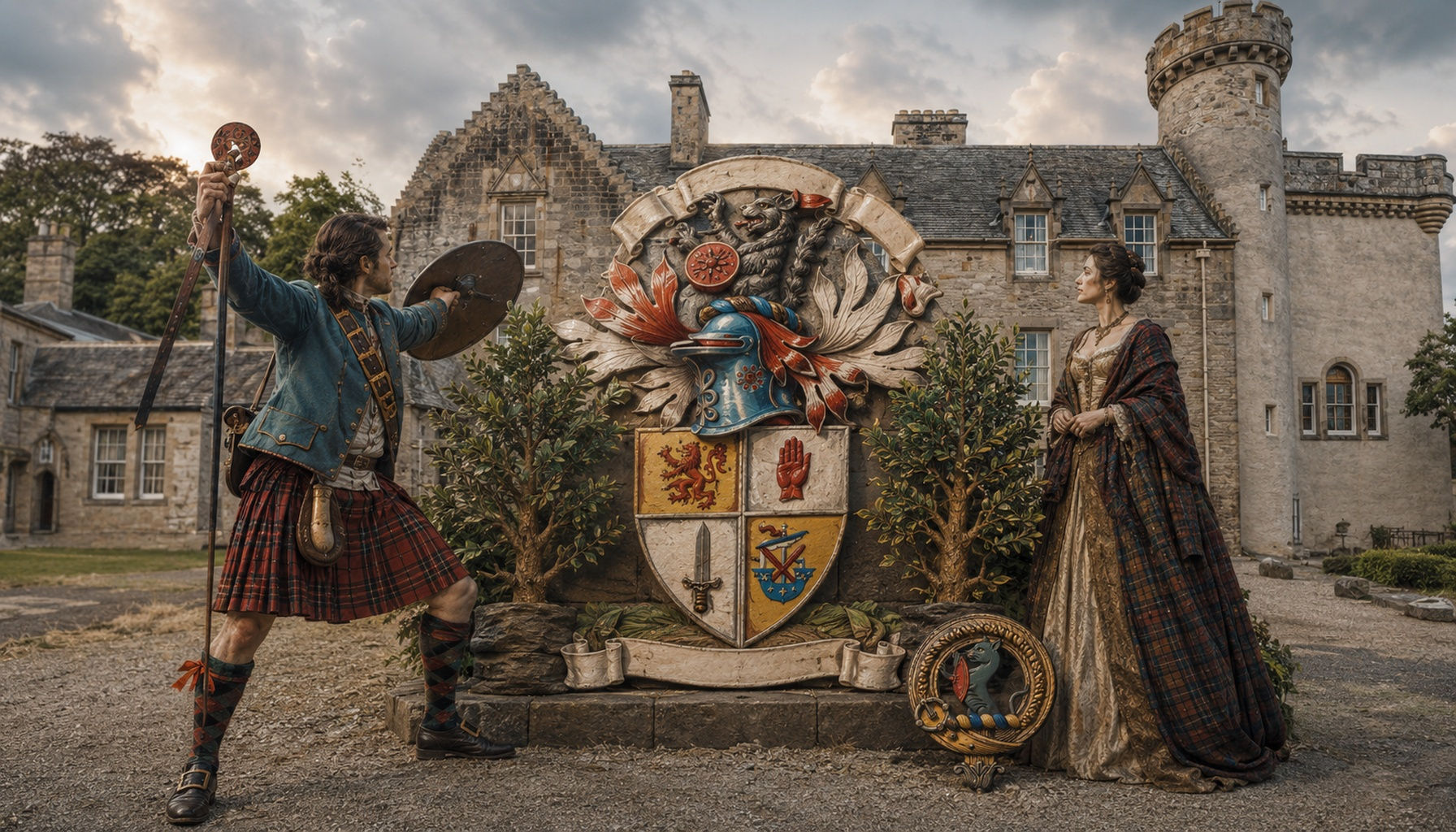
Clan MacBean was a Highland Scottish family rooted in Inverness-shire, shaped by Gaelic kinship, local power, and the hard practical business of survival in the central Highlands. As part of the wider Clan Chattan confederation, the MacBeans belonged to that very Highland pattern in which identity was not just about one surname in isolation, but about allied families, mutual defense, military service, and loyalty carried across generations. In genetic tagging terms, the primary family haplogroup linked here is R1b1a1b1a1a2c1a1f1a, a branch within the wider paternal lineages often associated with western Europe and frequently seen in populations tied to later Celtic-speaking regions.
The MacBeans emerged from a landscape where family history was never merely domestic. It was political, territorial, and sometimes violently public. Their story belongs to the world of Gaelic-speaking Highland society, where authority rested on bonds of kin, service, and reputation as much as on charters and parchment. Like other families within Clan Chattan, the MacBeans show how confederated strength worked in practice: smaller kindreds linked together for protection, status, and action in war. Their heritage carries the usual Highland ingredients in force: martial tradition, heraldic identity, regional memory, and that remarkable continuity of surname through centuries of upheaval, rebellion, clearance, and change.
One named figure who stands out in family memory is Gilles MacBean, remembered in 1746 in the grim shadow of Culloden. The battle has a habit of flattening Highland history into a single tragic tableau, but figures like Gilles remind us that clans were made up of individuals whose courage, loyalties, and losses were woven into much larger struggles. For the MacBeans, as for many Clan Chattan families, the eighteenth century was not simply an ending. It was a test of resilience. The family identity endured beyond battlefield defeat, beyond the reordering of Highland society, and beyond the pressures that drove so many names into migration, military service abroad, or quieter forms of local persistence.
A good place to anchor MacBean history in the landscape is Tulloch Castle, near Dingwall in Ross-shire, a Highland stronghold with roots going back to a fifteenth-century tower built for the Bain family, later expanded and altered over the centuries. In other words, this is not one of those castles that sprang fully formed from romantic imagination; it is a working Highland building, layered by ownership, rebuilding, and adaptation. The site later passed through the hands of notable families including the Davidsons and the Vickers, and the structure seen today is very much the result of long historical accretion. Its story fits Highland family history rather well: lineage, alliance, property, reinvention, and the occasional brush with legend. Tulloch Castle is also known in local tradition for ghost stories, which is exactly the sort of thing old Highland houses tend to collect as naturally as soot and genealogy. Yes, it can still be visited, as the castle survives today in hotel use, making it one of those rare family-history landmarks where the past is not merely on a plaque but inhabitable.
Read more about Clan MacKintosh
From an ancient DNA perspective, the MacBean-associated haplogroup tag R1b1a1b1a1a2c1a1f1a can be contextualized through related or linked ancient samples rather than claimed as direct ancestors. These include a notable cluster from Celtic Durotriges burials at Duropolis, Winterborne Kingston in England, such as WBK12, WBK20, WBK29, WBK41, WBK05, WBK30, WBK43, WBK06, WBK08, WBK18, and WBK191, alongside other linked individuals from Iron Age and later contexts across Britain and Europe: Celtic Briton Yarnton in Oxfordshire (I21182), Iron Age Worlebury in Somerset (I11991), Iron Age Battlesbury Bowl (I21309), Post Roman Worth Matravers in Dorset (I11580), Bronze Age Boatbridge Quarry in South Lanarkshire (I5473), Bell Beaker Upavon in Wiltshire (I4950), Bronze Age Amesbury Down (I2417), Trumpington Meadows (I3256), Bedfordshire samples I7576 and I7577, Hinxton Iron Age HI2, Early Bronze Age Thames I5377, and Rathlin2B from Copper Age Ireland. The wider linked network also reaches into Roman and medieval Europe, with samples such as I26776 from imperial-era Zadar in Croatia, R10656 from Late Roman Klosterneuburg, R10488 from Late Roman Conimbriga, IND013 from Merovingian Alt-Inden, ST2025 and ST1308 from medieval Sint-Truiden in Belgium, CGG023699 from Gallic France, VK242 from medieval Sandoy in the Faroe Islands, and VK386 from Viking Age Oppland in Norway. None of this proves descent from any one burial, of course, but it does place the MacBean-linked paternal signature within a broad archaeological world stretching from Bronze Age Britain and Iron Age Celtic communities to Roman frontier populations and medieval North Atlantic networks.
If you carry the MacBean surname, have roots in Inverness-shire, or simply suspect a Clan Chattan connection in your family tree, DNA can add an intriguing extra layer to the documentary story. Uploading your results can help you see whether you match Clan MacBean, related Highland families, or any of the ancient DNA samples linked to this broader paternal line. It is a modern tool, certainly, but one that sits rather neatly beside the older Highland obsession with memory, kinship, and belonging.
Comments