Clan Kinnaird

– 3 min read


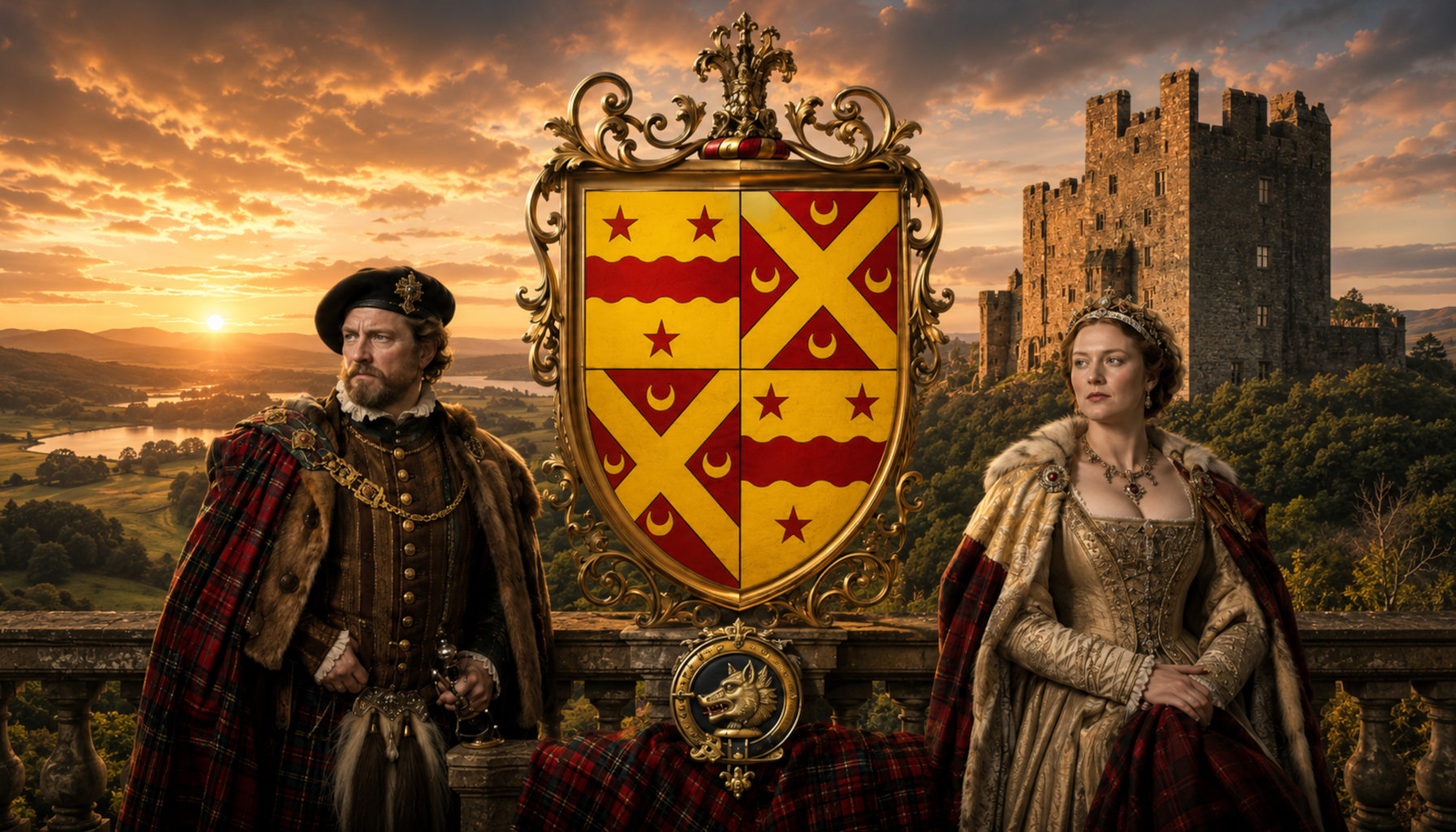
Clan Kinnaird was a Scottish noble and lairdly family rooted in the lands called Kinnaird, a place-name usually understood as meaning a high headland or high point. Their story belongs very firmly to eastern Scotland, especially Perthshire, Gowrie, and Angus, where landscape and lordship went hand in hand. This was the world of barons, estate holders, fortified houses, and royal service, where power was measured not only in acres but in loyalties, marriages, offices, and the ability to hold one's ground. For DNA tagging, the primary haplogroup linked here is R1a1a1b1a2b.
The Kinnairds emerged from place into lineage in the classic Scottish way: a family named from the land, then defined by its control of that land. Kinnaird Castle in Gowrie, with its strong, tower-like character, evokes the hard-edged realities of medieval and early modern Scotland, where lairds needed both status and stone walls. Over time the family rose through landholding, strategic marriage, military service, and political loyalty, eventually producing the Lords Kinnaird and figures active in wider Scottish public life. Their heraldry, rich in red and gold, with crescents, stars, and a wolf crest, gave the house a memorable visual identity as well as a social one. Among the best-known members were George Kinnaird, 1st Lord Kinnaird (1622-1689), who stood in the turbulent political world of seventeenth-century Scotland, and Charles Kinnaird (1780-1826), part of the family's later noble line as it moved into the modern age.
If one place anchors the later Kinnaird story particularly well, it is Rossie Priory near Inchture in Perth and Kinross. Despite the name, it is not a medieval priory in the monastic sense, but a country house that grew into an important Kinnaird seat. The estate passed into the hands of the Kinnairds and became closely associated with the family, especially after their older fortified residences spoke more to an earlier age of defence than to later aristocratic comfort. The present house is noted for its castellated and baronial appearance, shaped by later rebuilding and enlargement, and it sits in designed parkland that reflects the transition from feudal lordship to landed gentility. In other words, Rossie Priory shows the Kinnairds not simply as castle-holders, but as a family adapting across centuries, carrying medieval authority into the social language of the eighteenth and nineteenth centuries. The building and its grounds are known as a historic estate and can be viewed in the area, though access may depend on private ownership or event use, so it is sensible to check current visiting arrangements before setting out.
From a DNA perspective, the primary family haplogroup tag here is R1a1a1b1a2b, a branch with a wide and fascinating ancient footprint across Eurasia. That does not mean the Kinnairds descend directly from any particular excavated individual, and it is important not to pretend otherwise. What it does mean is that related or linked ancient DNA samples assigned to this broader paternal line appear in a remarkable range of archaeological settings: Scythian Ukraine at Medvyn Tract Girchakiv Lis (UKR035AB), Bronze Age Unetice burials at Leubingen in Thuringia (LEU027, LEU017), Avar elite graves in Hungary at Rakoczifalva (RKC052, RKC051) and Kunpeszer (KUP015), Bronze Age Hungary in the Balaton region (S9), Late Antique Pannonia at Arrabona in Hungary (GYS045, GYS058), Gothic-associated Poland at Strzyzow Wielbark (PL046), Piast-era and Piast-dynasty contexts in Santok, Greater Poland, Lubusz, Masovia, and Silesia (including PCA0393, PCA0404, PCA0520, PCA0216, PCA0381, PCA0382, PCA0564, PCA0211, PCA0350, PCA0317, PCA0198), Bronze Age Estonia and later Baltic contexts (0LS11, X15, X13, V16, VII15), medieval Belgium at Sint-Truiden (ST2653), western Slav settler cemeteries in medieval Sachsen-Anhalt (NDW036, NDW071, NDW013, NDW017, NDW025, NDW038, NDW039, NDW043, SDN028, SDN029), the Duchy of Sandomierz region (PDH011, PDH012), Thuringii tribal Germany (DRH007), Bronze Age Austria (DSH014), Iron Age Poland at Grodek nad Bugiem (GRK003, GRK008), early medieval Croatia (VEM035, VEM049), Iron Age and Germanic Denmark (CGG107504, CGG107512), Belgic Iron Age France (CGG022433), Early Nordic Bronze Age Norway (CGG105610), Late Bronze Age Germany and Poland (I0099, poz230, poz788, poz556, poz790, poz711), Bronze Age Romania (I6185), Roman-era Serbia (R9673), Late Bronze Age Bohemia (I13795), the Late Xiongnu world in Mongolia (NAI002), Trans-Volga Corded Ware-related contexts (kzb005, kzb008), and even a Hungarian conqueror burial (K2per36_GE). The point is not a neat family tree stretching from the steppe to Perthshire, but a deep paternal horizon: one that reminds us how Scottish surnames sit atop far older layers of movement, survival, and reshaping across Europe and beyond.
Explore the Piast rulers and DNA
If Clan Kinnaird is part of your story, the real pleasure lies in joining the paper trail of lairds and estates to the much deeper record hidden in DNA. Upload your DNA to MyTrueAncestry to see whether you match Clan Kinnaird, or any of the related ancient R1a1a1b1a2b-linked samples that illuminate the wider human background behind the name.






Comments