Clan Keating
– 3 min read


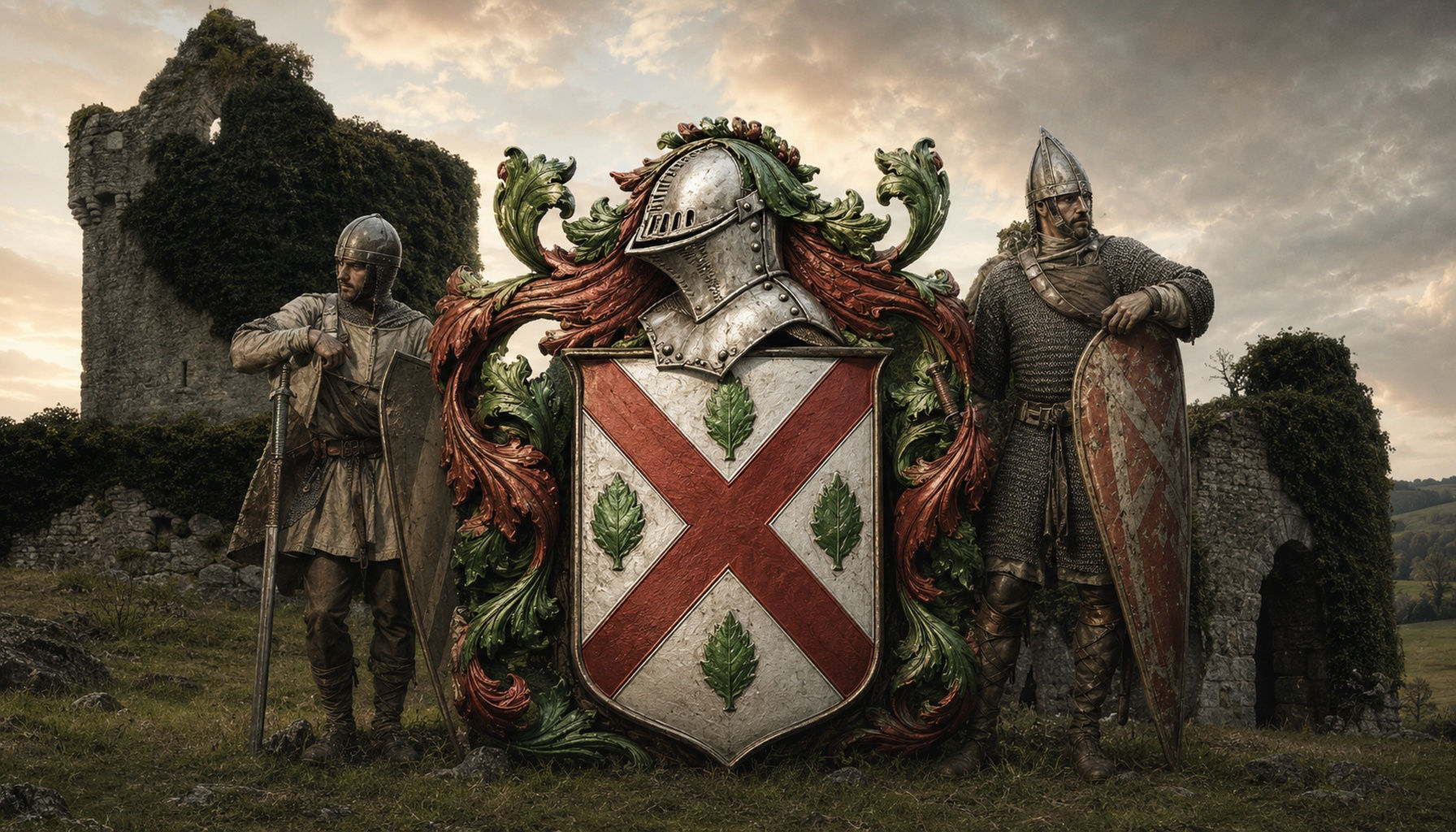
Clan Keating was one of the Norman-origin families that came into Ireland in the wake of the medieval Anglo-Norman settlement and became deeply associated with Munster. Over generations, the Keatings moved from being newcomers of continental and Anglo-Norman stock into the familiar pattern of a Norman-Irish family: landholding, military and civic service, local authority, marriage alliances, heraldic identity, and long continuity through centuries of upheaval. In haplogroup terms, the primary family line here is tagged with R1b1a1b1a1a2c1a4b2b1, a paternal branch linked with wider western European lineages.
What makes the Keatings so interesting is precisely that mixture of arrival and belonging. They came from the world shaped by Norman expansion, castle-building, lordship, and feudal settlement, yet in Ireland they became part of regional life in a thoroughly Irish way. Their story is not simply one of conquest, but of establishment and integration: estates rooted in the landscape, service to crown or locality, surnames carried forward through changing regimes, and a family memory that could look both to Ireland and to older continental origins. A notable figure from the lineage is Geoffrey Keating (1569-1644), the celebrated priest, poet, and historian whose writings became central to the telling of Ireland's past.
A particularly useful location anchor for the family story is Baldwinstown Castle in County Wexford, a place that still carries the atmosphere of the medieval and later world in which families like the Keatings operated. The castle is a tower house, associated in local tradition and antiquarian record with the network of Old English and Norman-descended families settled in the southeast. The surviving structure stands as a compact but eloquent reminder of the kind of residence that was not merely domestic, but defensive, symbolic, and social all at once. These were buildings from which land was managed, alliances maintained, status displayed, and local influence exercised. The antiquarian description notes features typical of a fortified residence of its kind, and the fact that it survives at all makes it valuable as a physical bridge to the era of medieval settlement and adaptation in Ireland. It appears to remain extant and visible, so it can reasonably be said to be a site that can still be visited, at least from the surrounding area if access conditions vary.
From a DNA perspective, the Keating haplogroup tag R1b1a1b1a1a2c1a4b2b1 sits within a paternal world that turns up in a broad sweep of ancient western European contexts. Related or linked ancient samples include Celtic Durotriges individuals from Duropolis at Winterborne Kingston in England such as WBK12, WBK20, WBK29, WBK41, WBK05, WBK30, WBK43, WBK06, WBK08, WBK18, and WBK191, along with later and wider examples such as ATP_PSN_192 from medieval Cambridge, I26776 from Imperial Roman Zadar, KD061 from Bronze Age Orkney, GMO015 from Bronze Age Calabria, ST2025 and ST1308 from medieval Belgium, CGG023699 from Gallic France, I11580 from post-Roman Dorset, IND013 from Merovingian Germany, R10656 from Late Roman Austria, R10488 from Late Roman Portugal, I11991 from Iron Age Somerset, I21309 from Iron Age Battlesbury, I3256 from Bronze Age Trumpington, I2417 from Amesbury Down, I4950 from Bell Beaker Wiltshire, I7576 and I7577 from Bronze Age Bedfordshire, I5473 from South Lanarkshire, HI2 from Iron Age Hinxton, I5377 from Early Bronze Age England, and Rathlin2B from Copper Age Ireland. These do not prove direct descent from any one individual, of course, but they do place the Keating paternal signature within a very old and very recognisable Atlantic-facing European story that reaches from prehistoric Britain and Ireland into Roman and medieval populations.
Explore ancient DNA and Celtic origins
If you carry the Keating surname, have Keating ancestors in Munster, or simply want to see how family history and archaeogenetics can meet, you can upload your DNA to MyTrueAncestry and explore whether you match Clan Keating or any of these related ancient DNA samples.
Comments