Clan Joyce

– 3 min read


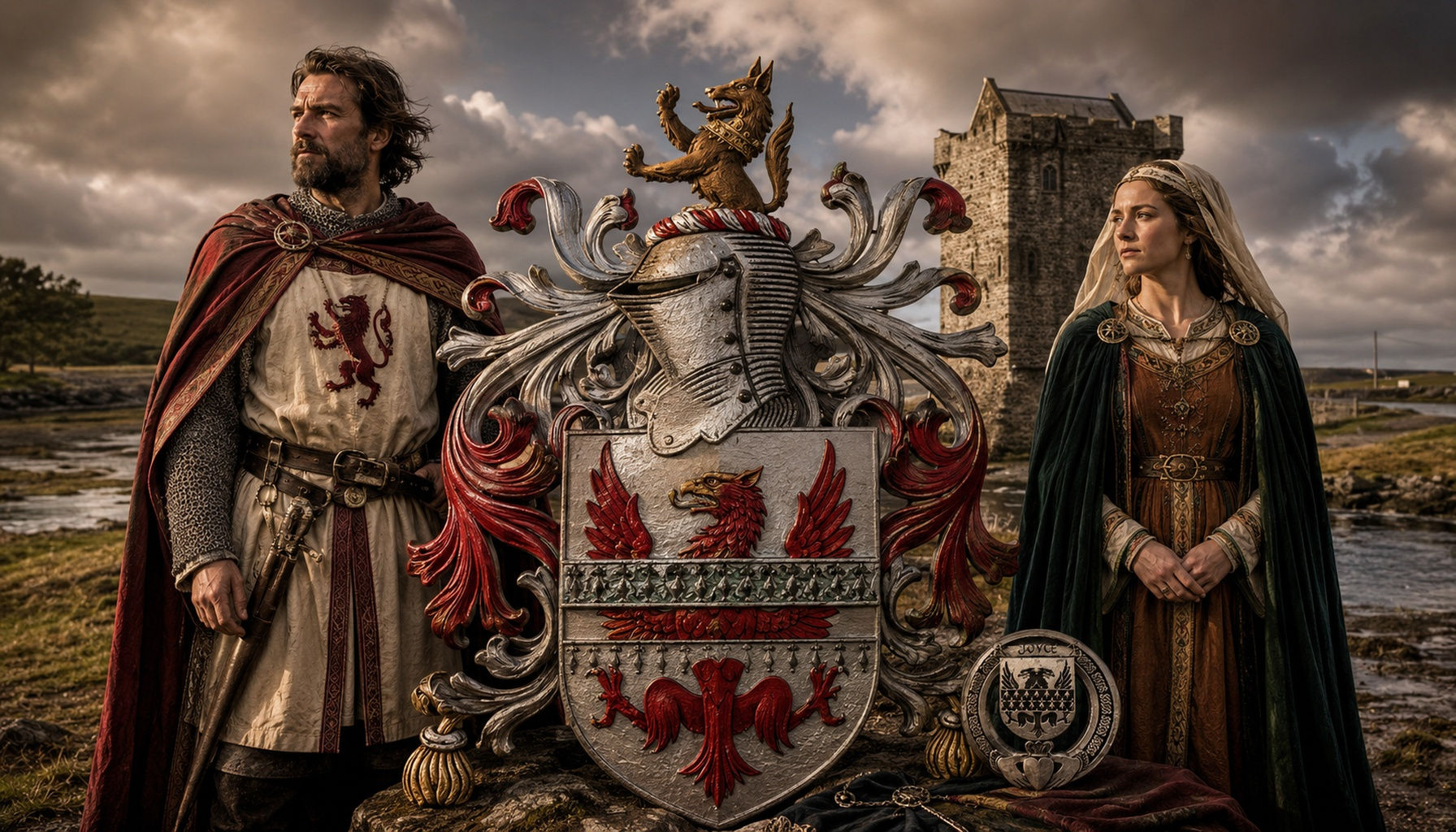
Clan Joyce was a family of Welsh-Norman origin that came into Ireland in the medieval period and became one of the best-known surnamed lineages of Connacht, especially in Galway and the district long remembered as Joyce Country. In historical terms, the Joyces are a splendid example of how a migrant family could arrive through conquest and settlement, take root through landholding and service, and then become thoroughly local without ever quite losing the memory of where they had come from. Haplogroup tags associated with this family include R1a1a1b1a2c, treated here as the primary family haplogroup tag.
The surname itself is usually traced to the Welsh personal name ap Iorwerth, which in Anglo-Norman and Irish contexts became Joyce. That is already a little history lesson in miniature: Welsh, Norman, English, and Irish worlds all packed into one family name. By the high and later Middle Ages the Joyces were established in western Ireland, where they acted as landholders, local leaders, and participants in the mixed Gaelic and Anglo-Irish society of the region. They married into local networks, carried heraldic traditions, and maintained a strong surname identity over centuries of upheaval. One named figure often cited is Walter Jorse, who became Archbishop of Armagh in 1311, a reminder that the family was not confined to one valley or one castle but could also move in ecclesiastical and political circles of considerable importance. The story of the Joyces is not simply one of arrival, but of belonging: a settler family that became unmistakably Irish in place, memory, and continuity.
One strong location anchor for Joyce heritage is Rockfleet Castle in County Mayo, not far from the wider world of Galway and the western seaboard in which families like the Joyces made their history. Rockfleet Castle is a late medieval tower house, traditionally linked above all with Grace O'Malley, the famous pirate queen, and set on an inlet where sea, land, and lordship meet in the most dramatic Irish fashion. The castle rises tall and compact, built for defense as much as residence, with thick walls, multiple storeys, and the commanding view one would expect from a stronghold in a region where maritime movement mattered enormously. It stands as a vivid reminder of the western Irish pattern of power: coastal access, local authority, family alliances, and the constant negotiation between Gaelic and Old English worlds. The site still survives and can be visited from the exterior, and it remains one of those places where the landscape does half the explaining for you.
From the ancient DNA side, the R1a1a1b1a2c tag linked with Clan Joyce has parallels in a wide spread of older Eurasian samples, though of course these are related or linked markers rather than proof of direct descent. Among them are Scythian Ukraine Medvyn Tract Girchakiv Lis (UKR035AB), Bronze Age Unetice Thuringia Leubingen Sommerda Germany (LEU027 and LEU017), Gothic Tribe Poland Strzyzow Wielbark (PL046), Late Antique Pannonia Arrabona Szechenyi Square Hungary (GYS045), Piast Dynasty samples from Poland including Santok Lad (PCA0393), Greater Poland Lad (PCA0216), and Medieval Poland Piast Dynasty Lad (PCA0211), as well as Bronze Age Estonia Harju Jelhtme (0LS11) and Late Bronze Age Estonia samples X13 and V16. Also in this wider linked picture are Bronze Age Austria Drasenhofen (DSH014), Thuringii Tribe Germany Deersheim Saxony-Anhalt (DRH007), Medieval Germany Niederwuensch (NDW013), Medieval Belgium Sint-Truiden Groenmarkt (ST2653), Iron Age Denmark South Sjaelland Holmegaard Toksvard By (CGG107504), Germanic Tribe Denmark Sjaelland Tybjerg Mose (CGG107512), and Belgic Suessiones Iron Age France Bucy-le-Long (CGG022433). What that tells us, broadly, is that this paternal line appears across a deep and complicated tapestry of Bronze Age, Iron Age, Migration Period, and medieval European populations. It is a reminder that even a very local Irish surname can sit on top of a much older and much wider human story.
If you carry the Joyce surname, have family roots in Galway, Connacht, or Joyce Country, or simply suspect a western Irish line with medieval layers behind it, this is exactly the sort of heritage worth testing against both family history and ancient DNA context. Upload your DNA to MyTrueAncestry and see whether you match Clan Joyce or any of the related ancient samples linked with haplogroup R1a1a1b1a2c.
Comments