Clan Elliott
– 3 min read


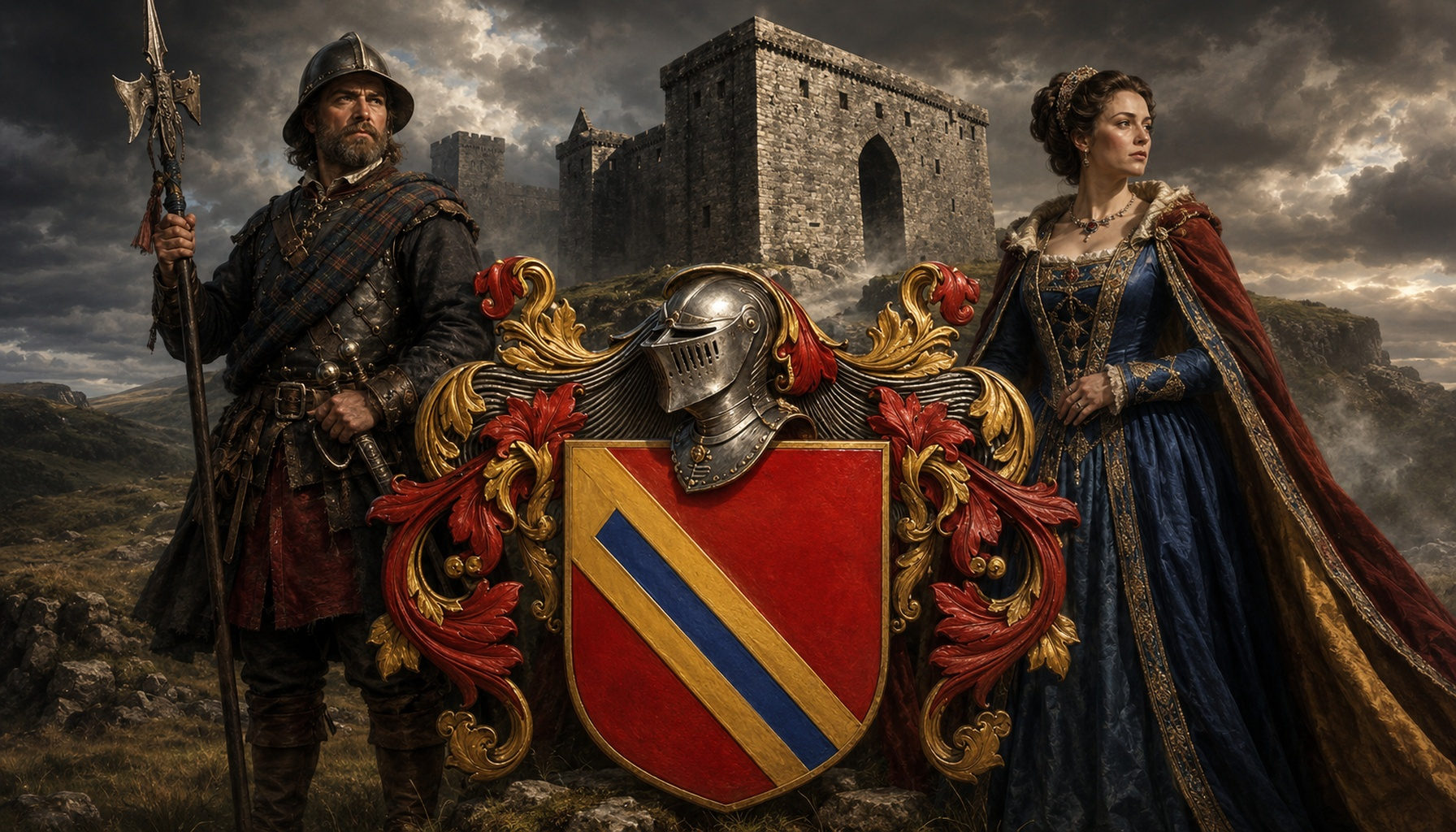
Clan Elliott was one of the great riding families of the Scottish Borders, rooted above all in Liddesdale, that hard and beautiful stretch of country along the frontier with England. This was not a world of neat Highland romance or courtly polish. It was a frontier society shaped by raid and counter-raid, by loyalty to kin, by horses, towers, and the constant knowledge that the next trouble might come over the hill before dawn. The Elliotts built their name in exactly that setting: resilient, independent, and very much at home in a landscape where family solidarity could matter more than distant kings. In genetic terms, the primary haplogroup associated here is R1b1a1b1a1a2c1a2a2a1d1, a branch within the wider Atlantic-facing R1b world so common in parts of Britain and Ireland.
The family seems to have emerged in the medieval Border zone rather than arriving as some single grand conquering house. That matters, because the Elliotts are best understood as a product of place: a clan formed in the pressure-cooker of march politics, where Scottish and English authority overlapped, failed, and reasserted itself in cycles. Their story includes reiving, feuds, shifting alliances, military service, and periodic attempts by both crowns to discipline men who were useful in war and inconvenient in peace. Among the earlier named figures is Gilbert Scott Elliot, recorded in 1364, a reminder that by the later 14th century the name was already visible in the documentary record. The Elliotts belong to that unmistakable Border pattern, where identity was tied to surname, valley, stronghold, and mounted fighting power.
Read more about Clan Armstrong
If you want one place that anchors the Elliotts in stone as well as story, it is Redheugh Tower in Liddesdale. This was one of the clan's key strongholds, standing in the sort of country where a tower house was not just a residence but a defensive necessity. Redheugh was associated with a principal line of the Elliotts and belonged to the everyday realities of Border life: watching routes through the valley, guarding stock, sheltering kin, and signalling both status and readiness. Sources connected with clan history describe it as a central family seat in the old riding country, and that makes perfect sense. A Border tower was a statement in masonry: we are here, we are armed, and we intend to remain. The site of Redheugh can still be visited in the Liddesdale landscape, and for anyone interested in the Elliotts it offers something more valuable than tourist gloss, namely the chance to stand in the terrain that made the clan what it was.
For those interested in the deeper genetic backdrop, the Elliott-linked haplogroup R1b1a1b1a1a2c1a2a2a1d1 can be placed beside a range of related ancient DNA samples from Britain and wider Europe. These are not proof of direct descent from any one ancient person, and should not be read that way. Rather, they show the long historical spread of related paternal lines across the same broad world from which later Border families emerged. Particularly striking are multiple Celtic Durotriges samples from Duropolis, Winterborne Kingston in England, including WBK12, WBK20, WBK29, WBK41, WBK05, WBK30, WBK43, WBK06, WBK08, WBK18, and WBK191. Other linked or related samples include Celtic Briton East Kent England I13730, Iron Age Worlebury Somerset England I11991, Iron Age Roundhouse Bu Orkney Scotland I2982, Iron Age Hillfort Battlesbury Bowl England I21309, Bell Beaker Wiltshire Upavon England I4950, Bronze Age Amesbury Down Wiltshire England I2417, Bronze Age Trumpington Meadows Cambridge England I3256, Bronze Age Bedfordshire England I7576 and I7577, Bronze Age Boatbridge Quarry South Lanarkshire Scotland I5473, Celt Hinxton Iron Age HI2, Early Bronze Age England Thames I5377, and Ireland Copper Age Rathlin2B. Beyond Britain, related branches also appear in samples such as Imperial Roman Era Zadar Croatia I26776, Late Roman Era Klosterneuburg Lower Austria R10656, Late Roman Conimbriga Portugal R10488, Early Medieval Belgium Sint-Truiden Groenmarkt ST2025, Medieval Belgium Outsider Sint-Truiden Onze-Lieve-Vrouwekerk ST1308, Merovingian Grave North Rhine-Westphalia Germany Alt-Inden IND013, Gallic France Parancot CGG023699, Post Roman Era Worth Matravers Dorset England I11580, Bronze Age Orkney Westray Links of Noltland KD061, Bronze Age Calabria Cosenza Grotta della Monaca Sant Agata di Esaro GMO015, and Medieval Age Faroe Islands Sandoy Church VK27. What this gives us is not a tidy family tree, but a wonderfully messy and human picture of long continuity, movement, and survival across the Atlantic and northwestern European world.
If the Elliotts of Liddesdale are part of your story, DNA can add an entirely new dimension to the paper trail. Upload your DNA to MyTrueAncestry to see whether you match Clan Elliott, its primary haplogroup R1b1a1b1a1a2c1a2a2a1d1, or any of the related ancient DNA samples linked to the wider ancestry of Britain and the Borderlands.
Comments