Clan Butler
– 3 min read


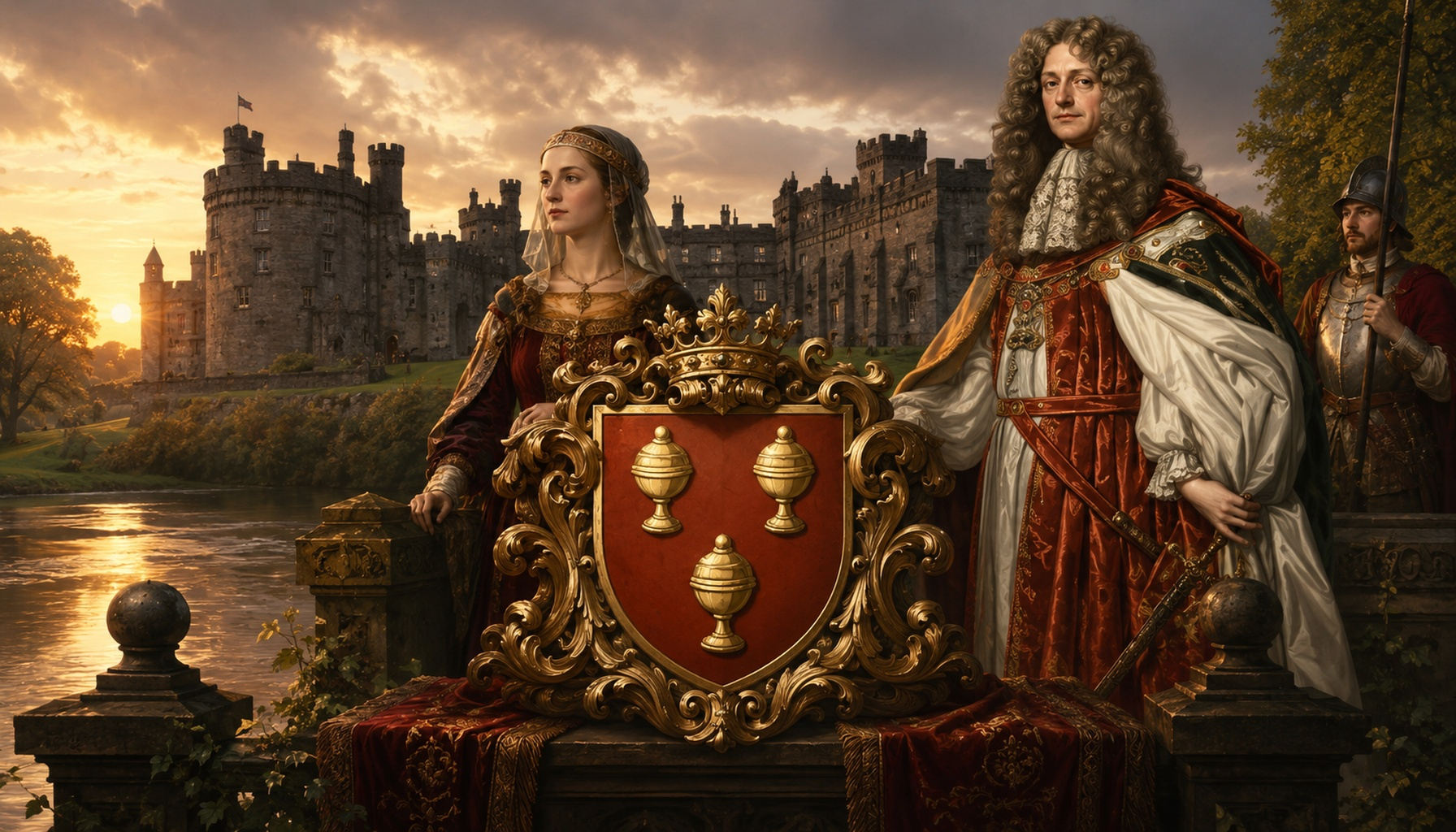
Clan Butler was one of the great Norman-Irish aristocratic families: a dynasty of office, land, castles, and long political reach. The family traced its rise to Theobald Walter, recorded in 1205 and earlier established in Ireland in the wake of the Anglo-Norman expansion, when ambitious military and administrative families crossed from Wales and England into Ireland under royal patronage. Their linked primary family haplogroup is R1b1a1b1a1a2c1a4b2a1, a paternal line found across a broad sweep of western European and later medieval contexts. In the Butler case, though, the important historical point is not just descent but position: the family name itself grew from office, because Theobald Walter was appointed Chief Butler of Ireland in service to the English crown.
That office was no mere ceremonial flourish. In the high medieval world, a royal office could be the seed of a territorial lordship, and that is exactly what happened here. The Butlers turned service into status, status into title, and title into lasting regional power. Over generations they became deeply embedded in Irish landholding and politics, especially in the south-east, where they managed estates, fought rivals, negotiated loyalties, and weathered the usual ingredients of noble survival: warfare, inheritance disputes, religious upheaval, and strategic marriage. They are, in many ways, a textbook example of the Norman-Irish pattern, foreign in origin but thoroughly rooted in Ireland within a few generations.
If one place anchors the Butler story, it is Kilkenny Castle. Standing above the River Nore in Kilkenny city, the castle began as a major Norman stone fortress in the late 12th century, strategically placed to control an important crossing and to project lordly authority into the surrounding region. It later became the principal seat of the Butler family, especially the earls and later dukes of Ormond, and from there they shaped the politics and society of much of south-eastern Ireland. Over the centuries the castle was altered repeatedly: medieval defensive work gave way to more comfortable aristocratic residence, and the building acquired the layered look that so many long-lived power centres have, part fortress, part palace, part statement of rank. The famous long gallery, landscaped parkland, and Victorian remodelling all speak to that continuing reinvention. In other words, Kilkenny Castle is not just a ruin of feudal muscle but a living record of how a Norman lordship matured into an Irish great house. It can still be visited today, which makes it one of the best places to grasp the Butler world in stone, space, and setting.
The Butler-linked haplogroup R1b1a1b1a1a2c1a4b2a1 also appears in a range of ancient and historic DNA samples from Britain and wider Europe. These include Celtic Durotriges individuals from Duropolis, Winterborne Kingston in England such as WBK12, WBK20, WBK29, WBK41, WBK05, WBK30, WBK43, WBK06, WBK08, WBK18 and WBK191, as well as later individuals like Medieval England Cambridge St Johns Hospital ATP_PSN_192, Early Medieval Belgium Sint-Truiden Groenmarkt ST2025, Medieval Belgium outsider Sint-Truiden Onze-Lieve-Vrouwekerk ST1308, Imperial Roman Era Zadar Croatia I26776, and Post Roman Worth Matravers Dorset I11580. The broader linked set reaches back even further, to examples such as Bronze Age Orkney KD061, Bronze Age Calabria GMO015, Iron Age Worlebury I11991, Iron Age Battlesbury Bowl I21309, Bronze Age Trumpington Meadows I3256, Amesbury Down I2417, Bell Beaker Upavon I4950, Bronze Age Bedfordshire I7576 and I7577, Boatbridge Quarry I5473, Hinxton HI2, Early Bronze Age Thames I5377, and Ireland Copper Age Rathlin2B. These are not evidence of direct descent from or to the Butler family; rather, they show that the Butler paternal line sits within a deep and widespread western European genetic landscape, one that stretches from Bronze Age and Iron Age Britain into Roman, post-Roman, and medieval populations.
If you are exploring Butler roots, this is where family history becomes especially interesting: not just names on a pedigree, but office, migration, castle-building, and the long genetic background of the societies they moved through. Upload your DNA to MyTrueAncestry to see whether you match Clan Butler, their linked haplogroup R1b1a1b1a1a2c1a4b2a1, or related ancient DNA samples from Britain, Ireland, and medieval Europe.
Comments