Clan Boswell
– 3 min read


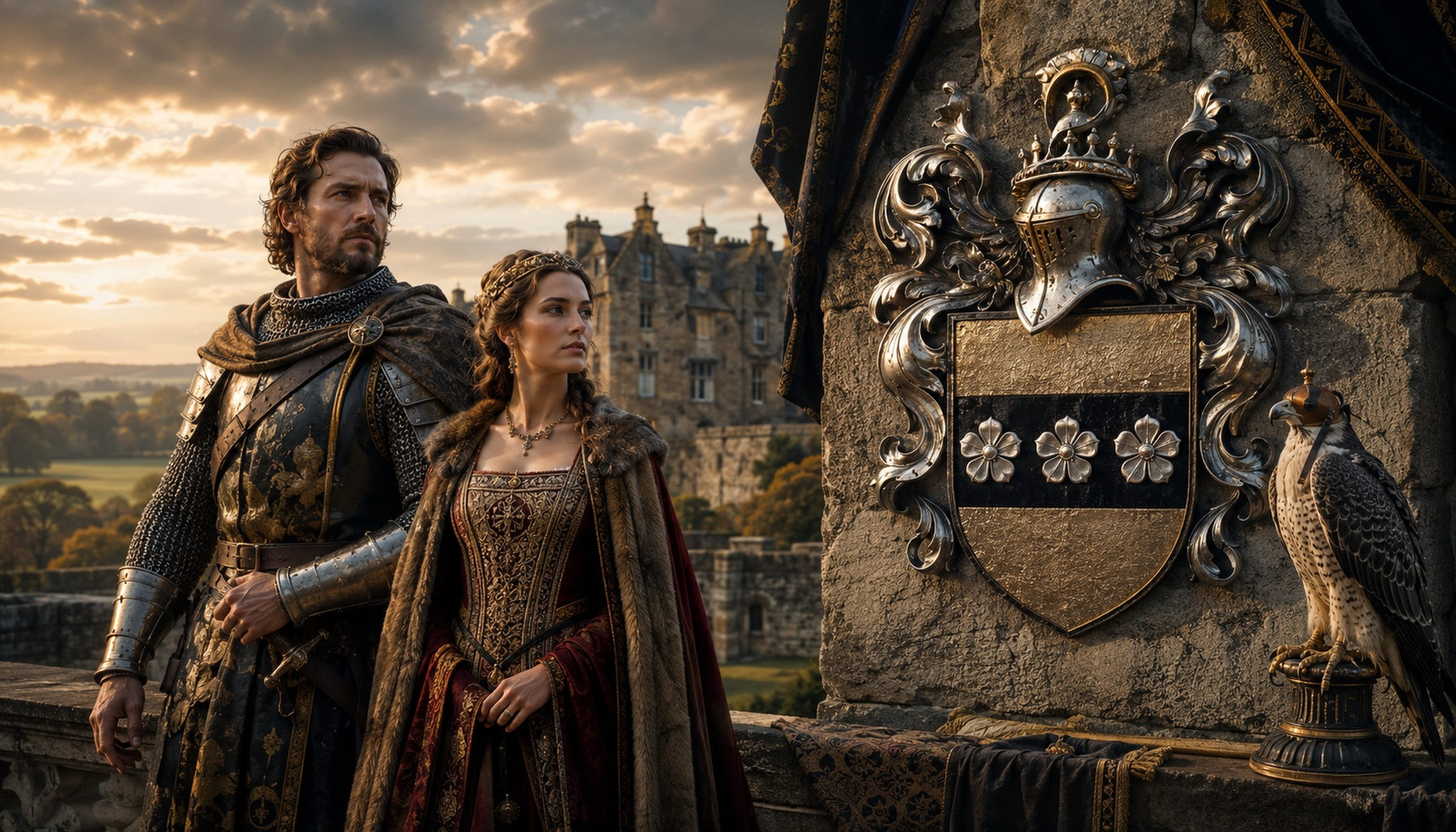
Clan Boswell was a Lowland Scottish family of landed standing rather than a Highland clan gathered beneath a single chiefly banner, and that distinction matters. The Boswells belong to that very Scottish world of estate identity, heraldry, education, law, and public life, where a surname was made durable through charters, marriages, offices, and remembered land. Their primary family haplogroup is linked here with R1b1a1b1a1a2a1a2, a paternal line found widely across parts of western Europe and often encountered in ancient DNA from Britain and the Continent alike. Tag: Haplogroups R1b1a1b1a1a2a1a2.
The name appears in medieval record as forms such as Robert de Boseuille (1165-1214), Henry de Boysuill (1225), and William de Boswill (1329), which already tells us something useful: this is a family whose identity grew out of place, document, and status in the feudal and post-feudal Lowlands. The old motto, Vraye Foy, meaning true faith, sits squarely within Scottish armorial culture, expressing loyalty, constancy, and sincerity. Over time the Boswells became part of the broad network of gentry families whose influence was preserved not by spectacular warlord politics, but by landholding, legal service, education, marriage alliances, and a careful sense of family continuity. In that sense, Boswell history is a fine example of how Lowland Scottish surnames were anchored in property and public participation as much as in blood and battle.
One of the great location anchors for the Boswell story is Auchinleck House in East Ayrshire, southwest Scotland. The house is an important 18th-century country mansion associated above all with the Boswell family of Auchinleck, and with the celebrated writer James Boswell, biographer of Samuel Johnson. Set in a designed landscape near the River Lugar, the house replaced an older family seat and reflects that moment when Scottish landed families expressed status not only through old lineage but through architecture, taste, and improvement. Built in the 1750s for Lord Auchinleck, it is a handsome Palladian house, orderly and self-assured in exactly the way the Scottish Enlightenment gentry liked to present themselves: cultivated, rooted, and thoroughly conscious of rank. It remains one of the best physical reminders that Boswell identity was tied to estate society and civic ambition rather than to a Highland-style chiefship. Auchinleck House and its grounds have had periods of restoration and public access, and it is indeed a place that can still be visited in a heritage sense when open through tours or events, so it remains a real and tangible point of connection for anyone tracing Boswell history.
From the DNA angle, the Boswell-linked haplogroup R1b1a1b1a1a2a1a2 belongs to a broad and long-lived western Eurasian paternal story rather than to one single family line that can be followed neatly from prehistory to the present. Related or linked ancient samples carrying this haplogroup or close placement within that branch include Medieval England Cherry Hinton (ATP_PSN_950), Merovingian period Frankish Eltville Germany (EV8), Historic St. Mary City Chapel Field Cemetery Maryland (I35260), Bronze Age and later Iberian samples from Murcia Almoloya Pliego such as ALM036, ALM039, ALM050, ALM052, ALM058, ALM063, ALM064, ALM070, and ALM081, along with examples from Bronze Age Yorkshire (I7629), Late Bronze Age Scotland (I2860), Celtic Briton Brassington in Derbyshire (I12771), Worlebury Camp Somerset (I11143), Thornholme Yorkshire (I14327), Pocklington Yorkshire (I12413), Fin Cop Derbyshire (I20630), Trethellan Farm Cornwall (I16450), Constantine Island Cornwall (I16454), Belgic Gaul (ISL6950), Iron Age France (CGG022434), Viking Age Denmark (VK365), and even later individuals such as a soldier of Napoleon's Grande Armee at Vilnius (YYY095A). None of these should be read as proven direct Boswell ancestors. What they show instead is the deep time spread of a paternal lineage connected with populations moving through Bronze Age Iberia, Iron Age Britain, Roman and post-Roman Europe, and the medieval worlds from which surnamed families like the Boswells eventually emerged.
Explore Roman and Early Medieval Britain DNA
If you carry the Boswell surname, have Boswell lines in your family tree, or simply want to see how your own ancestry fits into the larger Lowland Scottish story, DNA can add an intriguing extra layer. Upload your DNA to MyTrueAncestry to see whether you match Clan Boswell, the Boswell-linked haplogroup R1b1a1b1a1a2a1a2, or any of the related ancient DNA samples from Britain, France, Germany, Iberia, and beyond.






Comments