Clan Abernathy

– 3 min read


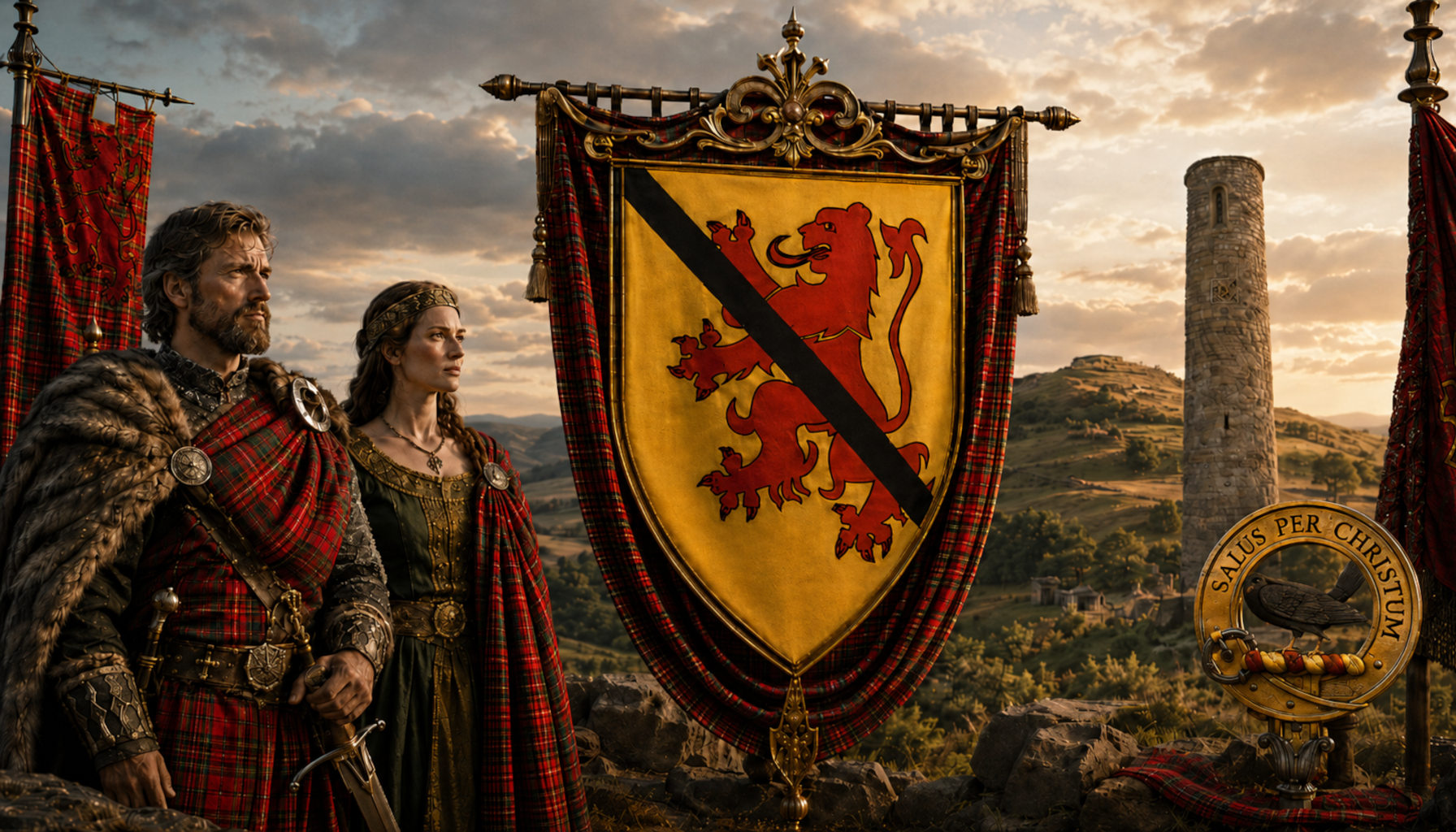
Clan Abernathy, more often found in historical records as Abernethy, was an old Scottish baronial house rooted in Abernethy in Perthshire, near the River Tay, and linked here with the Y-DNA haplogroup R1b1a1b1a1a2c1a. This was not a clan invented by later romance, but a family shaped by a very ancient landscape: a place of kingship, church power, earthworks, and roads of movement through central Scotland. Their name comes directly from that place, and that matters, because in medieval Scotland names tied people to land, lordship, and memory as much as to blood.
The family emerges clearly in the 12th century, with figures such as Orm de Abernethy, recorded around 1170, and Lawrence de Abernethy, among those associated with establishing the house as a landed and political force. Later men of the line, including Sir Hugh de Abernethy and Sir Alexander de Abernethy, moved within the hard-edged world of medieval Scottish politics, where loyalties were tested between native kings, rival nobles, and the pressure of the English crown. Their heraldry is striking and unmistakable: a red lion on gold crossed by a black diagonal bend, while the crest bears a raven and the motto Salus Per Christum, salvation through Christ. Taken together, the family story is one of sacred Perthshire origins, noble service, fortified country, and the turbulent age of Scotland's kings and guardians.
Read more about Clan Abercrombie
The great location anchor for this story is the Abernethy Round Tower, one of Scotland's most remarkable early medieval monuments. It stands beside the church at Abernethy and is a rare Irish-style round tower, built in stone, rising to about 22 metres high, with its doorway set above ground level in the old monastic manner. The tower is generally dated to the 11th or early 12th century, though the site itself is far older and was already important in Pictish and early Scottish history. Abernethy was long remembered as an ecclesiastical centre, and the tower is the surviving vertical sign of that prestige, rather like a stone exclamation mark in the landscape. Nearby too is Castle Law, a hill fort that reminds us this was not merely a village, but a place where religion, defence, and political authority overlapped. Yes, the Round Tower can still be visited, and it remains one of those rare places where the deeper past of a family territory can be seen rather than merely imagined.
From the ancient DNA side, the haplogroup R1b1a1b1a1a2c1a belongs to a broad and well-travelled paternal network found across later prehistoric and historic Europe, so any links should be understood as related or haplogroup-linked rather than proof of direct descent. Samples associated with this branch include medieval individuals from Las Gobas in northern Spain such as ldo066, ldo037, ldo048, ldo062, ldo039, ldo052, and ldo242; Roman and medieval individuals from England including KNF006 from Knobbs Farm Somersham, FEN008 from Fenstanton, VIC016 from Cambridge Vicars Farm, ATP_PSN_192 and ATP_PSN_68 from Cambridge St John's, ATP_PSN_512 and ATP_PSN_520 from the Augustinian Friars, and ATP_PSN_1217 from Clopton; and notably northern British examples such as the Pict-era Orkney sample KD004 and the Late Bronze Age Moray, Scotland sample I2859x from Covesea Caves. Further linked finds stretch back into Iron Age and Bronze Age Europe, including elite Celtic burials at Asperg-Grafenbuehl and Ludwigsburg Roemerhuegel in Germany, as well as Bell Beaker and Bronze Age samples from Britain and the Low Countries. What this suggests, in broad historical terms, is that the Abernethy haplogroup sits within an old western European paternal continuum that long predates medieval surnames, yet fits very comfortably within the deep ancestry of Britain, Celtic Europe, and the North Sea world.
Explore Roman and early medieval Britain DNA
If you carry the Abernathy or Abernethy name, or suspect Perthshire roots somewhere in your family story, this is exactly the sort of lineage that becomes richer when history and DNA are read together. Upload your DNA to MyTrueAncestry to see whether you match the family haplogroup R1b1a1b1a1a2c1a or related ancient DNA samples from Britain and beyond.
Comments