Clan Abercrombie
– 3 min read


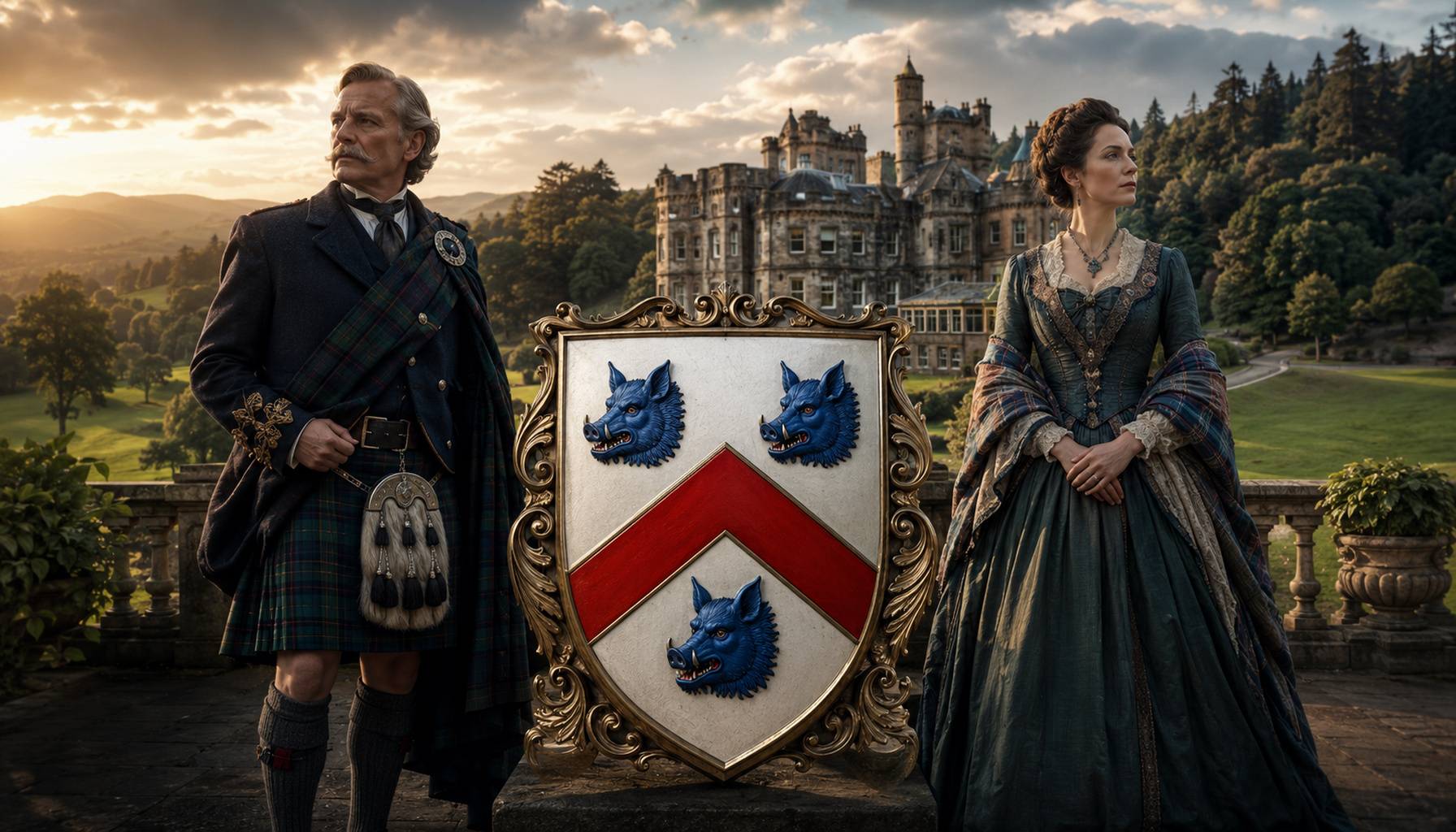
Clan Abercrombie was a Scottish Lowland family rooted in the lands of Abercrombie in Fife, and its story belongs to that very recognisable medieval world of charters, parish boundaries, estate management, royal service, and regional influence. The name is locational, drawn from the place itself, which tells us something important at once: this was a family grounded in landscape before it was celebrated in biography. In genetic tagging terms, the primary family haplogroup linked here is R1b1a1b1a1a2c1a1e, a branch within the broad Atlantic-facing R1b world so common in later British and western European paternal lines.
What makes the Abercrombies interesting is that they were never merely a romantic tartan flourish. They were part of the durable machinery of Lowland Scotland: landholders, churchmen, soldiers, and public servants whose name appears across Fife, Stirlingshire, and beyond. A figure such as Robert Abercromby, recorded in 1534, belongs to that long paper trail of named local standing, while Sir Ralph Abercromby, born in 1734 and killed in 1801 after the Battle of Alexandria, carried the family name onto the imperial and military stage. Through him, the surname became widely known, but the deeper history remained what it had long been: a lineage shaped by land, heraldry, service, and continuity.
Airthrey Castle is one of the most tangible later anchors for the Abercrombie story. Located near Stirling, at the foot of the Ochils and close to the Wallace Monument, the present castle is largely an 18th-century building in the neoclassical style, developed on an older estate landscape. It became associated with the Abercromby family of Airthrey, most famously through Sir Ralph Abercromby, whose connection gives the site a particular historical weight. The setting matters as much as the stone: this is not a Highland stronghold perched for feud and spectacle, but a Lowland estate house in a cultivated designed landscape, expressing status, education, and modernity in the age of improvement. Today the castle stands within the grounds of the University of Stirling, and while access to the interior may vary, the wider estate area can certainly still be visited, making it a very real place to stand and think about the later world of the family.
The haplogroup tag R1b1a1b1a1a2c1a1e links Clan Abercrombie to a much older paternal backdrop stretching across Britain and western Europe, though not as proof of direct descent from any specific ancient individual. Rather, these are related or linked ancient DNA examples that help sketch the wider population history in which a Lowland Scottish family emerged. Particularly striking are multiple Celtic Durotriges samples from Winterborne Kingston in Dorset, including WBK12, WBK20, WBK29, WBK41, WBK05, WBK30, WBK43, WBK06, WBK08, WBK18, and WBK191, alongside Iron Age and Brittonic-era samples from Kent, Oxfordshire, Somerset, Yorkshire, East Lothian, Applecross, Orkney, and Wales. There are also linked examples from Pict-era Scotland such as Mine Howe in Orkney, Bronze Age and Iron Age Scotland including Covesea and Broxmouth, and a wider arc of related samples reaching into Roman Croatia, Belgic and Gallic France, medieval Ireland, Saxon England, early medieval Belgium, northern Spain, and beyond. In other words, the Abercrombie genetic story fits comfortably within the old, layered population world of Atlantic Britain and adjacent Europe: a world not of one neat origin point, but of long continuity, movement, and local survival.
If you carry the Abercrombie name, have family roots in Fife or Stirlingshire, or simply want to see how your DNA connects with Scottish Lowland history and these R1b1a1b1a1a2c1a1e-linked ancient samples, you can upload your DNA to MyTrueAncestry and explore whether you match the family story or its deeper ancient context.
Comments