Clan MacDuff
– 3 min read


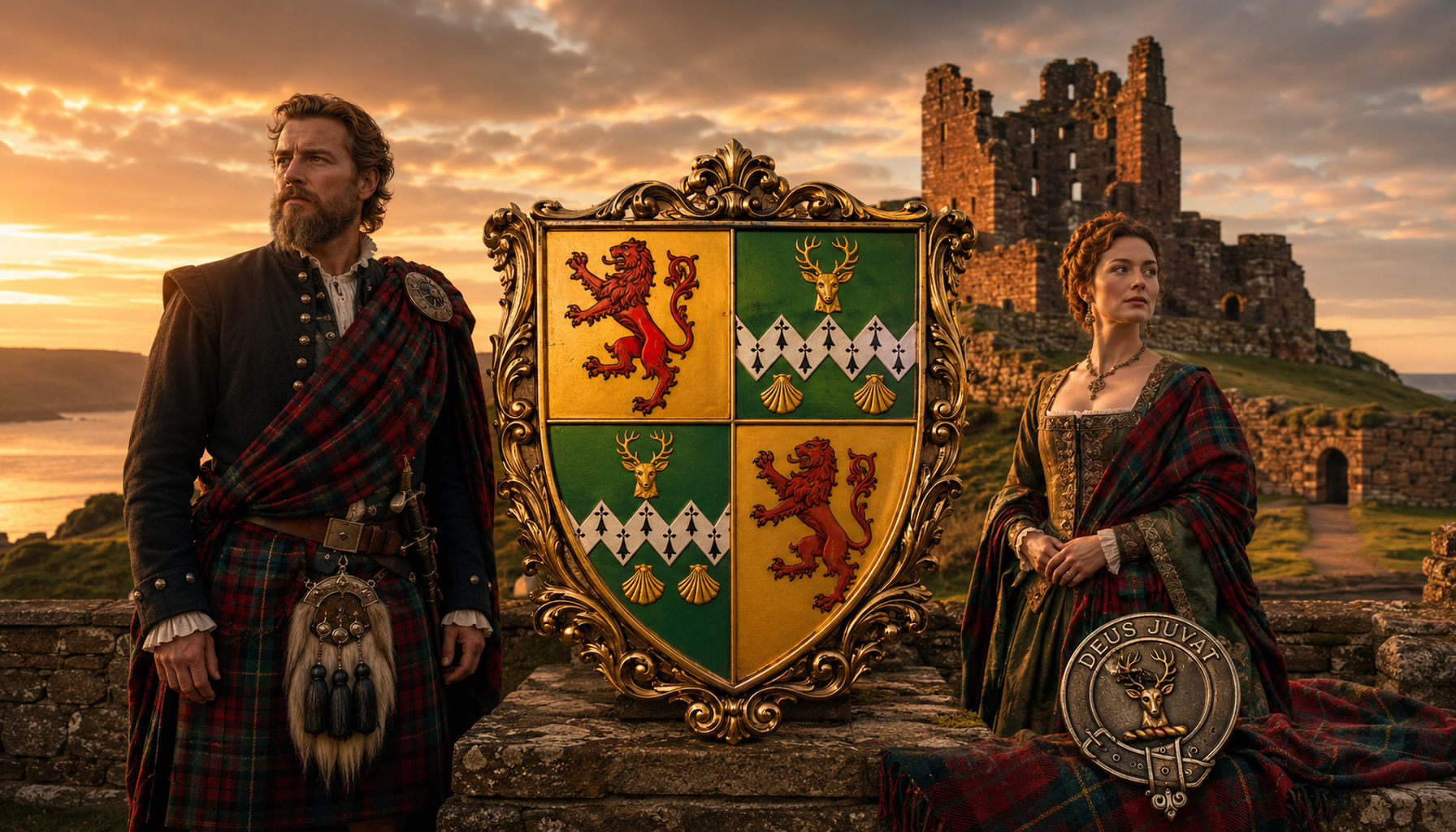
Clan MacDuff was one of the oldest and most exalted noble kindreds in Scotland, rooted above all in Fife, the old political heartland of the kingdom. The name MacDuff means son of Dubh, or descendant of Dubh, and it carries us straight into the world of early Gaelic aristocracy, when power rested not only on land and warbands, but on ancestry, ritual, and closeness to kingship itself. The clan is traditionally linked with the ancient Earls of Fife, among the greatest magnates of medieval Scotland, and in later genetic tagging the primary family haplogroup associated with the line is R1a1a1b1a3a1a1a1, alongside the broader Haplogroups context often used to explore deep paternal connections.
What makes the MacDuffs so memorable is that they stand at the meeting point of history and national legend. In medieval tradition they held a privileged role in the inauguration of Scottish kings, a striking sign of how closely Fife and the MacDuff line were bound to sacred kingship. The famous MacDuff of 1057 belongs to that turbulent age of Macbeth and Malcolm III, when rival dynasties, loyalties, and blood claims shaped the future of Scotland. Centuries later, Isabella MacDuff, Countess of Buchan, did something unforgettable when she crowned Robert the Bruce in 1306, drawing on the old ceremonial rights of her house. And in the modern age the name endured in another form through Alexander Duff, 1st Duke of Fife, whose career reminds us how ancient lineages in Britain often adapted, survived, and reappeared in new aristocratic settings.
The great location anchor for the family is Macduff's Castle, near East Wemyss on the coast of Fife. The site is a dramatic ruin perched above the Firth of Forth, and although what survives today is largely later medieval in date, the place has long been associated by tradition with the Earls of Fife and the MacDuff story. Like many Scottish strongholds, it is not a single-period monument but a layered one: part noble residence, part fortified statement, part reminder that lordship in medieval Scotland was always tied to control of coast, land, and local allegiance. The castle was altered over centuries, and its surviving tower house and courtyard remains speak more to the later medieval and early modern phases than to the 11th-century world of Macbeth. Still, that is precisely what makes it interesting: it is not a fairy-tale relic frozen in one heroic moment, but a working seat of power that changed as Scotland changed. The ruins can still be visited from the exterior area and viewpoint, making it one of those places where landscape, legend, and hard stone all pull together rather wonderfully.
From an ancient-DNA perspective, the MacDuff-associated primary haplogroup R1a1a1b1a3a1a1a1 links the family, at least in a broad paternal sense, to a wide northern and central European genetic landscape rather than to any single proven medieval individual. Related or linked samples under this branch or nearby lineages include Medieval Vasterhus, Sweden (mbv281), Medieval Hungary in the Carolingian sphere at Zalavar-Varsziget (AHS18), Post-Viking Era Denmark at St Clemen, Zealand (KPN002), Viking Age Skara Varnhem, Sweden (VK35), Viking Age Ingiridarstadir, Iceland (VK129), Medieval Sandoy Church in the Faroe Islands (VK244), Vendel Age Saaremaa Salme II-U (VK551), Viking Age Gotland Kopparsvik, Sweden (VK48), and a Viking-Gaelic mixed context in Iceland (GTE-A1). These do not prove direct descent from Clan MacDuff, of course, but they do show the sort of far-flung northern world in which related paternal lines circulated: Scandinavia, the North Atlantic, the Baltic, and parts of central Europe, all places entangled with the same medieval networks of mobility, war, marriage, and kingship that shaped Scotland too.
If Clan MacDuff appears in your family story, or if you are simply curious whether your DNA connects with this ancient noble world of Fife, royal ceremony, and medieval Scotland, you can explore it more deeply through genetic matches. Upload your DNA to MyTrueAncestry and see whether you match the family profile or any related ancient DNA samples connected to the wider R1a1a1b1a3a1a1a1 story.
Comments