Catoctin Furnace Victim
– 5 min read


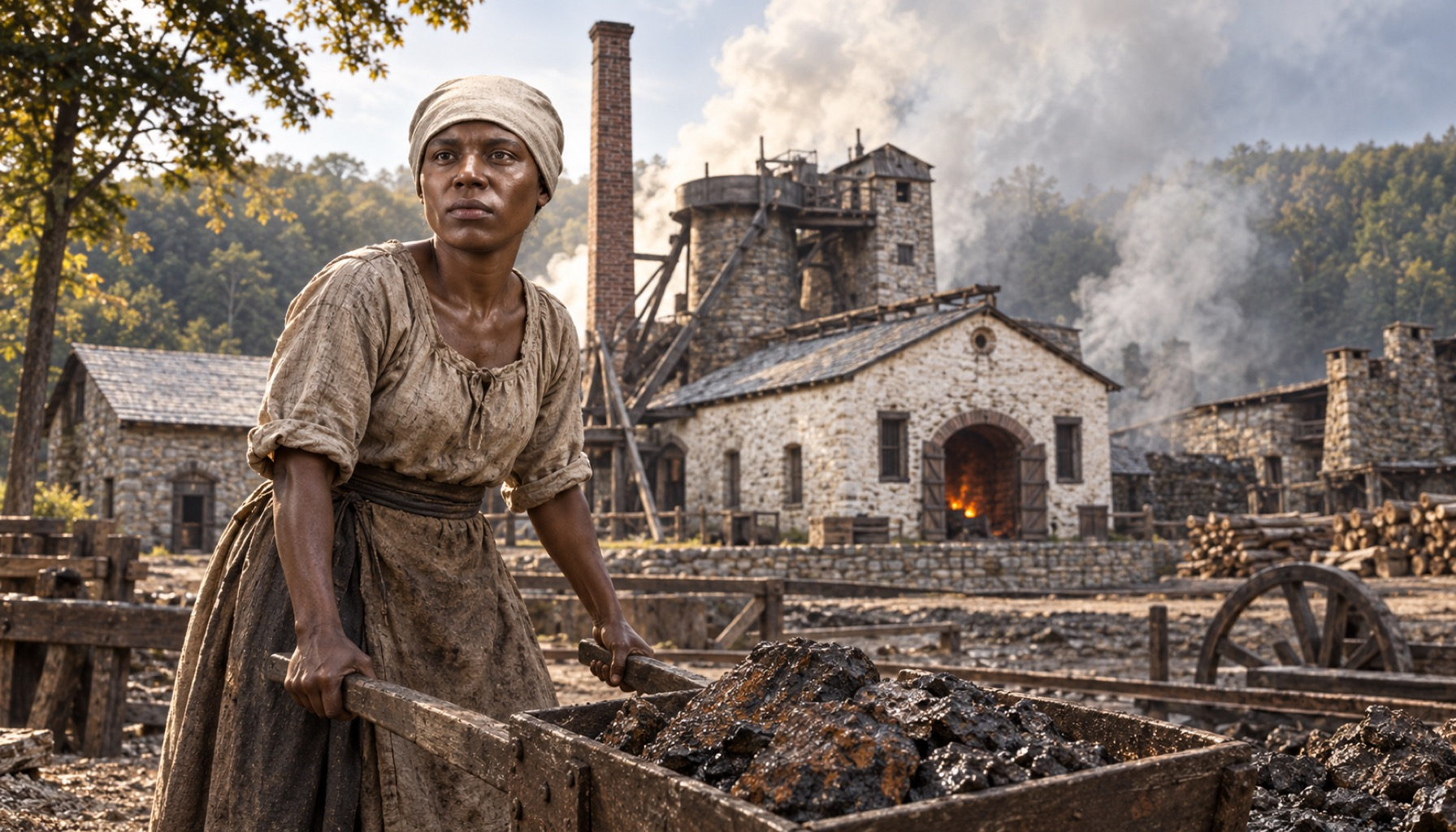
The woman often called the Catoctin Furnace Woman was an enslaved African American woman who lived and died in industrial Maryland around the beginning of the 19th century, probably close to 1810. She belonged to the community at Catoctin Furnace, an ironworks in Frederick County that helped supply a young and expanding United States. That brisk phrase, “helped supply,” can sound terribly neat. In practice it meant hard labour, heat, smoke, extraction, transport, and the daily coercion of enslaved people whose work stood behind American industry.
She matters historically because archaeology and ancient DNA have pulled her, at least in part, out of anonymity. Her remains were recovered from the African American cemetery associated with the furnace, where dozens of men, women, and children were buried in the late 18th and early 19th centuries. Osteological study showed that she was an adult woman in her thirties and that her skeleton carried signs of physical hardship. She was buried in close association with an infant, a detail that turns statistics about slavery into something more intimate and more difficult to ignore: a family, a loss, a life lived under constraint.
Catoctin Furnace was not a plantation in the usual popular imagination, but an industrial community where enslaved and free workers made pig iron for the early republic. That is precisely why this woman is so important. She reminds us that slavery in the United States was not confined to tobacco, cotton, or rice fields. It also powered furnaces, forges, transport networks, and the material growth of the new nation. Men, women, and children in such places lived in a world shaped by owners, overseers, skilled trades, dangerous work, and a constant negotiation of kinship and survival within slavery.
Her face has also become known in a way that is unusual for an archaeologically recovered enslaved person of this period. Forensic specialists reconstructed her appearance from her skull, making her one of the most visually recognizable individuals from the Catoctin Furnace cemetery. That reconstruction does not restore her name, voice, or full biography, and it should not be mistaken for complete recovery of identity. But it does something important all the same: it reminds modern viewers that the people buried here were not background figures in economic history. They were individuals who lived in the furnace community, formed relationships, endured pain, and were mourned.
The associated biological sample is described as Enslaved Adult Female Laborer Catoctin Iron-Working Furnace Antebellum Maryland, with an approximate date of 1810 AD. This is not a securely identified named historical individual in the sense of a queen, general, or diarist whose remains can be matched to documentary records. Rather, it is a strongly contextualized archaeological individual: an adult woman from the African American cemetery at Catoctin Furnace, identified through burial context, osteological analysis, and scientific study of the remains.
The supplied evidence indicates that her remains came from that cemetery and that she was buried near an infant. The burial context is crucial. It places her within a specific enslaved and free African American industrial community, rather than presenting her as an isolated skeleton removed from history. What researchers can say with confidence is that she belonged to this burial ground and this world. What they cannot yet do, on the information supplied here, is attach a documented personal name to her with certainty.
The broader research context, including the study reported at https://www.biorxiv.org/content/10.1101/2022.06.12.495320v1, has used ancient DNA from individuals in the Catoctin Furnace cemetery to investigate ancestry and biological relationships within the community. That sort of work is especially valuable in a setting where the written archive of enslaved lives is fragmentary, biased, and often silent about the very people whose labour sustained the site.
The mitochondrial DNA haplogroup for this woman is L3e1. Mitochondrial DNA, or mtDNA, is inherited through the direct maternal line: from a mother to her children, with daughters passing it on again. Her Y-DNA haplogroup is not available here, which is entirely expected, because Y-DNA follows the direct paternal line and is ordinarily only recoverable in biological males. Since this individual was female, no Y-DNA haplogroup is reported.
L3e1 is a maternal lineage within the wider African mtDNA diversity that is well represented in West and Central African population history. That matters here, but in a careful way. It does not, by itself, tell us her exact ethnic identity, language, or homeland, still less the precise community from which one maternal ancestor came. Haplogroups are lineages, not ethnic labels. What L3e1 can do is contribute one thread of evidence showing that the woman buried at Catoctin Furnace carried a maternal lineage rooted in African population history, which is entirely consistent with the history of the transatlantic slave trade and the forced movement of African people into early America.
The ancient-DNA work on the Catoctin Furnace cemetery becomes more powerful when individuals are considered together rather than one by one. Related linked samples from the same burial community, including Enslaved Laborer Catoctin Iron-Working Furnace Antebellum Maryland (I8096) and Enslaved Laborer Catoctin Iron-Working Furnace Antebellum Maryland (I8085), help researchers examine biological relationships within the cemetery and reconstruct aspects of community formation under slavery. That does not magically restore full family trees, but it can reveal kinship patterns that written records either ignored or actively erased.
There is also a more specific maternal comparison in the cemetery itself. Another L3e1-linked individual, Enslaved Adult Female Laborer Catoctin Iron-Working Furnace Antebellum Maryland (I8097), shares the same reported mtDNA haplogroup. This does not automatically mean a close relationship; many people can share the same maternal haplogroup without being close kin in a genealogical sense. But it does show that this maternal lineage was present in more than one individual at Catoctin Furnace, adding to the picture of African-descended maternal continuity within the cemetery population.
The interest of this woman’s DNA is not that it “solves” her identity. It does something both more modest and more historically meaningful. It helps restore ancestry, relationship, and human specificity to a woman whose life unfolded in a system designed to reduce people to property. Combined with her burial context, skeletal evidence, and facial reconstruction, the genetic data make it possible to speak about her not as an abstraction but as a member of a real community of African American workers in early industrial Maryland. DNA can illuminate maternal lineage and possible kinship; it cannot by itself recover her name, her memories, or the fullness of the life slavery denied her.
The genetic legacy of the 17th-century colonial capital of St. Mary's City
Thomas Jefferson’s DNA and the Sally Hemings Paternity Question
African Maternal DNA Diversity and Population History
MyTrueAncestry allows you to compare your DNA with ancient populations and archaeological samples from the worlds discussed in articles like this one. It cannot prove direct descent from the Catoctin Furnace Woman, but it can help you explore whether your genetic profile shows connections to ancient lineages and historical populations that shaped the wider human story.


Comments