Athens Plague Likely Caused by Salmonella
– 3 min read


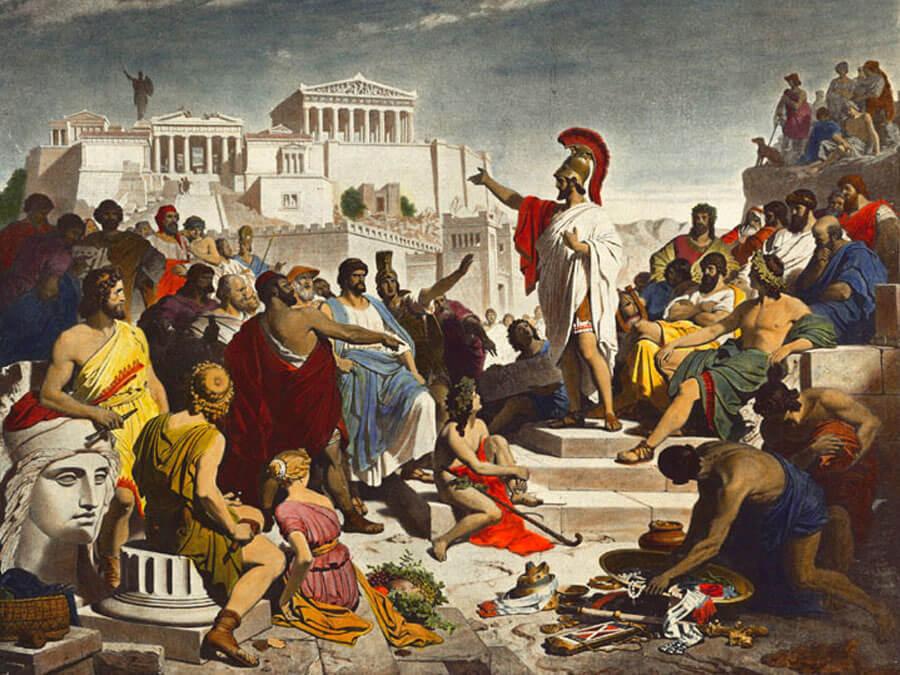
In the summer heat of ancient Athens, while Spartan armies ravaged the countryside, another enemy moved silently inside the city walls. Thousands of rural refugees had flooded into a space never meant to hold them. The result was overcrowding, broken sanitation, hunger, and the perfect conditions for catastrophe.
The outbreak that followed killed perhaps a quarter of the population, including the statesman Pericles. It shook religion, morale, and social order. The city that had built temples and an empire found itself overwhelmed by bodies and grief.
At the center of this story stands Thucydides, a remarkable witness who fell ill himself and survived. Writing with the urgency of someone who had felt the disease in his own body, he wanted future generations to recognize it if it ever returned.
His account describes sudden fever, burning heat, headaches, inflamed eyes, coughing, vomiting, diarrhea, delirium, and skin eruptions. Caregivers died tending the sick. Funeral rites collapsed under the weight of too many dead. One extraordinary observation stands out: survivors appeared protected against second fatal attacks, one of history's earliest recorded recognitions of acquired immunity.
The ancient description reads like close observation under terrible pressure, tracking sequences of symptoms across many suffering bodies. The illness attacked multiple systems simultaneously: fever, severe bowel disruption, mental confusion, and skin damage together. When dehydration, infection, and delirium arrive at once, the body collapses rapidly.
One detail especially excited scholars: scavenging animals died after consuming victims' bodies. This rules out diseases restricted to humans alone, suggesting the pathogen belonged to a wider natural world of infection shared between species.
What emerges is a cluster of clues: sudden fever, violent bowel illness, mental disturbance, high mortality, survivor immunity, and animal involvement, each suggestive alone, but powerful together.
If the written record gives the epidemic its voice, the Kerameikos cemetery gives its silence. Excavators uncovered a mass grave containing around 150 individuals, men, women, and children, buried in disorderly fashion. This was not calm ritual. It was burial under impossible pressure.
Associated pottery dated the grave to around 430 BC, precisely when the plague first struck Athens with full violence. The arrangement spoke of haste, yet grave offerings had still been placed with the dead. Even in catastrophe, people tried to honor those they had lost.
The grave transformed the plague from abstract historical event into physical reality, a trench in the earth preserving bones of all ages: children, adults, and elderly people whose lives ended during one of antiquity's bleakest urban epidemics.
Researchers examining dental pulp from the Kerameikos burial reported DNA matching Salmonella enterica. Teeth protect biological traces inside their hard outer structure, and if a person died while a pathogen circulated in their blood, fragments may survive for millennia.
This was a major moment, giving the long debate a molecular clue beyond literary symptom lists. However, early testing methods could not distinguish precisely which branch of Salmonella was present, identifying the family name but not the individual strain. The finding pointed strongly toward Salmonella without delivering a final verdict.
The result remains significant. It narrows the field considerably and links the literary and archaeological evidence to a biological reality. Future broader sequencing and independent replication could confirm or refine the picture further.
Placing all evidence side by side, a striking candidate emerges: an invasive form of non-typhoidal Salmonella enterica. Ordinarily associated with food poisoning, this bacterium can spread from the gut into the bloodstream under severe conditions, becoming dramatically more deadly in overcrowded, malnourished, sanitation-poor environments.
It fits the evidence with unusual consistency. It explains the severe gut symptoms and full-body collapse. It suits the wartime conditions of Athens almost perfectly. It accounts for survivor immunity. Most importantly, it explains the animal deaths, since non-typhoidal Salmonella is zoonotic, circulating between humans and animals alike, a feature that eliminates most rival candidates including cholera, measles, smallpox, typhoid, and bubonic plague.
No single line of evidence proves the case absolutely, but the crowded port, contaminated water, violent bowel illness, mental disturbance, animal deaths, survivor immunity, mass grave, and DNA signal all belong coherently in the same story. The most plausible villain is not divine punishment or vague pestilence, but a hard, adaptable bacterium amplified by war and urban collapse into something fearsome. The real killer was a partnership between microbe and circumstance.
https://www.ijidonline.com/article/S1201-9712(26)00363-2/fulltext

Comments