Anna of Antioch
– 5 min read


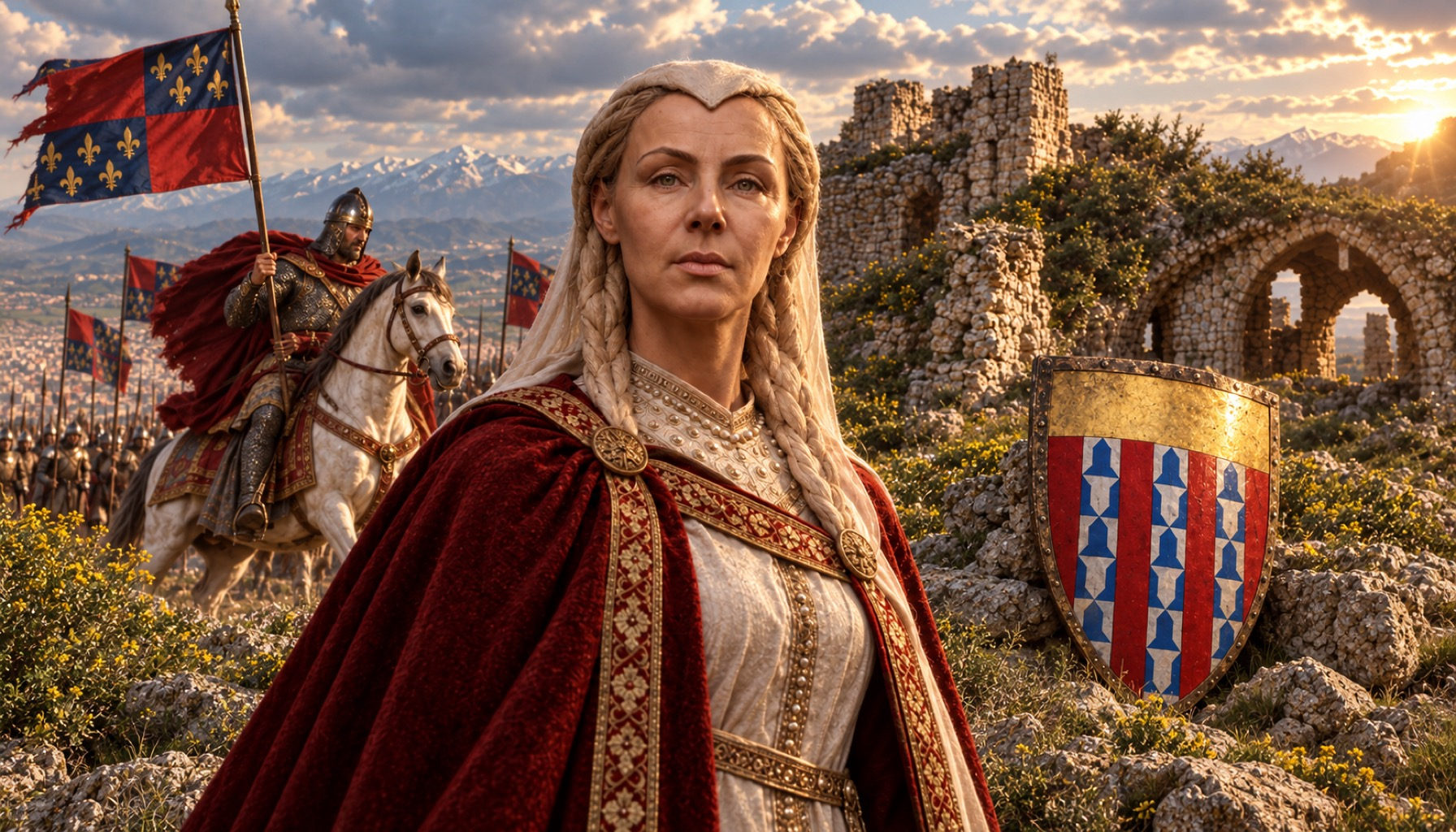
Anna of Antioch was one of those medieval women whose life makes the map of the 12th century suddenly look smaller and more connected. Born into the world of the Crusader states, she was the daughter of Raynald of Chatillon, Prince of Antioch and later lord of Oultrejordain, a figure remembered in Latin, Byzantine, and Muslim history alike for his audacity, his violence, and his role in the struggle against Saladin. Yet Anna’s own career carried her far beyond the frontiers of the Levant. Through marriage she became queen of Hungary, linking the Latin East, Constantinople, and the Árpád monarchy in a single dynastic story.
That is what makes her so interesting historically. Anna belonged to a generation for whom Antioch, Jerusalem, Constantinople, and Székesfehérvár were not separate worlds but parts of one political web. She lived at the intersection of crusading ambition, Byzantine diplomacy, and the rise of medieval Hungary as a major kingdom. And unusually for a queen of this period, the remains attributed to her burial have also entered the world of archaeogenetics, giving us a rare chance to place a named medieval royal woman into both history and DNA research.
Anna’s father, Raynald of Chatillon, was among the most controversial lords of the crusading era. He was associated with Antioch, later ruled from the formidable fortress of Kerak, fought in the age of Baldwin IV, and became one of Saladin’s most bitter enemies before being personally executed after the disaster of Hattin in 1187. That grim end has tended to dominate the family story, but Anna’s life took a rather different path. She spent part of her life within the Byzantine orbit of Constantinople, the great imperial capital where western crusader dynasts and eastern imperial politics constantly collided, negotiated, and intermarried.
Her marriage to Béla III of Hungary was of real political significance. Béla had strong Byzantine connections before becoming king, and under his rule Hungary emerged as one of the most powerful states in Central Europe. As queen, Anna stood at the meeting point of several worlds: the crusader aristocracy of the Levant, the ceremonial and diplomatic culture of Byzantium, and the expanding authority of the Árpád dynasty in the Carpathian Basin. Their descendants would spread these links further through the royal and noble houses of Central Europe. So Anna matters not simply because she was Raynald’s daughter, but because she embodied the extraordinary mobility of medieval dynastic politics.
The biological sample associated with her is listed as Anna of Antioch House of Arpad and Chatillon, with an approximate date of 1184 AD. Anna and Béla III were buried together in the royal basilica at Székesfehérvár, the great coronation and burial church of medieval Hungarian kings. That alone places the remains in one of the most symbolically charged royal sites in the kingdom.
The identification of remains from such a site must be handled carefully. In this case, the historical tradition and burial context have long connected the excavated royal skeletons with Béla III and Anna. The remains have been the subject of scientific study, including the research discussed in the article published in Archaeological and Anthropological Sciences at Springer. On the basis of the supplied material, Anna should be treated as a strongly supported historical identification associated with the royal burial, rather than as a casual or purely speculative attribution. At the same time, good practice demands a note of caution: DNA can support authenticity and kinship questions, but it does not magically solve every uncertainty surrounding medieval royal burials.
For Anna of Antioch, the reported mitochondrial DNA haplogroup is H7b1. Her Y-DNA haplogroup is, naturally, not available here, because Y-DNA tracks the direct paternal line and is present only in males. Mitochondrial DNA, by contrast, is inherited through the direct maternal line, from mother to child. So H7b1 tells us about Anna’s maternal lineage only, not about her whole ancestry, not about the entire House of Chatillon, and certainly not about crusader identity in some broad cultural sense.
Haplogroup H as a wider maternal lineage is well known across Europe and the Mediterranean, including in both ancient and modern populations, but the important point is not to turn that into a crude ethnic label. Anna’s H7b1 result does not prove that she was “from” one modern nation or another. What it does provide is a secure genetic marker from her maternal line, useful in the study of royal remains, possible kinship patterns, and the biological reality behind a woman otherwise known mainly from texts and dynastic tables.
A short ancient-DNA comparison is helpful here. Related medieval and regional samples such as Migration Period Pannonia Scarbantia Hegyko Barbaricum Hungary (HMU051) and Byzantine Era Stratonikeia Church Aegean Coast Anatolia (I20146) sit in landscapes connected to Anna’s world: the Carpathian Basin where she became queen, and the Byzantine eastern Mediterranean through which her life passed. These are not “matches” proving family ties, but they remind us that Anna lived across zones that ancient DNA is now beginning to map in biological as well as political terms.
More specifically, the H7b1-linked material includes the sample Anna of Antioch House of Arpad and Chatillon (HUAA) itself. That makes this case especially valuable because we are not speaking only about a general medieval population profile, but about a named royal woman whose maternal lineage could be directly studied from her attributed remains. Even so, one haplogroup is just one thread. It cannot reconstruct the full family tree, cannot identify all her ancestors, and cannot by itself explain the cultural complexity of a queen who moved between crusader, Byzantine, and Hungarian spheres.
The fascination of Anna of Antioch lies in the way history and science briefly clasp hands. Here is a woman anchored in some of the great dramas of the 12th century: the crusader principalities, the rivalry with Saladin, Byzantine court politics, and the royal consolidation of Hungary. Her mtDNA result, H7b1, does not tell us whether she “looked eastern” or “western,” nor does it reveal some essence of crusader nobility. What it does do is add a biological dimension to a historically important queen whose burial was part of a royal couple at the heart of medieval Hungarian statehood.
In other words, the DNA is historically interesting because Anna herself is historically interesting. The genetics help illuminate the authenticity and lineage of an individual already important from the written record. They do not replace the chronicles, but they do allow archaeology and history to speak to one another in a rather direct way.
Compare Another Medieval Princess
MyTrueAncestry lets you compare your DNA with ancient populations and archaeological samples from worlds like Anna’s: the medieval Kingdom of Hungary, the Byzantine sphere, and the wider Christian societies of the crusading age. It cannot prove direct descent from Anna of Antioch, but it can help you explore whether your DNA shows connections to the populations and lineages that formed her historical world.




Comments