Aak of the Frisian Terps
– 4 min read


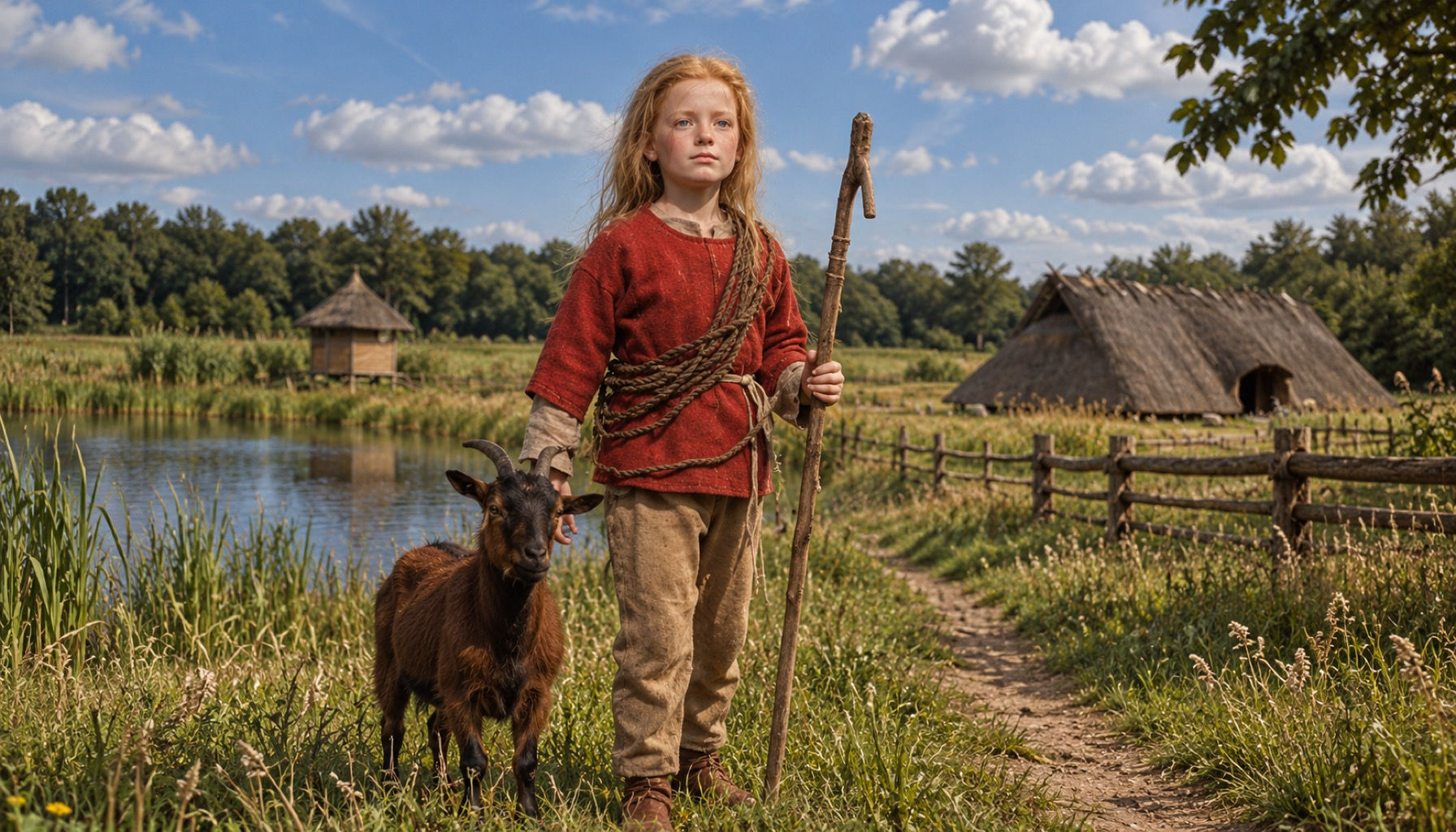
Aak was a boy of the Late Iron Age, living around 200 BC in the coastal wetlands of what is now the Netherlands, long before Roman authors began labeling and classifying the peoples of the North Sea world. His remains, found at Uitgeest-Dorregeest in Holland, have become unexpectedly important because they give us something rare for this region and period: not just pots, soil, and settlement traces, but the DNA of an actual person.
That matters because Aak belongs to the human landscape from which later Frisian communities emerged. He lived in a world of marshes, creeks, pasture, and shifting shorelines, where survival depended on managing water as much as working the land. Farming, herding, fishing, and seasonal adaptation were not romantic extras here; they were the whole business of life. In that sense, Aak is historically valuable not because he was a ruler or warrior, but because he represents the ordinary coastal population before written history pinned names to them.
The coastal Low Countries in Aak’s day were not empty margins waiting for civilization to arrive. They were already inhabited by communities deeply skilled in living with tidal change and fertile but unstable ground. Later Frisian history would become famous for precisely this stubborn relationship with water, and Aak stands very near the beginning of that long story. He lived centuries before the Roman conquest of the region, before the Batavians entered Roman texts, and before the North Sea coast became tied into imperial frontiers and military roads.
What we can say, carefully, is that Aak came from a pre-Roman society rooted in this coastal environment. What we cannot do is turn him into a named “Frisian” in the fully historical sense used for later centuries. Archaeology and genetics can place him within the cultural world ancestral to later Frisian populations, but they do not hand us a tribal passport. That distinction is important. Aak is most revealing precisely because he lets us look at the people behind later identities, before those identities were fixed in writing.
The biological sample associated with him is recorded as Late Iron Age Frisian Boy Aak Uitgeest-Dorregeest Holland, dated to about 200 BC. The popular name “Aak” is modern and commemorative rather than historical; his real personal name is unknown. So this is not a securely identified named individual in the way a king in an inscribed tomb might be. Rather, it is a securely excavated ancient individual whose remains were recovered from Uitgeest-Dorregeest and who has since become a recognizable public face of the region’s Iron Age inhabitants.
The reference article from NOS helped introduce Aak to a wider audience as an Iron Age child from the Dutch past, and that public framing is useful so long as we keep the limits in view. Archaeology gives us the place, period, and broader cultural setting. Ancient DNA adds a new line of evidence. But neither source tells us his spoken name, his family story, or the details of how he died. What they do provide is something almost as compelling: a direct connection to a coastal community that otherwise survives mostly through landscapes, settlements, and grave finds.
Aak’s Y-DNA haplogroup, inherited along the direct paternal line, was R1b1a1b1a1a1c1a. His mtDNA haplogroup, inherited along the direct maternal line, was N1a1a1a3*1. These are lineages, not ethnic labels. They do not prove that Aak was “Frisian,” “Germanic,” or anything else in a simple modern sense. What they do is place his direct father-line and mother-line within wider patterns that can be compared across ancient populations.
The paternal lineage is especially interesting because related R1b1a1b1a1a1c1a-linked samples appear in a broad arc of later European contexts: Aak himself at Uitgeest-Dorregeest (I12907), Batavian-period Netherlands at Valkenburg Marktveld (CGG107745), Early Iron Age Vlaardingen-Krabbeplas in the Netherlands (I17019), Saxon Coast Lower Saxony at Dunum (DUN010), early Anglo-Saxon burials from Buckland Dover (BUK059 and BUK027), medieval Jutland in Denmark (CGG100493), several medieval individuals from Sint-Truiden in Belgium (ST0052, ST0632, ST3006), Iron Age Britain among the Celtic Parisi at Wetwang Slack (I30975 and I36897), and even farther-flung cases such as Teplice in Bohemia, Tarquinii in Italy, Villa Magna, the Piast-associated sample PCA0193, and the Bathory-linked PER01. That does not mean all these people belonged to one tribe or close family. It means Aak’s direct paternal line belongs to a lineage that turns up across northwestern and central Europe over a long span of time, making him a useful early anchor for the North Sea zone within that wider genetic tapestry.
On the maternal side, the supplied related N1a1a1a3*1-linked sample is simply Aak himself (I12907). That makes his mtDNA lineage more limited in the present comparison set. In practical terms, it means his direct maternal line is recorded here as distinctive but not yet richly contextualized by a long list of close published parallels in the same dataset. This is a good reminder that ancient DNA evidence is uneven: some lineages are represented by many samples, others by very few.
Read about the Lower Rhine frontier
Aak’s importance lies in timing. He lived before the Roman conquest, before the documentary spotlight, and before the ethnic and political rearrangements of the early historic North Sea world. His DNA therefore helps scholars compare pre-Roman coastal populations of the Low Countries with later groups in the Netherlands, northwest Germany, Scandinavia, and Britain. That is the real historical prize: not a fantasy of identifying a single “first Frisian,” but a clearer sense of continuity, mixture, and regional connection along the North Sea rim.
And one must be sober about this. Aak’s haplogroups alone cannot tell us what language he spoke, what myths his family told, or whether he would have recognized any later Frisian identity. They also cannot prove direct descent for modern people who share similar lineages. But taken together with archaeology, they allow him to stand as something wonderfully concrete: one boy from a watery Iron Age world, whose remains now help illuminate the deep population history of the Dutch coast.
Discover the Lower Rhine-Meuse past
MyTrueAncestry lets you compare your DNA with ancient populations and archaeological samples from the worlds that shaped Europe, including North Sea and Low Countries history. You may discover genetic connections to populations related to the broader landscape Aak once inhabited, while keeping in mind that such matches reflect shared ancient ancestry rather than proven direct descent from this individual.

Comments