Wenceslaus of Płock
– 5 min read


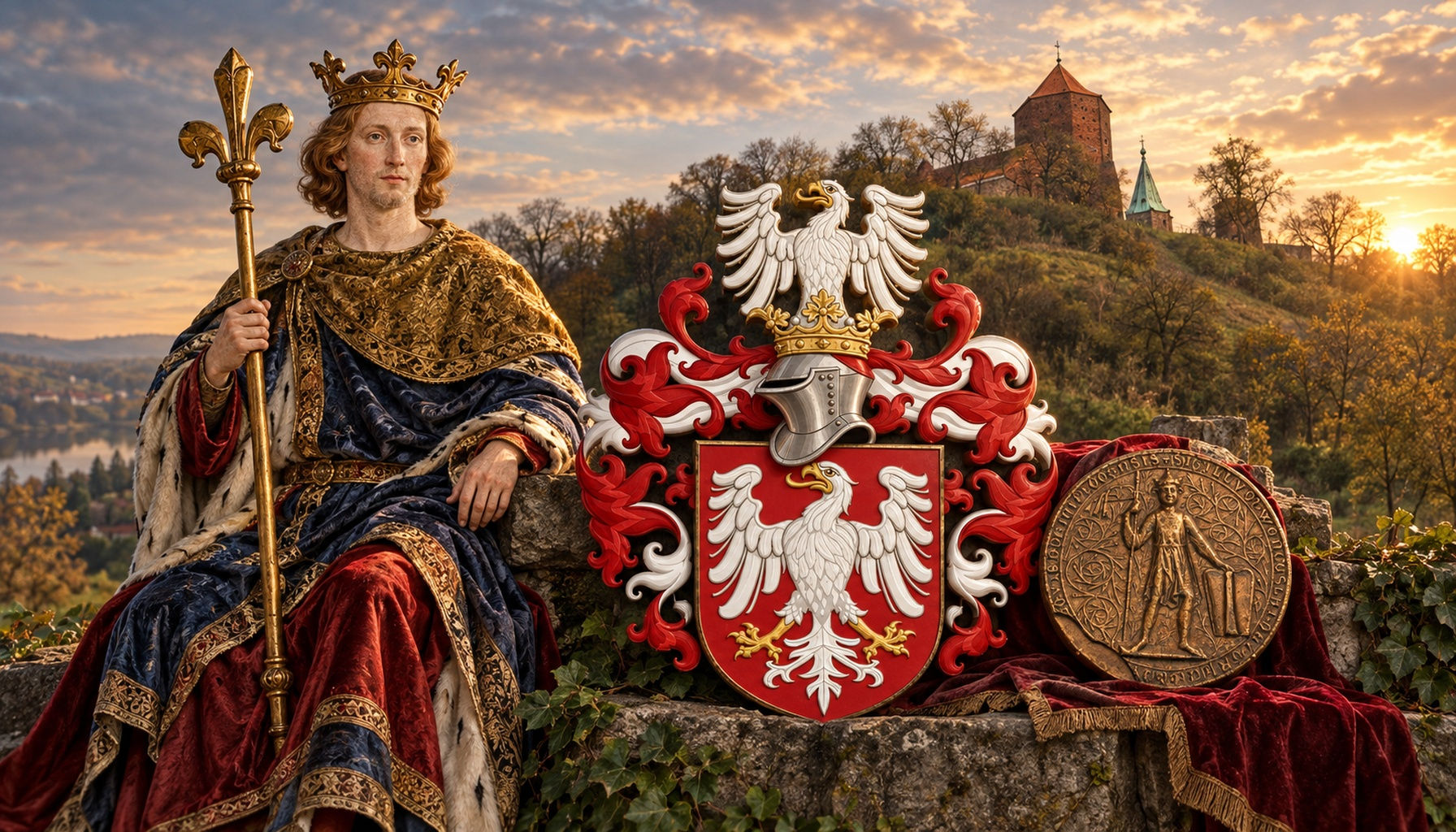
Wenceslaus of Płock, also known as Wanko, was a fourteenth-century Masovian Piast prince who ruled the Duchy of Płock from 1313 until his death in 1336. He belonged to one of those wonderfully tangled medieval ruling families whose fortunes were shaped not just by inheritance, but by the uncomfortable geography of eastern Central Europe: between the reunited Polish kingdom, the kings of Bohemia, pagan and then newly Christian Lithuania, and the Teutonic Order.
He was the son of Bolesław II of Masovia and Kunigunde of Bohemia, and through his mother he was a grandson of Ottokar II of Bohemia, one of the great rulers of thirteenth-century Central Europe. That ancestry mattered. Medieval politics was family politics, and Wenceslaus lived in a world where a duke’s marriage, his homage to a stronger king, or his refusal to choose sides could redraw the map as effectively as a battle.
When Bolesław II’s lands were divided among his sons, Wenceslaus received Płock. That sounds tidy; it rarely was. Masovia in this period was politically fragmented, its Piast rulers balancing local autonomy against the ambitions of larger neighbours. In 1329 Wenceslaus accepted the overlordship of King John of Bohemia, bringing Płock into the orbit of the Luxembourg monarchy. This was not some romantic act of fealty but a hard political calculation in a dangerous region. His marriage to Elisabeth, also called Dannila, daughter of the Lithuanian grand duke Gediminas, linked the Masovian Piasts with another major ruling house of eastern Europe. Between his Přemyslid ancestry and his Gediminid marriage alliance, Wenceslaus sat at a dynastic crossroads. His son, Bolesław III, succeeded him as Duke of Płock, showing the usual medieval concern not just with ruling, but with getting the succession safely through the next generation.
Explore the House of Gediminid
The ancient DNA sample associated with him is listed as Wenceslaus of Plock Piast Masovian Dynasty, with an approximate date of 1336 AD. That makes this a particularly interesting case because we are not looking at an anonymous medieval burial from the broad Piast period, but at a sample attributed to a named ruler from a documented dynasty.
What we can say securely from the supplied information is that the sample is associated with Wenceslaus of Płock and belongs to the Masovian Piast context. What we cannot say, because the supplied material does not spell it out, is exactly which skeletal element was sampled, where the remains were recovered, or the full chain of identification by which the burial was matched to Wenceslaus himself. So the careful wording matters here: this is an attributed historical sample, but without inventing details we have not been given, one should avoid pretending that every step of the identification process is fully described in the brief summary alone.
The broader scientific context, including the reference study in Nature Communications, is important because Piast dynasty genomics has become a rare and valuable meeting point between written history, funerary archaeology, and biological kinship. In such work, genetics can help test whether burials form a biological family group, whether individuals fit expected dynastic relationships, and whether a princely burial really belongs within a known elite lineage.
The reported Y-DNA haplogroup for Wenceslaus of Płock is R1b1a1b. Y-DNA traces the direct paternal line: father to son to son across many generations. For a male member of a ruling house, that is especially relevant because dynasties were often defined politically through male-line descent, even if real power depended on far more than chromosomes.
His mitochondrial DNA, or mtDNA, is listed as unknown. mtDNA follows the direct maternal line, passed from mother to child, but only daughters pass it on further. Since no mtDNA haplogroup is supplied here, it is best simply to say that Wenceslaus’s direct maternal-line assignment was not determined or not reported in the provided summary.
R1b1a1b is a broad paternal lineage with a long and complex history across western Eurasia. It should not be treated as an ethnic badge and certainly not as proof that a person was “really” this or that nationality or people. Haplogroups are lineages, not identities. In a medieval ruler like Wenceslaus, the interesting point is not that one lineage somehow defines him, but that it offers one narrow genetic thread through a dynasty otherwise known from chronicles, charters, marriage alliances, and tombs.
A short ancient-DNA comparison helps place this result in perspective. The same broad Y-lineage label appears in the Wenceslaus of Plock sample itself, in other Piast-related individuals such as Piast Masovian Dynasty males and princes, and in a strikingly wide range of older and geographically distant archaeological samples, including Magdalenenberg elite burials in Germany, Roman-era individuals from England, Caucasus and steppe contexts, and later medieval and early modern burials across Europe. That breadth is exactly the point: sharing R1b1a1b does not mean close relationship. It means membership in a much larger paternal lineage whose branches spread over vast stretches of time and space. For Wenceslaus, the value lies in comparing his result with other Piast-associated males, not in lumping him together indiscriminately with every distant bearer of the same broad clade.
As for the maternal side, the only ?-linked sample explicitly available in the supplied material is Wenceslaus of Plock Piast Masovian Dynasty (PCA0654) itself. In practical terms, that means no secure mtDNA comparison set has been provided here. So the maternal line remains unresolved in this summary, a useful reminder that ancient DNA often answers one question while leaving another stubbornly open.
Wenceslaus is historically interesting because he was not a world conqueror or a mythical founder, but a very real regional ruler making difficult choices in a crowded political landscape. His DNA matters for the same reason. It anchors a documented medieval prince in the growing genetic record of the Piast dynasty and helps researchers ask whether the biological evidence fits the historical family story. It can illuminate paternal-line continuity and dynastic relationships; it cannot by itself explain his politics, his language, his loyalties, or the whole texture of Masovian society.
In other words, DNA gives us one line of evidence among several. The chronicles tell us that Wenceslaus maneuvered between Bohemia, Poland, Lithuania, and the Teutonic Order. His marriage tells us about diplomacy. His succession tells us about dynastic continuity. The genetic result adds another layer: one more way to place a named Piast ruler within the biological history of the house that governed Masovia.
Discover the Přemyslid dynasty
MyTrueAncestry lets you compare your DNA with ancient populations and archaeological samples from the worlds that shaped people like Wenceslaus of Płock: medieval Poland, dynastic Europe, and the deeper genetic history behind royal lineages and frontier societies. It cannot prove direct descent from Wenceslaus, but it can help you explore whether your DNA shows connections to the wider populations and lineages that formed his historical world.



Comments