The Royal House of OBrien
– 3 min read


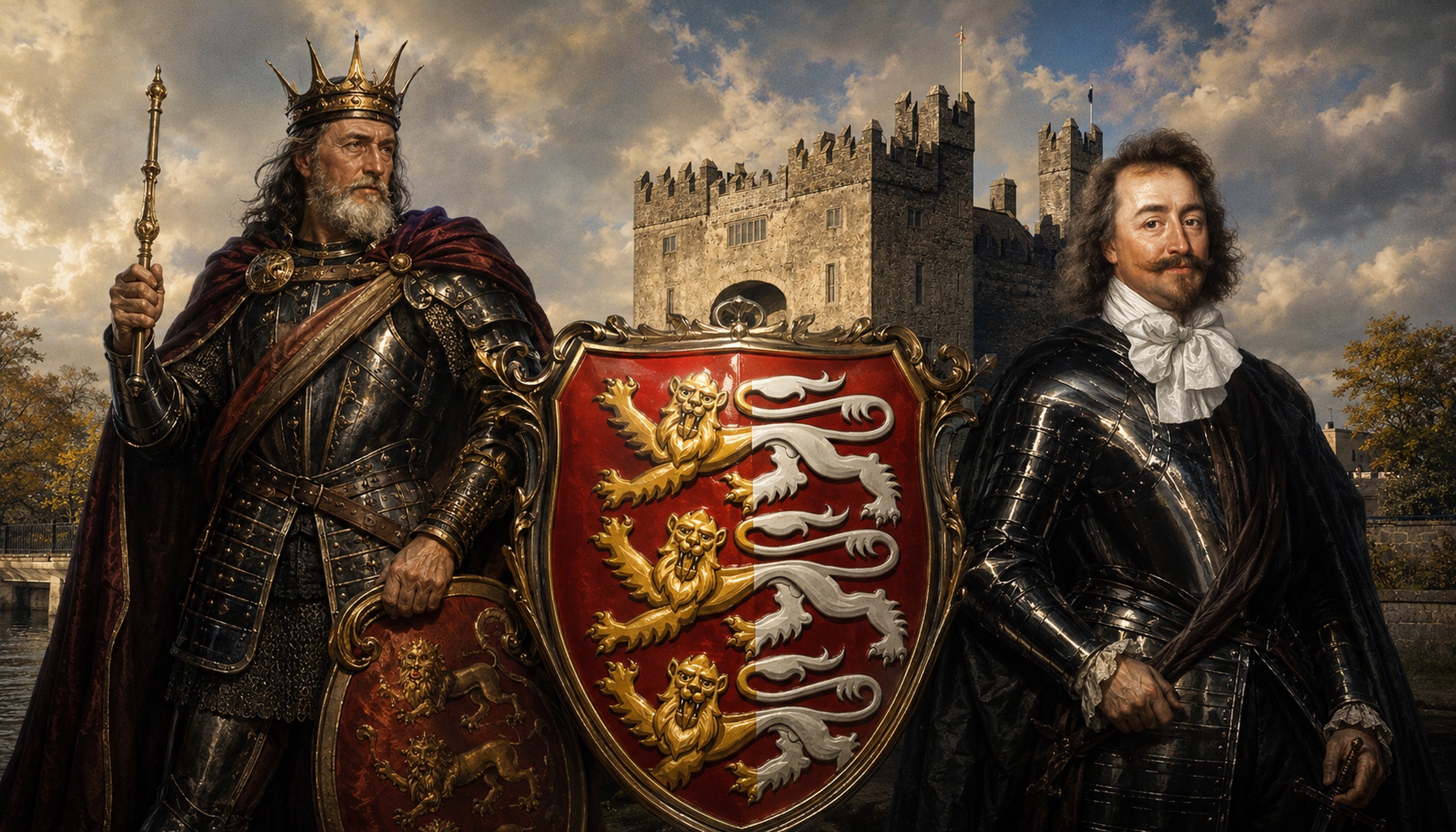
The House of OBrien was one of the great royal houses of Ireland, rooted in Munster and most closely associated with Thomond, the Dal gCais, and the memory of kingship on an almost epic scale. In genetic tagging terms, the primary family haplogroup linked here is R1b1a1b1a1a2c1a4b2a1a1, a branch that sits comfortably in the wider story of Atlantic and Insular Celtic paternal lineages. Historically, the OBriens emerged from the political landscape of early medieval western Ireland, where kinship, clientship, cattle wealth, church alliances, and warbands mattered every bit as much as borders on a map. Their rise was not an overnight miracle but the patient, forceful ascent of a dynasty that learned how to turn provincial strength into national authority.
That ascent is inseparable from Brian Boru, High King of Ireland (941-1014), whose name still has the weight of legend, though legends always need a bit of dusting and sorting. Brian was not merely a heroic warrior in a tidy storybook sense; he was a ruthless and effective political operator who broke the long dominance of older royal groupings and pushed the Dal gCais into the front rank of Irish power. His descendants carried that authority forward through figures such as Toirdelbach OBrien, High King of Ireland (1009-1086), and Muirchertach OBrien, High King of Ireland (1050-1119), while later generations ruled as Kings of Thomond and influential lords in Munster. The family became a classic example of the Irish royal house pattern: ancient kingship, battlefield authority, provincial dominance, dynastic prestige, and a remarkable ability to endure even as Ireland's political world shifted around them.
Read more about the Royal House of ONeill
If you want a physical anchor for OBrien power, Bunratty Castle in County Clare does the job splendidly. The site stands near the River Ratty and the Shannon estuary, in a place that mattered for movement, trade, defense, and the control of western Munster. Earlier fortifications existed there before the present tower house, and the current castle was built in the 15th century, later becoming strongly associated with the OBriens, especially the Earls of Thomond. Bunratty is one of the best-known and most substantial medieval tower houses in Ireland, with its great hall, thick walls, and commanding position still making the old language of lordship perfectly intelligible. It was not simply a residence; it was a statement in stone that this was a family accustomed to ruling land, receiving guests, commanding followers, and navigating the awkward dance between Gaelic tradition and changing political realities. Happily, Bunratty Castle can still be visited today, which means OBrien heritage is not trapped in manuscripts and annals but can be walked, climbed, and looked out from.
From an ancient-DNA perspective, the OBrien haplogroup tag R1b1a1b1a1a2c1a4b2a1a1 can be placed beside a broad scatter of related or linked ancient samples across Britain and Europe. These include Celtic Durotriges England Duropolis Winterborne Kingston individuals such as WBK12, WBK20, WBK29, WBK41, WBK05, WBK30, WBK43, WBK06, WBK08, WBK18, and WBK191, along with ATP_PSN_192 from Medieval England Cambridge St Johns Hospital, I26776 from Imperial Roman Era Zadar in Croatia, KD061 from Bronze Age Orkney at Westray Links of Noltland, GMO015 from Bronze Age Calabria, ST2025 and ST1308 from medieval Belgium, CGG023699 from Gallic France Parancot, I11580 from post-Roman Dorset, IND013 from Merovingian Germany, R10656 from Late Roman Austria, R10488 from Late Roman Conimbriga in Portugal, I11991 from Iron Age Worlebury, I21309 from Battlesbury Bowl, I3256 from Bronze Age Trumpington Meadows, I2417 from Amesbury Down, I4950 from Bell Beaker Upavon, I7576 and I7577 from Bronze Age Bedfordshire, I5473 from South Lanarkshire, HI2 from Iron Age Hinxton, I5377 from the Early Bronze Age Thames, and Rathlin2B from Copper Age Ireland. These samples should not be treated as proven direct ancestors of the OBrien dynasty, but they do help sketch the wider genetic landscape in which kindred paternal lines moved through Celtic, Roman, post-Roman, and medieval worlds before later Irish royal surnames crystallised.
The House of OBrien remains one of the clearest symbols of Irish royal continuity: from the Dal gCais heartland to the High Kingship, from Thomond to Bunratty, from war-leadership to noble adaptation under changing regimes. If your own family story carries OBrien heritage, Munster roots, or a broader Irish connection, this is exactly the sort of dynasty worth exploring through both records and DNA. Upload your DNA to MyTrueAncestry and see whether you match the OBrien family story or any of the related ancient DNA samples linked to this deep historical landscape.
Comments