The Noble House of Townshend
– 3 min read


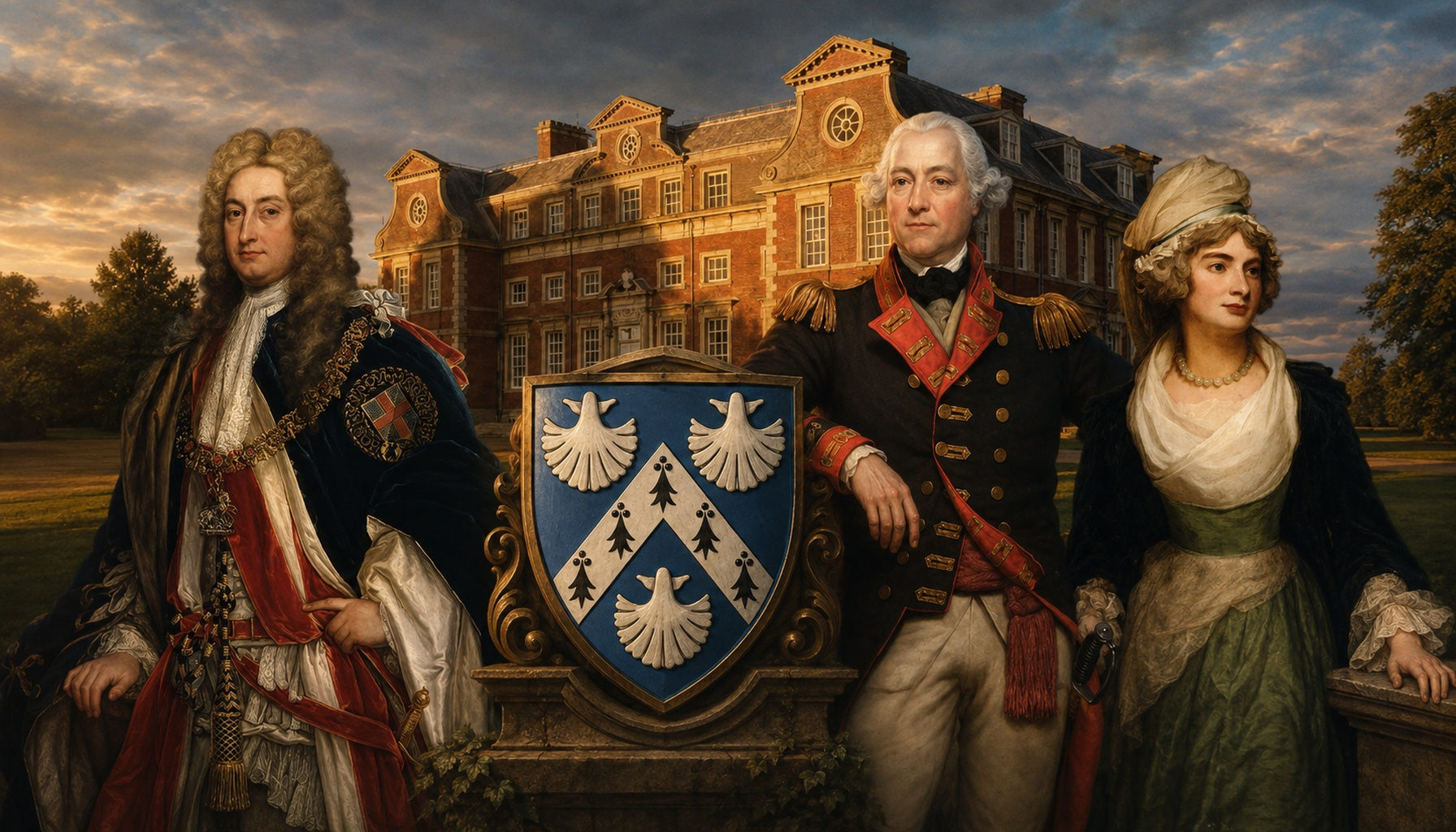
The House of Townshend was an English noble house rooted above all in Norfolk, and especially associated with the great estate world of the east of England. Its story is a very English one: land, office, Parliament, marriage, heraldry, and the slow building of status across generations until the family stood firmly within the peerage. Linked here with the primary family haplogroup R1b1a1b1a1a2c1a4c1a, the Townshends fit the familiar pattern of aristocratic power in Britain, where influence did not rest on castles and titles alone, but on county presence, royal service, and a readiness to take part in national government.
The family name points to a place-based origin, as so many English surnames do, and the wider setting matters. Norfolk was not some sleepy backwater but one of the key counties of medieval and early modern England, rich in agriculture, closely tied to trade, and full of gentry and noble competition. In that world the Townshends rose through landholding and strategic service to Crown and state, turning local standing into national importance. Figures such as Sir Roger Townshend of Raynham (1596-1637), Horatio Townshend, 1st Viscount Townshend (1630-1687), and Charles Townshend, 2nd Viscount Townshend (1675-1738), show the family at different moments in that ascent: county magnates, parliamentarians, royal servants, and political actors whose reputation rested on both estate management and public duty. This is what makes the House of Townshend so characteristic of the English noble house tradition: they were not merely owners of land, but participants in government.
Read more about the Howard family
The great location anchor of Townshend history is Raynham Hall, near Fakenham in Norfolk, long the family seat and one of those houses that tells you, almost at a glance, how aristocratic England worked. The present hall was built in the early seventeenth century and is often noted as one of the important early country houses of its kind in England, standing at that fascinating point where late Tudor habits and emerging classical taste meet. It remained deeply associated with the Townshends and became the physical expression of their identity: not just a residence, but a political stage-set, a dynastic archive, and a statement of continuity. The house is also famous in popular lore for the "Brown Lady" ghost story, which has helped keep its name alive well beyond strictly architectural history. Just as importantly, Raynham Hall sits in landscaped parkland that reflects the long evolution of the English country estate, where social prestige, agricultural wealth, hospitality, and influence all came together. It has at times opened for tours and special events, so it can still be visited in a limited but real sense when public access is arranged.
Explore another Norfolk family
From a DNA perspective, the Townshend-linked haplogroup R1b1a1b1a1a2c1a4c1a sits within a deeply rooted western European paternal landscape. Related or linked ancient samples associated with this branch include a strong cluster from Iron Age and Romano-British contexts in Britain, especially the Celtic Durotriges burials at Duropolis, Winterborne Kingston in England such as WBK12, WBK20, WBK29, WBK41, WBK05, WBK30, WBK43, WBK06, WBK08, WBK18, and WBK191, as well as Celtic Parisi and Brittonic-era individuals from East Yorkshire and Pocklington including I28771, I28772, I21644, I30911, I28927, I30903, I5509, I36995, I14102, I14104, I13753, I13760, and I14100. Other linked finds range widely across time and space, from Bronze Age Britain and Ireland, including Amesbury Down, Trumpington Meadows, Bedfordshire, Hinxton, the Thames, Boatbridge Quarry, and Rathlin2B, to Roman and post-Roman samples such as I26776 from Zadar in Croatia, R10488 from Conimbriga in Portugal, R10656 from Klosterneuburg in Austria, I11580 from Worth Matravers in Dorset, and medieval individuals from Belgium, Germany, and Ireland. None of this proves direct descent from any named ancient person, of course. What it does show is that the Townshend paternal line belongs to a broader genetic story deeply present in Britain and northwestern Europe across the Bronze Age, Iron Age, Roman, and medieval periods.
The House of Townshend is a reminder that noble history is never just about one title or one grand building. It is about how families embedded themselves in a county, served in Parliament, cultivated alliances, displayed heraldic identity, and left behind a memory strong enough to survive long after the fiercest political quarrels had faded. If you have Townshend ancestry, or simply want to see whether your DNA connects with this family or with related ancient samples from Iron Age, Roman, and medieval Britain, you can upload your DNA to MyTrueAncestry and explore the deeper past behind the paper trail.
Comments