The Noble House of OMolloy
– 3 min read


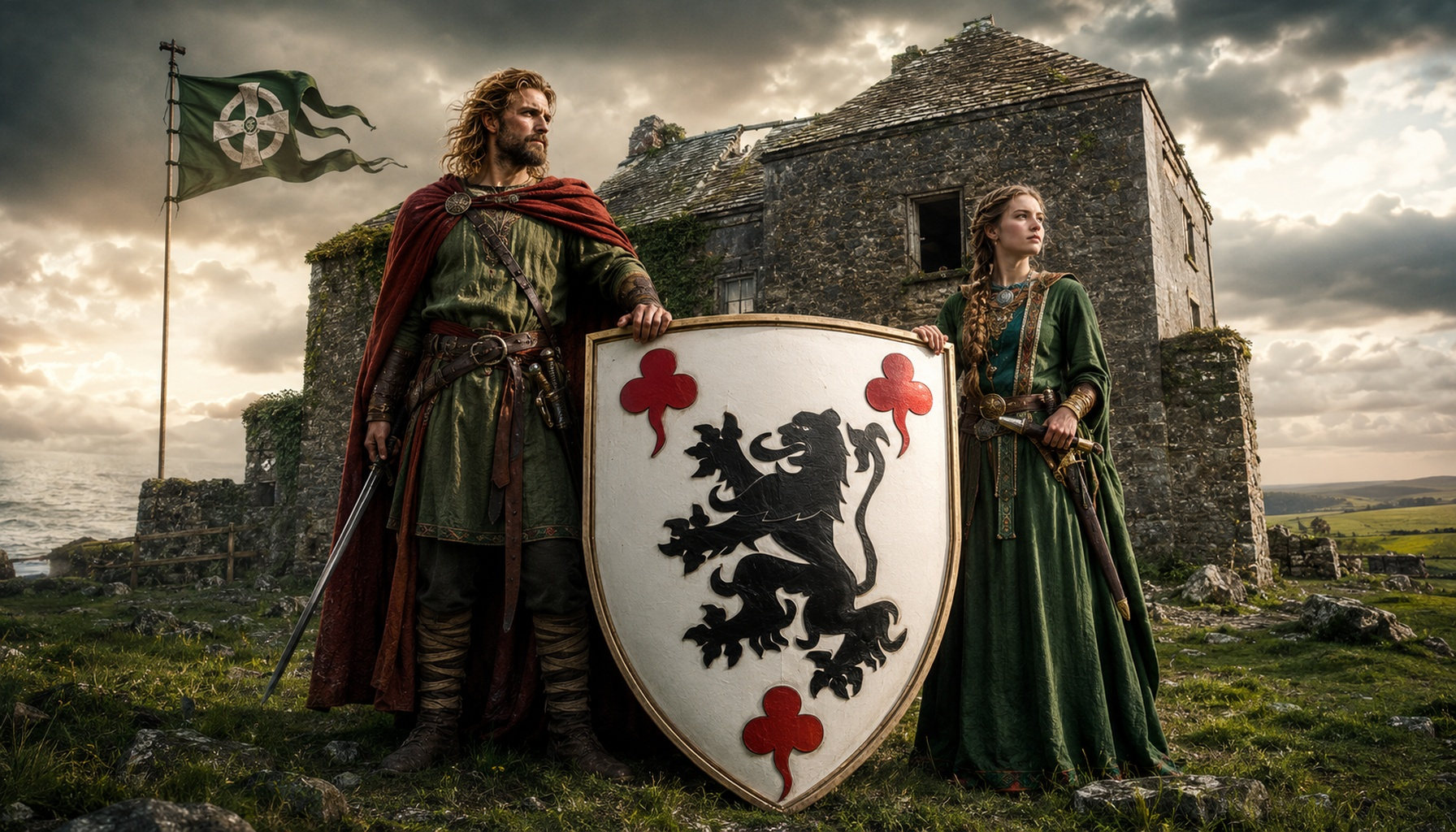
The House of OMolloy was one of the notable Gaelic noble houses of the Irish midlands, rooted in Firceall in what is now County Offaly, and remembered above all for its long association with local lordship, kin-based rule, and the stubborn defense of territory. Their story belongs to that very Irish pattern of power in which a family was not simply a surname, but a political community: chiefs, clients, church patrons, fighting men, and landed kindred bound together by ancestry, landscape, and reputation. The haplogroup most closely linked here as the primary family line is R1b1a1b1a1a2c1a1a1a1a1a1a, a branch within the wider paternal line often found across Atlantic and western European populations.
In historical terms, the OMolloys emerged from the Gaelic world of regional kingdoms and overlapping lordships, where control depended not on neat borders but on influence, tribute, marriage alliances, military followings, and the ability to hold land against rivals. Firceall was their homeland and power base, a territory whose name still carries the echo of an older political geography. Across the medieval centuries the family produced Lords of Firceall and Chiefs of the Name, figures who stood as guardians of both land and lineage. Among the better-known named members remembered in the historical tradition are Anadan O Maolmhuaidh, associated with the lordship of Firceall, and later chiefs of the house who appear in Gaelic genealogical and territorial records as Lords of Firceall and Chiefs of the Name. Like other enduring Irish houses, the OMolloys survived not because history was kind to them, but because memory was: the name, the descent, the territory, and the ancestral claim all remained meaningful even as the political world around them changed.
Read more about the Royal House of OReilly
A key location anchor for OMolloy heritage is Eglish Castle, near Rath in County Offaly, in the old Firceall heartland. This is precisely the sort of place that helps make sense of a Gaelic noble house: not an abstract pedigree on paper, but a defended residence set in a lived political landscape. Rath itself preserves evidence of long settlement, and the area around Eglish sits within the terrain from which the OMolloys exercised local authority. Eglish Castle is generally described as a tower house, the kind of late medieval stronghold that combined status, residence, and defense. In other words, it was built for a family that needed to watch roads, hold tenants, negotiate power, and if necessary withstand attack. The surrounding district, with its churches, ringfort associations, field systems, and old territorial memory, reminds us that Firceall was not just a map label but a functioning Gaelic lordship. The site and its wider locality can still be visited as part of the historic landscape of County Offaly, though as ever with old monuments, access and condition can vary.
From a DNA perspective, the OMolloy-linked paternal signature is tagged here to R1b1a1b1a1a2c1a1a1a1a1a1a. That does not mean every bearer of the surname shares one identical direct paternal line, nor does it make any ancient sample a proven ancestor of the family. What it does do is place the house within a wider network of related or linked paternal lineages found in medieval and post-Roman Europe. Examples include Medieval Ireland samples from Kilteasheen, Roscommon such as KIL033, KIL037, KIL043, and KIL009, which are especially evocative in an Irish context, alongside linked samples from Viking Age Dublin at Ship Street, sample VK545. Beyond Ireland, related examples appear in Medieval Jutland at Vor Frue Kirkegard, Aalborg, sample CGG100512, among the Thuringii at Deersheim in Saxony-Anhalt, sample DRH026, in Carolingian Groningen, sample GRO005, in Merovingian Alt-Inden, sample IND007, and in Anglo-Saxon Norfolk at Sedgeford, sample SED005. The same broader line also turns up in places as varied as Viking Age Hofstadir in Iceland, Medieval Sandoy Church in the Faroe Islands, Aquitani Pech-Maho in France, and even colonial Maryland burials linked to Philip Calvert. The point is not a fantasy of direct descent, but something historically richer: a reminder that the paternal world surrounding Gaelic Ireland was part of a deep and mobile northwest European story.
Read more about Clan OMaolagain
If you carry the OMolloy name, or suspect roots in Offaly, Firceall, or the wider Gaelic midlands, this is exactly the sort of family history worth testing against both records and genetics. Upload your DNA to MyTrueAncestry and see whether you match the House of OMolloy or any of the related ancient DNA samples linked to this broader haplogroup story.
Comments