The Noble House of Kinsella
– 3 min read


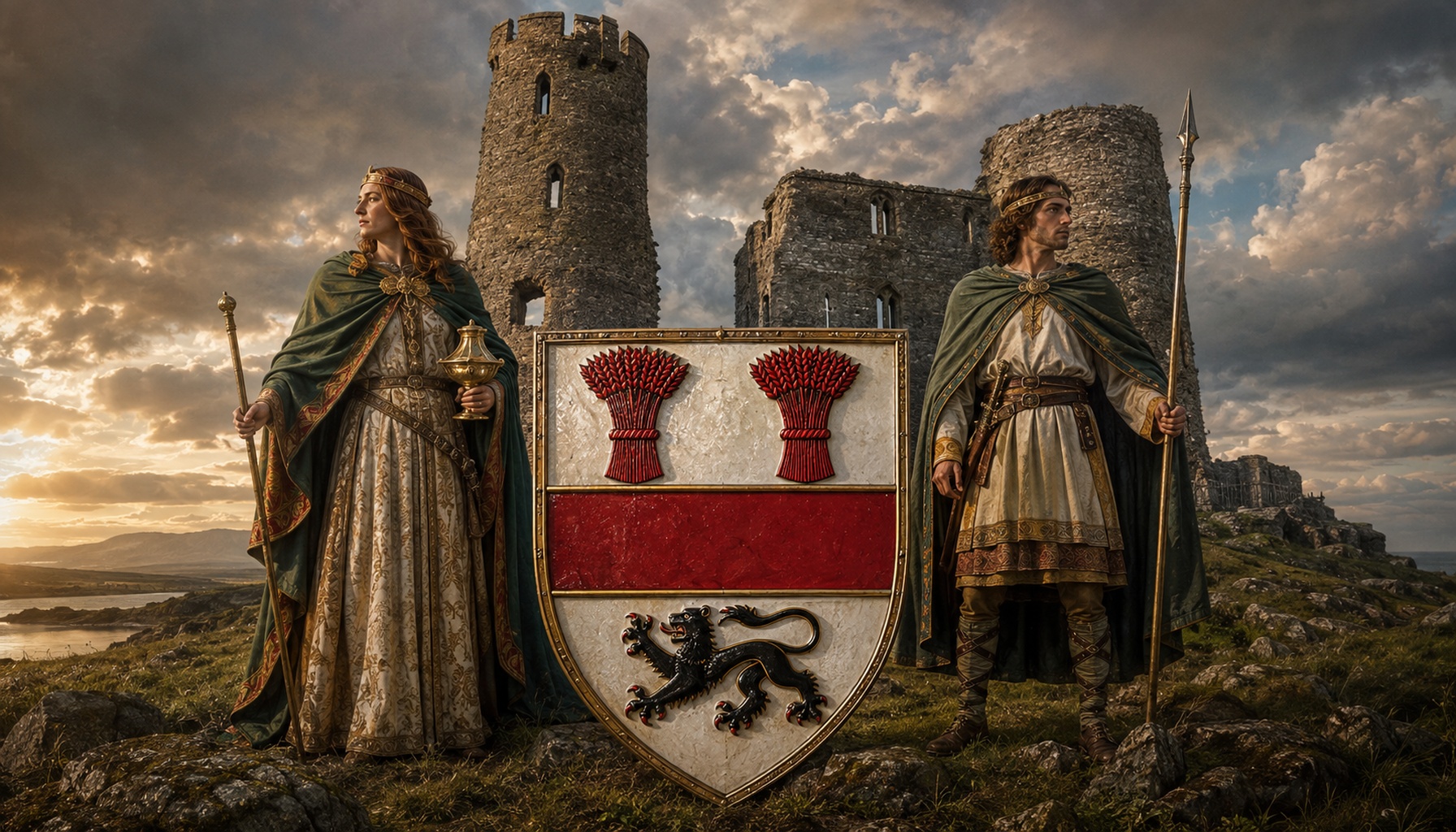
The House of Kinsella was one of the great Gaelic noble houses of Leinster, rooted above all in eastern Ireland, especially County Wexford and the old royal center of Ferns. Historically the family belonged to the world of the Ui Ceinnselaig, the royal kindred whose power shaped the politics of south Leinster for centuries. In genetic tagging terms, the primary family haplogroup associated here is R1b1a1b1a1a2c1a4a, a branch linked with many lineages across Atlantic and Celtic Europe. Haplogroups: R1b1a1b1a1a2c1a4a.
Kinsella is not simply a surname story but a dynastic one. This was a house formed through descent, kingship, warfare, landholding, and alliance, the classic ingredients of Gaelic aristocratic life. The family stands in the old Leinster pattern: ancient pedigree, territorial authority, noble memory, heraldic identity, and continuity through changing centuries. Among the figures tied to this tradition are Enna Cennsalach, King of Leinster, placed around 450, and much later Diarmait Mac Murchada, King of Leinster, 1110 to 1171, one of the most consequential and controversial rulers in Irish history, along with his son Murchad Mac Murchada, who died in 1172. Through them, the Kinsella story is bound into the wider royal kindred of Leinster itself.
Read more about Clan Mac Murchada
Ferns is the essential location anchor for the House of Kinsella. In medieval Ireland it was not some sleepy provincial place but a major political and ecclesiastical center, closely associated with the rulers of the Ui Ceinnselaig and with the kingship of Leinster. Ferns Castle, in County Wexford, preserves that memory in stone. The castle known today was built in the early 13th century, after the great upheavals that followed the Anglo-Norman arrival, and is traditionally connected with William Marshal. Even so, the site itself sits in a landscape already thick with royal significance. The surviving remains include a large Norman hall-keep and later additions, and they stand near a place whose importance long predated the castle walls. In other words, Ferns is one of those Irish sites where Gaelic kingship, church authority, and later lordship all seem to layer themselves on top of one another. Yes, it can still be visited today, and for anyone interested in Kinsella heritage it is one of the most immediate ways to step into the old Leinster world.
From an ancient-DNA point of view, the haplogroup tag R1b1a1b1a1a2c1a4a links the Kinsella story to a wide and very interesting network of related ancient males across Britain, Ireland, and parts of continental Europe. These are not claims of direct descent from named excavated individuals, and they should be treated as related or linked samples rather than family members in the documentary sense. Still, the pattern is striking. It includes multiple Celtic Durotriges samples from Duropolis at Winterborne Kingston in England such as WBK12, WBK20, WBK29, WBK41, WBK05, WBK30, WBK43, WBK06, WBK08, WBK18, and WBK191; medieval and Dark Ages samples from Las Gobas in northern Spain such as ldo039, ldo052, and ldo242; Iron Age and later individuals from Kent, Somerset, Oxfordshire, Yorkshire, Orkney, Scotland, Ireland, Belgium, France, Germany, Hungary, Croatia, Portugal, and beyond, including Medieval Ireland Kilteasheen samples KIL025, KIL015, and KIL012. Taken together, these linked finds suggest a deep paternal presence in the western European and Insular Celtic world, the sort of long-duration background from which a Leinster royal house like Kinsella could emerge.
Read more about the Royal House of ONeill
If the House of Kinsella is part of your heritage, or if you are simply curious about the old royal landscapes of Leinster, this is exactly the kind of story where history and DNA can illuminate one another. Upload your DNA to MyTrueAncestry and see whether you match the House of Kinsella story or any of the related ancient DNA samples connected with haplogroup R1b1a1b1a1a2c1a4a.
Comments