The Neolithic Expansion: A Genetic and Archaeological Journey Through Ancient Europe

– 4 min read



The saga of Neolithic expansion represents one of humanity's most transformative chapters, chronicling the migration of farmers from their Anatolian and Aegean homelands across the European continent approximately 8,600 years ago. This revolutionary movement fundamentally altered life in Europe, replacing millennia-old hunter-gatherer traditions with agricultural practices while also reshaping the genetic landscape of ancient populations. The research conducted by Alexandros Tsoupas and colleagues provides important new insights into this remarkable process of migration, interaction, and cultural transformation.
The rise and fall of ancient peoples left marks not only on the landscape but also in our genes. If you’ve ever wondered how your ancestry fits into that larger historical mosaic, MyTrueAncestry.com offers a fascinating perspective.
Standing at a Neolithic excavation site like Boncuklu in central Anatolia, one can imagine these early agriculturalists first tilling the soil, planting the literal and metaphorical seeds of what would become agricultural Europe. Through meticulous spatial simulations and high-quality DNA analysis from 67 prehistoric individuals across 17 archaeological sites, researchers have uncovered how these pioneer farmers interacted with indigenous hunter-gatherer populations throughout central Europe.
The coastal settlement of Lepenski Vir, nestled in the Danube Gorges, tells a particularly compelling story of cultural cross-pollination. Here, ancient communities stood at the meeting point of farming and fishing traditions. These findings underscore the complexity of the Neolithic transition, revealing it as less a simple replacement of one way of life by another and more a long process of coexistence and gradual integration spanning thousands of years.
Explore Denmark’s Mesolithic–Neolithic Transition
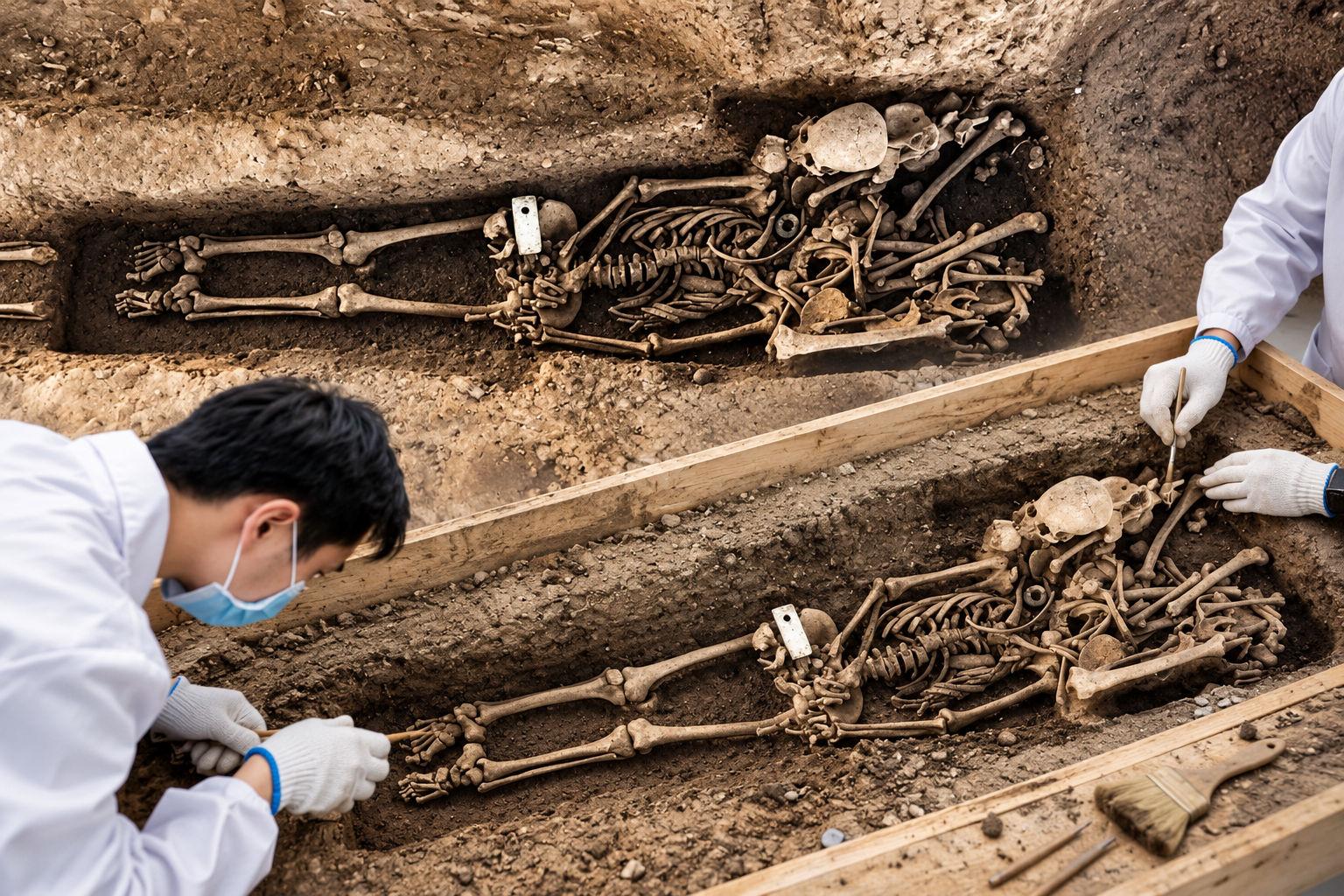
The paleogenomic evidence paints a vivid picture of increasing admixture between farming and foraging peoples, whose lineages became more intertwined over time. This genetic blending initially occurred sporadically, intensifying in regions stretching eastward from the Black Sea to the Baltic. Archaeological sites featuring Linearbandkeramik (LBK) culture artifacts provide tangible evidence of these interactions, where grave goods and skeletal remains point to both coexistence and occasional conflict.
The demographic picture suggests that farmers outnumbered hunter-gatherers by approximately five to one, yet the cultural and genetic exchange was far from straightforward. Demic diffusion appears to have unfolded as a leapfrogging movement along major continental river valleys, particularly the Danube. In other words, sporadic long-distance migrations helped spread agriculture, while local interactions with foraging communities helped stabilize these early farming settlements.
The Neolithic expansion followed distinct pathways across Europe, most notably the continental route along major river systems such as the Danube and Rhine. These waterways acted as highways of cultural and biological exchange, in contrast to the maritime Mediterranean route along European coastlines. Ancient settlements along these rivers preserve pottery, tools, and burial goods that illustrate the gradual blending of once-distinct lifeways.
Archaeological evidence from sites like Blätterhöhle and Barcın helps bring these encounters into focus. Genomic data from ancient individuals reveals gradual exchanges as settlers moved through the landscape, combining agricultural knowledge with local survival strategies developed over generations by indigenous communities.
Read more on forager ancestry in the Lower Rhine–Meuse
The LBK period, around 7,000 years ago, offers particularly revealing insights into ancient population dynamics. Archaeological evidence from massacre sites and mass graves during this era points to periods of social tension and crisis, yet paradoxically also shows increased genetic admixture between populations. These sites, stretching from the Balkans to Denmark, illustrate how even during turbulent times, cultural and genetic exchange continued to shape European populations.
The research further shows that admixture patterns were neither uniform nor constant. They varied significantly across regions and time periods, suggesting that local climates, ecological niches, and socio-economic conditions all influenced the degree of interaction between farming and hunter-gatherer communities.
The study employed cutting-edge techniques, including approximate Bayesian computation, to model ancient population dynamics with unprecedented precision. These methods allow researchers to trace subtle patterns of genetic flow and cultural exchange during the Neolithic transition, revealing stories of human adaptability and resilience encoded in ancient skeletal remains.
Each excavation site provides its own perspective on how communities adapted biologically and culturally to new agricultural landscapes. Notable locations include Aktopraklık in northwest Anatolia and Dillingen-Steinheim in Central Europe, where burial goods reflect lives connected across considerable distances through migration and exchange.
The Neolithic expansion represents far more than a technological transition. It reflects human resilience, adaptability, and the search for new ways of life. The genetic footprints left by these ancient interactions continue to shape European populations today, and they can now be traced with increasing clarity through genomic analysis.
The study deliberately avoids overly neat conclusions, instead offering glimpses into the continuing work of unraveling complex ancestry. Each grave uncovered and genome sequenced tells a story not merely of survival, but of interaction, adaptation, and cultural innovation. The findings suggest that the Neolithic transition was marked by episodic long-distance migrations punctuated by periods of intensive local interaction, helping create the genetic and cultural diversity seen in modern European populations.
Explore Neolithic Cerny culture ancestry in France
https://www.science.org/doi/epdf/10.1126/sciadv.adq9976
Upload your DNA to MyTrueAncestry to explore whether you match ancient individuals, families, or related populations connected to the Neolithic expansion and its legacy across Europe.






Comments