Haplogroup R1b1a1b1a1a1c2b2a1b1b
– 4 min read


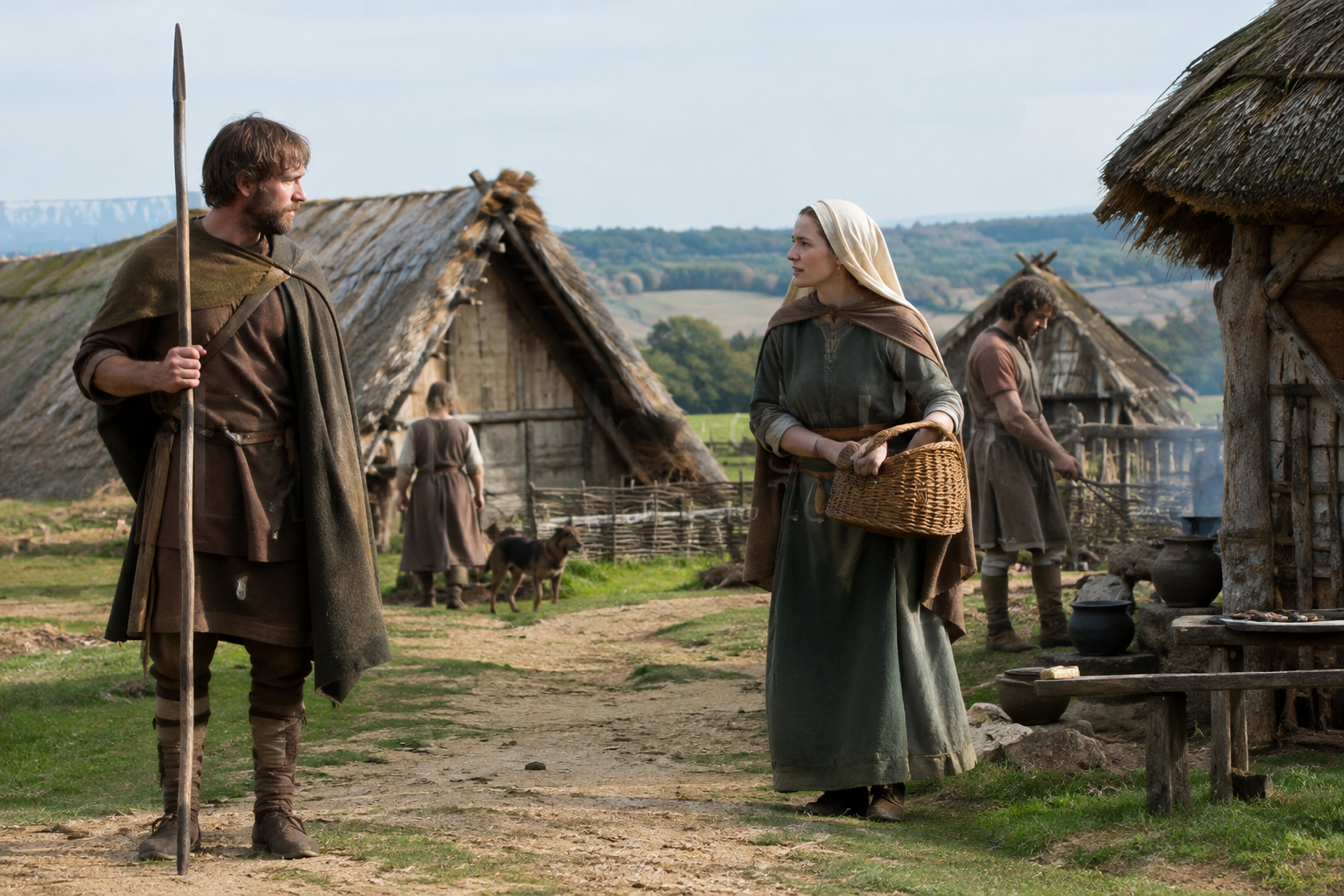
At Polhill, near Sevenoaks in Kent, one early medieval burial has become unexpectedly useful for tracing a very narrow paternal line. The individual known as POH008, dated to around AD 600, belongs to the period when Kent sat at the busy edge of the North Sea world: post-Roman, increasingly Christian, and deeply entangled with communities across the Channel. In MyTrueAncestry terms, this man is associated with the Y-DNA haplogroup R1b1a1b1a1a1c2b2a1b1b.
That long label needs a little unpacking. It is not a whole population, a tribe, or an ethnicity. It is one extremely specific twig on the much broader R1b paternal tree, tracing only a direct male line from father to son. What makes POH008 interesting is not that one grave can explain early English history, plainly it cannot, but that such a fine-grained branch turns up in an Anglo-Saxon-period cemetery in Kent, exactly where archaeology already shows close contact between Britain and the continental North Sea coast.
Polhill is the sort of site that reminds us how misleading neat textbook labels can be. "Anglo-Saxon Kent" sounds tidy, but actual burial grounds reveal something more mixed and more human: local continuity, incoming families, shifting fashions, and communities tied into trade and marriage networks stretching toward Francia and the southern North Sea.
POH008 belongs in that setting. With only one named ancient individual in this branch from the material provided here, caution matters. We should not pretend that this subclade defined Kent, nor that it marks a single migration event. But its presence in an early medieval Kentish burial does fit the broader picture emerging from archaeogenetics: southern and eastern England after Rome was not isolated, and paternal lines associated with continental northern Europe were part of the population forming early medieval England.
Roman and Early Medieval Britain DNA
Broad haplogroups are often historically noisy. A parent branch like R1b can be found across huge stretches of Europe and across many different eras. A lineage as narrow as R1b1a1b1a1a1c2b2a1b1b is different. It does not magically give us a named ancestor, but it can help place a paternal line inside much tighter historical contexts when ancient matches exist.
In this case, the useful fact is not some grand claim about "origins" going back into prehistory, because the evidence supplied here does not justify that leap. The useful fact is that one attested bearer appears in early medieval Kent. For a tester who matches this branch, that gives a historically grounded anchor in the centuries when eastern England was being reshaped by migration, alliance, and settlement from across the North Sea.
That is the value of ancient DNA at its best. It takes a lineage out of the abstract world of charts and places it, however briefly, in a real cemetery, in a real region, at a real historical turning point.
It is worth lingering on Kent itself, because geography is doing much of the historical work here. Kent was the landing place of embassies, traders, craftspeople, and migrants. Its elite links with Merovingian Francia are well known from archaeology and written sources, while its cemeteries show the cultural traffic of the 5th to 7th centuries in material form.
So when a paternal branch such as this appears at Polhill, the most sensible reading is not romance but context. This lineage belonged to a man living in one of the most outward-looking regions of early England. He may have had recent continental paternal ancestry, or he may have been part of a family already settled in Britain for generations within a still cosmopolitan Kentish community. The grave alone does not decide between those possibilities.
What it does support is the larger historical picture explored in studies of early medieval Britain and northwest European mobility: the making of England involved repeated movements of people, not a single clean replacement. That is why one cemetery sample can still be historically eloquent even when the personal biography remains stubbornly out of reach.
Germanic Languages and Genomics
Ancient Y-DNA evidence works rather like a surviving surname in a damaged archive: precious, specific, and incomplete. POH008 shows that a man associated with R1b1a1b1a1a1c2b2a1b1b was present in Kent around AD 600. That is a solid statement. It does not mean every modern bearer of the branch descends from Kent, still less from this one man in particular.
Yet even that modest conclusion is worthwhile. Many genetic lineages are discussed as if they float free of history. Here the lineage is pinned to a recognisable historical landscape: a burial ground in early medieval England, in a kingdom famous for exchange across the Channel. For family historians, that is the difference between a code and a clue.
This is also where archaeology helps keep genetics honest. The cemetery setting matters because it prevents us from treating the haplogroup as if it were a self-explaining ethnic label. POH008 was not simply a Y-chromosome walking about in Kent. He was a person embedded in a local community, in a time of religious change, political consolidation, and continuing movement across the North Sea.
Polhill does not stand alone in the historical sense, even if only one sample is listed here for this exact branch. Across early medieval England, ancient DNA has repeatedly shown that communities could include people with varying mixtures of local British and continental northern European ancestry. Kent, with its strong continental ties, is one of the clearest places to look for that pattern.
A broader discussion of post-Roman population change in Britain can be found in MyTrueAncestry's piece on Ancient DNA in Post-Roman Britain, while a more focused treatment of mixed ancestry and settlement after the Norman Conquest appears in Norman Conquest DNA: Viking, Saxon and French Ancestry in a Rural Surrey Community. Neither article is proof for this exact subclade, of course, but both help frame the world in which a lineage like that of POH008 makes historical sense.
The most distinctive thing about R1b1a1b1a1a1c2b2a1b1b, on the evidence here, is not immense antiquity or sweeping geographic range. It is specificity. This branch is tied, however sparingly, to an identifiable man from Polhill, Kent, around AD 600, at the very moment when early English society was taking shape through a mixture of continuity and new arrivals.
For someone researching this paternal line today, that does not offer a ready-made pedigree. What it offers is something better grounded: a historically plausible setting in which this branch was present, alive, and part of the complicated making of early medieval England.

Comments