Haplogroup R1b1a1b1a1a1c2a1d2
– 4 min read


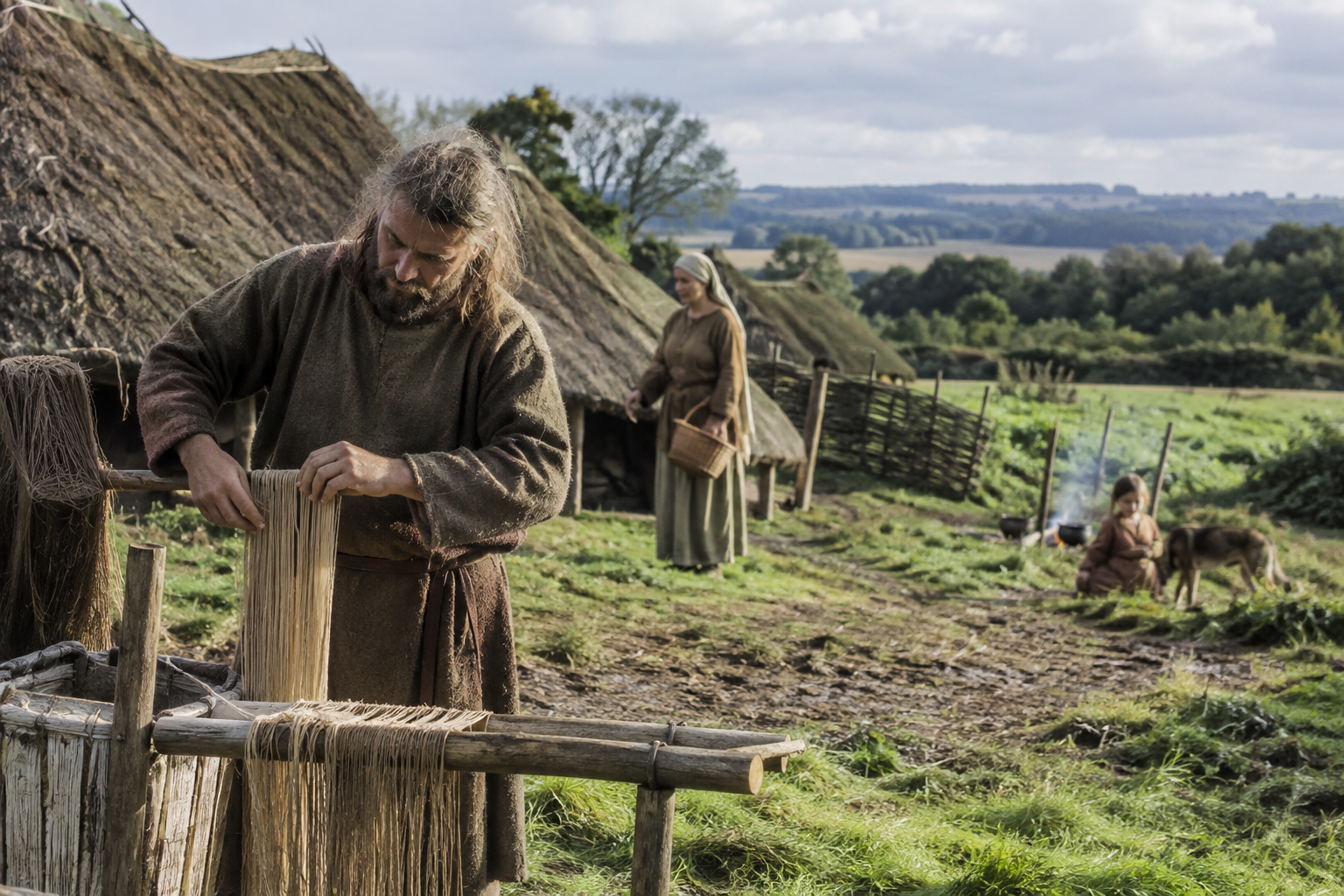
At Polhill near Kent, archaeologists uncovered an early medieval cemetery that belongs to one of the most closely watched episodes in English history: the centuries after Roman rule, when new communities from across the North Sea became part of the landscape of southern Britain. One of the men from that cemetery, sample POH003, dated around AD 600 and classified as Jute, has been associated here with the Y-DNA haplogroup R1b1a1b1a1a1c2a1d2.
That long string of letters and numbers is very precise, but the historical importance lies in something simpler. It places a direct paternal line inside a cemetery linked with the Jutish presence in Kent, in a period when identities in England were being remade. Y-DNA follows one male line only, so it does not define the whole ancestry or ethnicity of POH003, but it can still offer a sharply focused glimpse into how paternal lineages were carried into early medieval communities.
Polhill sits in Kent, the region most often brought into discussions of Jutes in early English history. Bede and other later writers famously associated Kent, the Isle of Wight, and parts of Hampshire with Jutish settlement, though archaeology and genetics both remind us that such labels were never neat ethnic boxes. Cemeteries, material culture, and now ancient DNA point instead to a world of mobility, mixture, and local adaptation.
That is what makes POH003 interesting. He is not simply a name in a list of haplogroups. He comes from a cemetery in one of the key zones where historians have long debated migration, acculturation, and continuity after the end of Roman Britain. A man carrying a paternal lineage assigned here to R1b1a1b1a1a1c2a1d2 was part of that world on the ground: not a theory, but a person buried in Kent around the turn of the 7th century.
The branch name R1b1a1b1a1a1c2a1d2 belongs within the wider R1b family, one of the major Y-chromosome groupings found across western Eurasia. But it is important not to flatten the tree. A narrow terminal branch is not the same thing as the whole of R1b, and the deep prehistoric spread of broader R1b lineages cannot automatically be pasted onto this much more specific subclade.
So what can be said responsibly? In this case, the value of the lineage is contextual. It is attached to an early medieval burial from Kent classified as Jutish, which means that this paternal branch was present in a community participating in the North Sea cultural zone of the 6th and 7th centuries. That is already useful for family historians: it ties the branch, at least in one ancient instance, to the making of early England rather than to a vague pan-European past.
There is a temptation, when faced with only one ancient sample, to dismiss it as too little. Archaeologically, that would be a mistake. Single individuals can be highly informative when they come from historically charged settings. Kent around AD 600 was not a quiet backwater. It was a kingdom with strong links across the Channel and North Sea, a place where burial customs, objects, language, and political forms were all being negotiated in the wake of Roman collapse.
POH003 therefore matters because of where and when he lived. A paternal line associated with R1b1a1b1a1a1c2a1d2 was present in a region often treated as one of the earliest and most distinctive entry points for migrant groups into lowland Britain. That does not prove a simple one-step migration from Jutland to Kent by one unbroken family. It does show that this lineage belonged within the human reality of that transformation.
Recent work on the genomics of early medieval England has repeatedly shown that migration was substantial in some regions but also socially complex, with ancestry patterns varying from site to site and household to household. A broader MyTrueAncestry discussion of that process can be found here:
One of the pleasures of archaeology is that it so often makes old labels wobble. "Jute" sounds straightforward when written in a chronicle, but cemeteries do not speak in the tidy language of textbooks. Burial grounds in early medieval England show overlap in costume, artefacts, and mortuary habits, while ancient DNA has made it even clearer that communities could be culturally Germanic without being genetically uniform, and locally rooted without being genetically isolated.
That is the right frame for POH003. His classification as Jute places him in an archaeological and historical conversation about Kentish identity, but the haplogroup itself is not an ethnic badge. What it offers is a paternal thread running through that conversation. It helps pin one male line to a Jutish-associated setting in early medieval Kent, which is rather more concrete than many grand claims about "tribes" ever manage to be.
For readers interested in the wider genomic background behind Germanic-speaking expansions, this related piece gives the larger continental context:
Germanic Languages and Genomics
Kent's importance was geographical as much as political. It faced the continent, controlled key routes, and became one of the first English kingdoms to enter clearly into the documentary light. That means burials there often carry more historical weight than their modest excavation summaries might suggest. A man from Polhill was part of a zone where people, fashions, marriage partners, and probably languages circulated with unusual intensity.
In that sense, R1b1a1b1a1a1c2a1d2 is not interesting here because it can be turned into a sweeping origin myth. It is interesting because it is anchored in a place where identities were being assembled at close range. The paternal line of POH003 belonged in a community shaped by migration across the North Sea, but also by life in Kent itself, among neighbours whose own ancestries may not all have matched his direct male line.
That broader point has been strengthened by genetic work on Roman and early medieval Britain, which shows both continuity and change rather than a single simple replacement. A related MyTrueAncestry article explores that balance well:
Roman to Early Medieval Britain
If your paternal line falls under R1b1a1b1a1a1c2a1d2, the clearest ancient anchor here is not a Bronze Age chief or a legendary dynasty, but an early medieval man from Polhill in Kent: POH003, living around AD 600 in a cemetery associated with Jutish England. That is a small but historically vivid piece of evidence. It places this branch within the lived world of post-Roman Kent, where migration from the North Sea met the making of early English society.
For family history, that is often the most useful kind of result: not a fantasy pedigree, but a real burial in a real landscape, at a moment when Britain was being reshaped village by village, cemetery by cemetery, and lineage by lineage.






Comments